
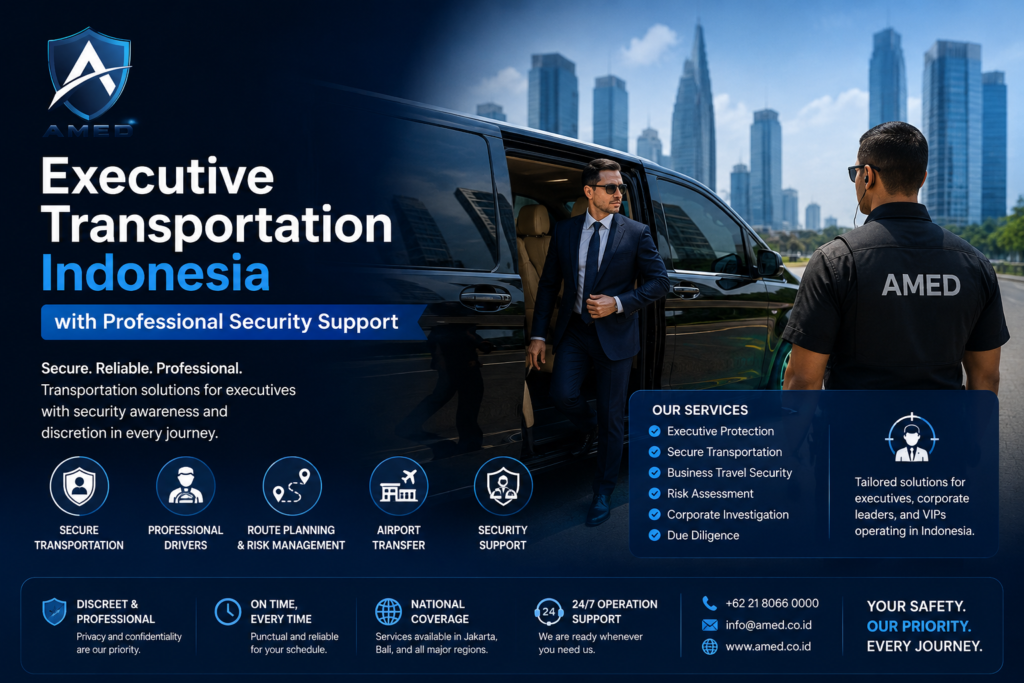
Executive transportation Indonesia provides secure, professionally coordinated ground transportation for executives, corporate leaders, VIP guests, and international business travelers operating across Indonesia. Unlike standard chauffeur services, executive transportation with professional security support combines a suitable vehicle and trained driver with route planning, situational awareness, travel coordination, and security measures based on the traveler’s profile and itinerary.
For executives visiting Jakarta, Bali, industrial areas, project sites, or other business destinations, transportation should not be treated only as movement from one location to another. The journey itself can involve traffic disruption, unfamiliar routes, schedule changes, public exposure, sensitive meetings, and other operational risks.
A more structured approach connects:
Itinerary → Risk Assessment → Route Planning → Vehicle & Driver → Movement → Monitoring → Arrival
This allows executive mobility to remain efficient while security considerations are integrated into the journey.
What Is Executive Transportation Indonesia?
Executive transportation Indonesia is a professional ground transportation service designed around the mobility, privacy, schedule, and security requirements of executives and VIP travelers in Indonesia.
The service may include a professional driver, premium vehicle, airport pickup, itinerary coordination, route planning, alternative route preparation, and security support depending on the client’s risk profile.
The key difference from conventional transportation is planning.
A regular transportation service may focus primarily on:
Pickup → Drive → Destination
Executive transportation should consider a broader process:
Traveler Profile → Schedule → Destination → Route → Risk → Movement → Contingency → Arrival
This is especially relevant for senior executives whose schedules may involve airports, hotels, corporate offices, government meetings, factories, industrial facilities, conferences, and multiple destinations in one day.
AMED’s Executive Protection service integrates professional protection, secure transportation, and situational awareness for executives operating in Indonesia. Its secure transportation offering includes security-aware professional drivers, premium MPV vehicles, route risk management, and airport transfers.
Why Executives Need More Than a Standard Driver
For ordinary travel, selecting transportation based on vehicle type, price, and availability may be sufficient.
Executive travel can require a different approach.
Senior executives may carry confidential information, attend sensitive meetings, visit unfamiliar locations, or operate according to tightly controlled schedules. Foreign executives may also have limited knowledge of local routes, traffic conditions, access points, or operational environments.
Therefore, the driver should not simply know how to reach the destination.
The transportation arrangement should consider where the executive is going, when the movement will occur, which route is appropriate, where delays could happen, and what alternatives are available.
This is where professional executive transportation Indonesia becomes different from ordinary chauffeur services.
The objective is not to create unnecessary security complexity. The objective is to make executive movement planned, discreet, reliable, and appropriate to the actual risk level.
Executive Transportation vs Regular Chauffeur Service
A regular chauffeur service primarily provides a vehicle and driver. Executive transportation with security support adds another layer of planning and awareness.
For example, consider an executive arriving at an Indonesian airport for a three-day business visit.
A conventional arrangement may be:
Airport → Hotel → Office → Meeting → Hotel
A security-aware arrangement considers:
Arrival Information → Pickup Coordination → Vehicle Positioning → Route Planning → Alternative Route → Destination Access → Schedule Monitoring
The destination may be identical, but the preparation is different.
This distinction becomes increasingly important when the traveler has a higher corporate profile, carries sensitive information, represents a multinational company, or travels to locations where additional coordination is required.
7 Elements of Professional Executive Transportation
Professional executive transportation should be evaluated as an integrated service rather than simply a vehicle rental.
1. Professional and Security-Aware Driver
The driver is one of the most important components of executive transportation.
Beyond driving ability, the driver should understand professional conduct, discretion, punctuality, situational awareness, route discipline, and communication.
For international executives, English-speaking capability can also reduce communication problems during itinerary changes or unexpected situations.
AMED specifically includes an English-speaking driver within its Safe-Guide service and describes its secure transportation drivers as trained in security awareness.
A professional driver should support the executive’s schedule without creating unnecessary interaction or disruption.
2. Route Planning Before Movement
Route planning is not simply opening a navigation application after the passenger enters the vehicle.
The primary route should ideally be reviewed before movement begins.
Factors may include travel time, traffic conditions, destination access, road characteristics, planned stops, arrival requirements, and potential alternative routes.
The basic principle is:
Primary Route + Alternative Route + Destination Access Plan
If conditions change, the team already has another option to consider instead of improvising from zero.
AMED lists route risk management as part of its secure transportation service and advance route planning within its Executive Protection Detail.
3. Suitable Executive Vehicle
Vehicle selection should match the mission.
For routine executive movement in major Indonesian cities, a comfortable premium MPV or similar executive vehicle may provide the right balance of passenger comfort, luggage capacity, privacy, and mobility.
However, vehicle requirements can change depending on the number of passengers, itinerary, destination, duration, luggage, and security assessment.
Therefore, the correct question is not simply:
“What is the most expensive vehicle?”
A better question is:
“What vehicle is appropriate for this executive, itinerary, destination, and operational requirement?”
The answer should determine the transportation setup.
4. Airport Transfer Coordination
Airport arrival is one of the most common requirements for international executives visiting Indonesia.
However, airport transportation involves more than waiting outside the terminal.
Flight delays, terminal information, luggage, pickup points, communication, traffic, and changes in arrival time can affect the movement.
A professional process may follow:
Flight Information → Arrival Monitoring → Pickup Coordination → Passenger Meeting → Vehicle Movement → Hotel/Meeting
When the traveler has an immediate meeting after arrival, delays can affect the entire business schedule.
This is why airport transfer should be integrated into itinerary planning rather than treated as an isolated journey.
AMED includes airport transfers as part of its secure transportation offering for executives operating in Indonesia.
5. Situational Awareness During Travel
Professional security support does not mean every journey requires a visible bodyguard.
Security should be proportional to risk.
For many executives, the first layer is simply stronger situational awareness.
This means paying attention to the surroundings, identifying unusual situations, maintaining communication, avoiding unnecessary exposure, and adjusting movement when conditions require it.
For higher-risk profiles, the transportation arrangement can be integrated with dedicated executive protection personnel.
AMED’s broader Executive Protection service combines secure transportation with situational awareness, threat assessment, executive escort, and travel coordination.
This allows security measures to be adjusted according to the client’s actual requirements.
6. Itinerary and Travel Coordination
Executive schedules can change quickly.
A meeting may finish early. Another appointment may be added. A site visit may run longer than expected. The executive may need to travel directly from a meeting to the airport.
Therefore, transportation needs to follow the business itinerary.
For example:
Time | Activity |
8:00 | Hotel Pickup |
9:00 | Corporate Meeting |
11:30 | Government Meeting |
14:00 | Industrial Site Visit |
17:30 | Return to Hotel |
19:00 | Business Dinne |
Each movement affects the next.
A professional transportation team should understand the overall schedule so that vehicles, routes, pickup positions, and travel times can be coordinated accordingly.
7. Contingency Planning
Not every journey goes according to plan.
Traffic can change. Access can be restricted. A destination can move. Meetings can run late. A route can become unsuitable.
Therefore, executive transportation should include contingency thinking.
A simple model is:
Plan A → Monitor → Change Detected → Plan B → Continue Movement
This reduces dependence on last-minute decisions.
The objective is not to predict every possible event. Instead, the team prepares reasonable alternatives for situations that could materially affect the executive’s movement.
Example: Executive Business Visit in Jakarta
Consider a regional director traveling to Jakarta for two days.
The schedule includes an airport arrival, hotel transfer, meetings with local management, a visit to an industrial facility, dinner with business partners, and departure the following day.
A standard transportation arrangement might simply assign one vehicle and driver.
A professional executive transportation Indonesia arrangement starts earlier.
The team receives the itinerary and reviews arrival information, destinations, expected movement times, and route requirements.
Before each movement, the driver understands the destination and route.
For the industrial visit, additional attention may be given to access points and travel time because the destination is outside the executive’s familiar environment.
If the traveler requires a higher security level, a protection officer can be integrated into the transportation detail.
The result is not merely transportation.
It is coordinated executive mobility.
When Should Security Support Be Added?
Not every traveler needs the same protection level.
Security support should be determined according to profile, destination, itinerary, visibility, business activity, and identified risks.
A visiting manager attending routine meetings in Jakarta may only require a professional security-aware driver.
A CEO involved in a sensitive corporate transaction may require more structured protection.
A senior executive visiting remote industrial operations may require additional travel coordination and situational awareness.
Meanwhile, a high-profile individual facing a specific threat may require dedicated executive protection personnel.
A practical approach is:
Low Exposure → Security-Aware Transportation
Moderate Exposure → Safe-Guide / Security Support
Higher Risk → Dedicated Executive Protection
The service should be scaled according to the situation rather than applying the same solution to every client.
Executive Transportation for Business Travel in Indonesia
Indonesia is geographically large, and executive business travel may involve more than Jakarta.
Corporate travelers may need to visit Bali, industrial zones, manufacturing facilities, mining areas, plantations, project sites, or regional offices.
This makes local coordination particularly important.
AMED states that its protection services support physical security in Jakarta, Bali, and across the Indonesian archipelago. Its Business Travel Security capability covers site visits, industrial inspections, business meetings, and regional travel.
For companies sending executives to multiple locations, transportation and security planning can therefore be integrated into the wider business travel program.
Executive Transportation for Site Visits and Industrial Inspections
Site visits create different requirements from city meetings.
An executive visiting a factory or industrial project may travel farther from major business districts, encounter unfamiliar access arrangements, and spend more time on the road.
The transportation plan should therefore consider departure time, road conditions, site access, waiting arrangements, communication, and return movement.
For example:
Hotel → Route Assessment → Industrial Site → Vehicle Standby → Site Visit → Return Route → Hotel/Airport
If several executives are traveling together, vehicle and coordination requirements may also change.
This is particularly relevant for foreign companies conducting investment reviews, audits, inspections, acquisitions, or project monitoring in Indonesia.
Privacy and Discretion Matter
Executive transportation should also protect privacy.
Drivers and security personnel may indirectly become aware of meeting locations, schedules, business partners, hotel information, or travel patterns.
Professional conduct and discretion are therefore essential.
The team should avoid unnecessary discussion about client activities and handle itinerary information appropriately.
For senior corporate travelers, confidentiality can be as important as physical comfort.
Transportation Can Be Integrated with Executive Protection
For higher-risk assignments, transportation should not operate separately from protection.
The protection officer, driver, vehicle, itinerary, route, and destination should function as one coordinated system.
The model becomes:
Threat Assessment → Advance Planning → Secure Transportation → Executive Escort → Monitoring → Emergency Coordination
AMED’s Executive Protection Detail includes dedicated security personnel, travel coordination, advance route planning, and a trained executive protection agent. Its broader Corporate Protection Program adds dedicated safe-guide support and emergency-response coordination.
This creates a scalable approach where the client can select protection according to operational requirements.
How to Choose an Executive Transportation Provider in Indonesia
Companies should evaluate more than vehicle appearance when selecting a provider.
Start by examining driver professionalism and security awareness. Then assess the provider’s ability to plan routes, coordinate airport transfers, understand executive schedules, respond to itinerary changes, and provide additional security support when necessary.
For international corporate clients, communication capability is also important.
Before confirming a service, provide enough information for proper planning, including:
Travel Date → City → Flight → Hotel → Destinations → Passenger Count → Schedule → Security Requirement
Sensitive details should only be shared through appropriate communication channels and to the extent necessary for service planning.
A provider that understands the complete itinerary can prepare a more suitable transportation arrangement than one that receives only a pickup location.
Expertise: Transportation as Part of Corporate Protection
Executive transportation works best when viewed as part of a broader corporate protection strategy.
For AMED, transportation sits alongside executive protection, situational awareness, travel coordination, and business travel security rather than functioning simply as a chauffeur service.
This distinction matters because corporate travelers often move between different risk environments during the same trip.
A traveler may begin the day at a secure hotel, continue to a corporate office, travel to an industrial location, attend an external meeting, and finish at an airport.
Each location and movement can require a different level of awareness.
For organizations operating or investing in Indonesia, this protection approach can also complement broader business risk management. AMED’s work includes business investigation and due-diligence support for foreign investors evaluating companies, partners, and operational risks in Indonesia.
For information about the broader EFBA business ecosystem, visit PT EFBA Digital Mulia.
Checklist Before Booking Executive Transportation
Before confirming an executive transportation assignment, companies should verify the traveler’s itinerary, flight information, passenger count, luggage requirements, vehicle requirement, destinations, meeting schedule, and required security level.
The provider should then determine:
Driver → Vehicle → Route → Timing → Communication → Security Support → Contingency
This makes the assignment easier to coordinate and reduces avoidable operational problems.
For higher-profile executives or more sensitive itineraries, a preliminary security assessment can determine whether transportation alone is sufficient or dedicated protection should be added.
FAQ About Executive Transportation Indonesia
What is executive transportation in Indonesia?
Executive transportation is professional ground transportation designed for executives, VIPs, and corporate travelers. It may include a premium vehicle, professional driver, airport transfer, route planning, itinerary coordination, situational awareness, and additional security support according to the client’s needs.
How is executive transportation different from a normal chauffeur?
A normal chauffeur primarily provides transportation. Security-supported executive transportation adds route planning, situational awareness, travel coordination, contingency planning, and the option to integrate executive protection personnel.
Can executive transportation include airport pickup in Indonesia?
Yes. AMED includes airport transfers within its secure transportation services, together with security-aware professional drivers and route risk management.
Do all executives need a bodyguard?
No. Protection should be based on the traveler’s profile, itinerary, destination, exposure, and identified threats. Some travelers may only need a security-aware driver, while higher-risk assignments may require dedicated executive protection.
Is executive transportation available outside Jakarta?
AMED states that its executive protection services cover Jakarta, Bali, and locations throughout the Indonesian archipelago. Business travel security can also support regional travel and site visits.
Can transportation support factory or industrial site visits?
Yes. Business travel security can be particularly relevant for site visits and industrial inspections where executives may travel outside familiar business districts. AMED specifically includes site visits and industrial inspections within its business travel security coverage.
What information should companies provide before booking?
Provide the travel date, city, flight details, pickup and destination points, itinerary, passenger count, luggage requirements, vehicle preferences, and relevant security requirements. This allows the provider to prepare the appropriate transportation plan.
Secure Executive Mobility in Indonesia
Professional executive transportation Indonesia should deliver more than a comfortable vehicle.
The service should connect:
Professional Driver + Suitable Vehicle + Route Planning + Situational Awareness + Travel Coordination + Security Support
This creates a transportation system designed around the executive’s schedule, privacy, mobility, and risk profile.
For routine corporate visits, a security-aware transportation service may be sufficient. For more complex itineraries, industrial visits, high-profile travelers, or sensitive business activities, transportation can be integrated with dedicated executive protection.
AMED provides professional protection and secure transportation for executives operating in Indonesia, including security-aware drivers, premium vehicles, route risk management, airport transfers, advance route planning, and executive protection support.
Planning executive travel to Indonesia?
Discuss the itinerary, destinations, transportation requirements, and security profile with AMED before arrival so the appropriate movement and protection plan can be prepared.