
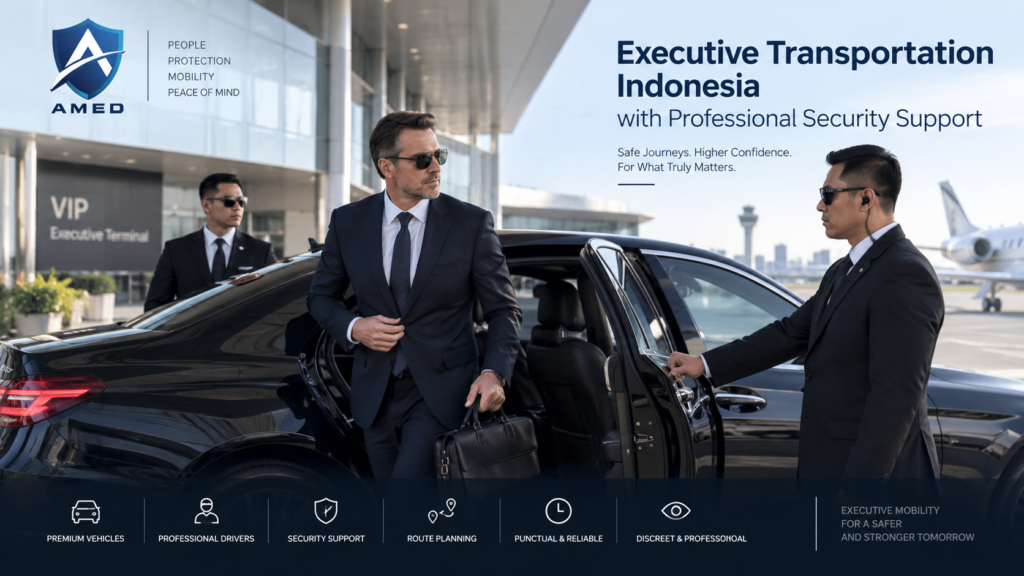
Executive transportation Indonesia provides more than a premium vehicle and a professional driver. For executives, corporate leaders, VIP guests, investors, and international business travelers, transportation also involves privacy, punctuality, route planning, discretion, and security awareness throughout the journey.
Business travel in Indonesia can involve airport transfers, hotel-to-office transportation, corporate meetings, site visits, conferences, government engagements, and multi-location schedules. Each movement creates operational requirements that need to be managed carefully.
Therefore, executive transportation should combine professional driving, journey planning, secure mobility, discretion, and coordinated support.
For travelers with elevated risk profiles, professional security support can also be integrated into the transportation plan based on the situation and security assessment.
What Is Executive Transportation Indonesia?
Executive transportation Indonesia is a professional mobility service designed for executives, VIPs, corporate guests, and other individuals who require reliable and discreet transportation while traveling in Indonesia.
Unlike conventional transportation, executive mobility places greater attention on journey management.
The process can include pickup coordination, route planning, vehicle preparation, driver readiness, schedule management, alternative routes, communication protocols, and security considerations.
A structured movement can be illustrated as:
Schedule → Risk Assessment → Vehicle Preparation → Route Planning → Pickup → Journey Monitoring → Destination Arrival
This approach helps reduce uncertainty during business travel.
For executives with demanding schedules, transportation is not simply about getting from one location to another. It is part of maintaining productivity, privacy, and operational continuity.
Why Executives Need Professional Transportation in Indonesia
Executives often travel with limited time and tightly connected schedules.
A typical business itinerary may include an airport arrival in the morning, a meeting at a corporate office, lunch with business partners, a site visit, and an evening event.
A delay during one movement can affect the entire schedule.
Furthermore, senior executives and VIP guests may have additional concerns related to privacy, unwanted attention, sensitive business information, or personal security.
Therefore, executive transportation Indonesia should consider the complete journey rather than focusing only on the vehicle.
Professional planning helps ensure that the driver, vehicle, route, timing, and communication process support the client’s agenda.
Executive Transportation Is More Than a Premium Car
A luxury vehicle can improve comfort, but the vehicle alone does not create an executive transportation service.
Service quality depends on the people and processes behind the journey.
A professional executive driver needs to understand punctuality, discretion, professional appearance, communication etiquette, passenger comfort, and situational awareness.
At the same time, the operational team needs to understand the client’s itinerary and movement requirements.
For this reason, executive mobility can be viewed as:
Vehicle + Driver + Planning + Communication + Security Awareness = Executive Mobility
When these elements work together, transportation becomes part of the client’s business support system.
1. Professional Executive Driver
The driver is one of the most important elements of executive transportation.
Senior executives, VIPs, and international visitors often spend significant time inside a vehicle. Therefore, professional behavior matters.
An executive driver should understand when communication is necessary and when privacy should be maintained.
The driver should also avoid unnecessary discussion about the passenger, itinerary, meetings, destination, or other information obtained during an assignment.
In addition, security awareness can become valuable when transporting clients with higher profiles.
A driver with professional security awareness can pay closer attention to the environment, route conditions, unusual activity, and operational changes while maintaining safe driving as the primary responsibility.
For a more specific discussion, read Executive Driver Indonesia with Professional Security Awareness.
2. Journey and Route Planning
Professional transportation begins before the passenger enters the vehicle.
The operational team should understand the pickup point, destination, expected departure time, meeting schedule, route options, and other relevant movement requirements.
Route planning is particularly important for time-sensitive journeys.
For example, an executive may need to travel from a hotel to a corporate meeting and then continue directly to another location.
The transportation plan should account for realistic travel time and possible disruption.
Depending on the assignment, an alternative route may also be considered.
The objective is not simply to identify the shortest route. Instead, planning should support safety, reliability, timing, and operational continuity.
3. Airport Transfer for Executives and VIPs
Airport movements are often the first and last part of an executive’s visit.
Therefore, airport transportation needs clear coordination.
Flight schedules may change. Immigration and baggage collection can also affect pickup timing. International travelers may be unfamiliar with the airport environment and local transportation arrangements.
A professional executive transportation service can coordinate arrival information, pickup points, vehicle readiness, and onward transportation.
After pickup, the passenger may travel to a hotel, corporate office, meeting venue, residence, or another destination.
For important corporate guests, a well-managed airport transfer also contributes to the overall impression of the host organization.
4. Discretion and Privacy During Transportation
Vehicles can become temporary working environments.
Executives may receive phone calls, discuss internal matters, review confidential documents, or communicate with business partners while traveling.
Therefore, discretion is essential.
Drivers and supporting personnel should respect passenger privacy and avoid sharing information about client movements or activities.
Professional conduct is particularly important when transporting executives involved in sensitive negotiations, investments, corporate transactions, government engagements, or other confidential activities.
In this context, privacy is not an additional luxury.
It is part of professional service.
5. Security Awareness During Executive Mobility
Not every executive requires a close protection officer. However, every executive movement can benefit from basic security awareness.
The level of security support should depend on the client’s profile, itinerary, destination, activities, and risk environment.
For routine corporate travel, professional transportation with security-aware personnel may be appropriate.
Meanwhile, executives with elevated exposure may require additional security planning.
The key is proportionality.
Security measures should match the actual risk rather than automatically applying the same approach to every client.
This principle helps maintain protection without unnecessarily disrupting business activities.
6. Integration with Executive Protection
For higher-risk movements, executive transportation Indonesia can become part of a broader executive protection arrangement.
Transportation and personal protection should not operate as separate systems.
The protective team may need to coordinate routes, departure times, pickup areas, destination access, vehicle positioning, communication, and contingency plans.
A simplified structure can look like:
Threat Assessment → Advance Planning → Secure Transportation → Protective Coverage → Destination Security → Monitoring
The exact arrangement depends on the client’s risk profile.
For further information about protective services, read Executive Protection Indonesia.
When professional transportation and executive protection work together, the client receives a more coordinated mobility solution.
7. Support for Corporate and International Travelers
Indonesia receives business travelers for investment meetings, conferences, site inspections, project visits, negotiations, and corporate events.
International visitors may not understand local routes, travel times, pickup procedures, or regional conditions.
Therefore, local operational support can reduce uncertainty.
A professional transportation provider can help coordinate the client’s movement based on the itinerary.
For example:
Airport → Hotel → Corporate Office → Project Site → Business Dinner → Hotel
Instead of arranging each trip separately, the movement can be planned as one coordinated schedule.
This approach becomes especially useful for multi-day business visits.
Example of an Executive Transportation Assignment
Consider an international company sending a senior executive to Indonesia for a three-day business visit.
The executive arrives at the airport and needs transportation to a hotel. The next morning, the schedule includes meetings at two corporate offices followed by a project site visit.
On the final day, the executive attends another business meeting before returning to the airport.
Instead of viewing these movements as separate car bookings, the transportation team can build an integrated plan.
The process may begin with:
Itinerary Review → Client Profile → Route Planning → Vehicle & Driver Assignment → Movement Coordination → Daily Review
Before each movement, the driver receives the relevant schedule and destination information.
Meanwhile, route conditions and timing can be reviewed according to operational needs.
If the executive’s profile requires additional protection, security personnel can be incorporated into the movement plan.
The result is a more structured transportation arrangement that supports both business efficiency and personal security.
Executive Transportation for Site Visits
Corporate travel does not always take place in business districts.
Executives may need to visit factories, warehouses, plantations, construction sites, industrial estates, or project locations.
These movements can require different preparation.
The operational team may need to understand road conditions, site access procedures, travel distance, communication availability, meeting points, and local considerations.
For longer journeys, vehicle readiness becomes even more important.
Therefore, the transportation plan should follow the actual itinerary rather than applying the same arrangement to every assignment.
Vehicle Selection Should Follow the Assignment
There is no single vehicle that is suitable for every executive movement.
Vehicle selection should consider the number of passengers, luggage, travel distance, road conditions, client preferences, level of discretion, and operational requirements.
For example, an airport transfer with multiple suitcases may require a different vehicle configuration from a single-passenger corporate meeting.
Likewise, a long-distance site visit may require different considerations compared with transportation within a central business district.
The priority should remain:
Safety → Reliability → Comfort → Suitability → Professional Appearance
Luxury is valuable, but operational suitability comes first.
The Importance of Contingency Planning
Professional executive mobility should anticipate disruption.
Traffic conditions may change. A meeting can end earlier or later than expected. A destination may change. A route can become unsuitable.
Therefore, transportation planning should maintain a degree of flexibility.
Depending on the assignment, contingency planning may include alternative routes, updated departure times, communication procedures, or backup arrangements.
This does not mean every movement requires complex security procedures.
Instead, the level of preparation should match the importance and risk of the assignment.
The goal is to prevent small disruptions from becoming major operational problems.
Secure Transportation vs. Regular Transportation
Regular transportation primarily focuses on moving passengers between locations.
Secure executive transportation adds another layer of planning.
The difference can involve driver selection, confidentiality, itinerary management, situational awareness, risk assessment, communication, route preparation, and coordination with security personnel when required.
Therefore, clients should not evaluate executive transportation only based on vehicle specifications.
A better question is:
How will the entire journey be managed?
The answer provides a clearer picture of the service quality.
Expertise: AMED’s Approach to Executive Mobility
Executive mobility requires coordination between people, vehicles, information, and operational planning.
AMED approaches transportation as part of a broader professional support system rather than simply providing a vehicle.
The process can be structured around:
Understand → Assess → Plan → Coordinate → Execute → Monitor
First, the team needs to understand the client’s profile and itinerary.
Next, operational and security considerations can be assessed according to the assignment.
The transportation plan can then cover the driver, vehicle, route, timing, communication, and additional support required.
This structured approach helps create a service that supports the executive’s schedule while maintaining discretion and professional standards.
Combining Mobility with Professional Security Support
The security requirement for a visiting executive can vary considerably.
A corporate manager attending routine meetings may require professional transportation and privacy.
Meanwhile, a CEO involved in a sensitive transaction, a high-profile individual, or a VIP attending a major event may require a higher level of security support.
Therefore, the security model should be scalable.
A practical framework is:
Profile + Exposure + Location + Activity + Threat = Security Requirement
The resulting plan can range from security-aware transportation to integrated executive protection.
This prevents unnecessary measures while ensuring that additional protection can be added when the risk profile justifies it.
Business Continuity Through Reliable Mobility
Transportation delays can create business consequences.
Missing a meeting, arriving late for an airport departure, or experiencing coordination problems can affect an executive’s agenda and potentially disrupt important business activities.
Therefore, mobility should be considered part of business continuity during executive travel.
Reliable transportation helps executives maintain their schedule and focus on their business responsibilities.
This becomes especially important when companies host investors, international partners, senior management, or other important stakeholders.
For broader corporate and business development perspectives, visit EFBA, which provides business insights and professional services within the wider EFBA ecosystem.
How to Choose an Executive Transportation Provider in Indonesia
Choosing an executive transportation provider should involve more than comparing vehicle prices.
Companies should evaluate the provider’s operational approach.
Consider whether the provider understands executive protocols, privacy, punctuality, itinerary management, communication, security awareness, and contingency planning.
The provider should also be able to explain how transportation will be managed from the initial briefing through completion of the assignment.
For clients requiring additional security, ask whether transportation can coordinate with professional protection personnel.
A strong provider should be able to adapt the arrangement according to the client’s profile and actual operational requirements.
FAQ About Executive Transportation Indonesia
What is executive transportation Indonesia?
Executive transportation Indonesia is a professional transportation service for executives, VIPs, corporate guests, and international travelers. It typically emphasizes reliable mobility, professional drivers, discretion, journey planning, comfort, and security awareness.
Who needs executive transportation services?
The service can be used by CEOs, directors, investors, diplomats, VIP guests, international business travelers, corporate delegations, speakers, and other individuals requiring professionally managed transportation.
Is executive transportation the same as a regular chauffeur service?
Not necessarily. Executive transportation may include additional planning related to itinerary management, routes, privacy, communication, contingency preparation, and security requirements.
Can executive transportation include security personnel?
Yes, depending on the provider and assignment. Clients with elevated security requirements may combine transportation with executive protection or other professional security support.
Can the service be used for airport transfers?
Yes. Executive airport transfers can support pickup coordination and onward transportation to hotels, offices, meetings, residences, or other destinations.
Can executive transportation support multi-day business trips?
Yes. A coordinated transportation plan can be developed around a multi-day itinerary, including airport movements, meetings, site visits, events, and other scheduled activities.
Is executive transportation suitable for foreign business travelers?
Yes. International executives can benefit from local route knowledge, professional coordination, itinerary management, and transportation support while visiting Indonesia.
How far in advance should executive transportation be arranged?
Advance booking is recommended, particularly for complex itineraries, multiple vehicles, site visits, major events, or assignments requiring security personnel. Earlier planning gives the operational team more time to assess and prepare the movement.
Professional Executive Transportation in Indonesia
Business travel should allow executives to focus on their responsibilities rather than transportation logistics.
A professionally managed executive transportation Indonesia service combines reliable vehicles with trained drivers, itinerary coordination, discretion, route planning, and security awareness.
For clients with elevated risk profiles, transportation can also be integrated with professional security support to create a more comprehensive mobility arrangement.
AMED supports executive and VIP movements through an approach focused on:
Professionalism → Discretion → Planning → Mobility → Security Awareness → Coordination
Whether the requirement involves airport transfers, corporate meetings, business events, project site visits, or multi-day executive travel, the transportation plan should follow the client’s actual itinerary and risk profile.
Contact AMED to discuss executive transportation requirements in Indonesia and develop a mobility arrangement based on your schedule, destination, and security needs.