
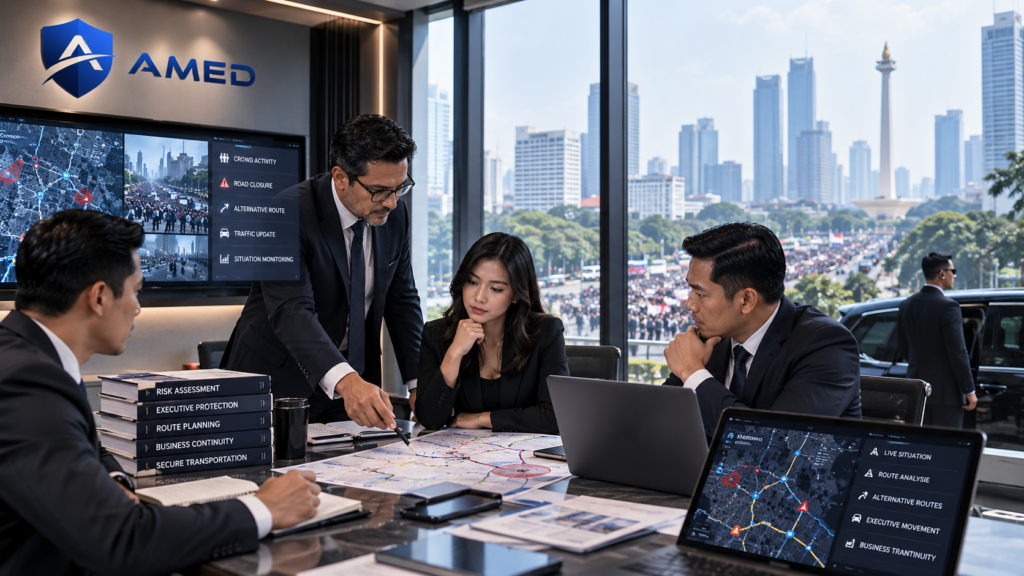
Civil unrest, demonstrations, and large public gatherings can affect executive mobility even when a company’s office or personnel are not directly involved. Road closures, changing traffic arrangements, crowd movement, access restrictions, and sudden schedule changes can disrupt meetings, airport transfers, site visits, and other business activities.
For companies, effective corporate security civil unrest planning should therefore focus on two priorities: protecting people and maintaining business continuity. The objective is not to create an excessive security presence, but to understand changing conditions early and adjust executive movement accordingly.
Recent events in Jakarta illustrate this operational challenge. On September 24, 2026, Polda Metro Jaya handled 73 public demonstrations among 99 public activities, while traffic management was adjusted according to crowd size, traffic conditions, and developments on the ground. Police also advised road users to consider alternative routes around affected locations. Korlantas Polri
For executives, this makes a structured approach useful:
Monitor → Assess → Plan → Move → Adjust → Continue Business
AMED’s published executive protection capabilities include threat assessment, situational awareness, route planning, executive escort, secure transportation, travel coordination, advance route planning, and emergency response coordination. These services can support executive mobility when changing conditions affect normal business travel. Amed Protection & Investigation
What Is Corporate Security During Civil Unrest?
Corporate security during civil unrest is the process of protecting executives, employees, business travel, and critical corporate activities while adapting operations to changing public-security and mobility conditions.
The goal is not automatically to stop business activity whenever a demonstration occurs. Instead, corporate security should determine what has changed, whether the executive’s itinerary is affected, and what adjustment is proportionate to the actual situation.
A practical framework is:
Situation → Exposure → Business Impact → Security Decision → Continuity
For example, a demonstration several kilometers away from an executive meeting may require no significant action. However, an event affecting the executive’s route, hotel, meeting venue, airport access, or site visit may require a route or schedule adjustment.
This risk-based approach avoids two extremes: ignoring relevant developments or overreacting to events that do not materially affect the business.
1. Protect the Executive Without Stopping the Business
One of the first questions companies ask is simple:
Can executives continue working during civil unrest?
Often, the answer depends on location, timing, itinerary, and actual exposure.
Corporate security should therefore support business decisions rather than automatically canceling activities.
The process can follow: Business Priority → Current Situation → Executive Exposure → Adjustment → Continue
A meeting may remain possible but use another route. A site visit may move to another time. An airport departure may require an earlier transfer.
The security function should help management find the safest practical way to continue essential activities.
2. Start with Situational Awareness
Conditions around demonstrations can change quickly.
Corporate security teams therefore need current information before deciding whether an executive should proceed, reroute, delay, or modify an activity.
AMED includes situational awareness and threat assessment within its published Executive Protection service. Amed Protection & Investigation
The principle is:
Information → Assessment → Decision
This matters because the existence of a demonstration alone does not establish the level of risk to a particular executive.
Location, crowd movement, road access, destination, timing, and the executive’s profile all matter.
3. Identify Whether the Executive Is Actually Exposed
Security decisions should focus on exposure rather than headlines.
Ask:
Where is the executive? → Where is the activity? → Where is the destination? → Does the route intersect? → What could disrupt movement?
This distinction helps prevent unnecessary disruption.
For example, an executive working from a location outside the affected area may face little immediate impact. Meanwhile, another executive traveling through an area subject to road closures may need an alternative movement plan.
The objective is to identify the relationship between the event and the principal.
4. Review the Executive’s Itinerary
The itinerary becomes a critical security document during changing conditions.
Corporate security should review upcoming movements such as:
Hotel → Office → Meeting → Site Visit → Airport
Each movement has different timing, route, destination, and exposure.
AMED’s Business Travel Security service covers business meetings, site visits, industrial inspections, and regional travel. Its Executive Protection Detail also includes travel coordination and advance route planning. Amed Protection & Investigation
Therefore, security planning can focus on maintaining the executive’s business schedule wherever conditions reasonably allow.
5. Prepare Alternative Routes Before Movement
Traffic disruption is one of the most practical business impacts of large public gatherings.
On September 24, 2026, Jakarta police stated that traffic engineering around demonstration areas would be implemented situationally according to traffic flow, crowd size, and developments on the ground. Authorities advised people without business in affected areas to consider alternative routes. Korlantas Polri
For executives, route planning should therefore happen before the vehicle departs.
A useful model is: Primary Route → Alternative Route → Destination Access → Timing
AMED publishes both route planning under Executive Protection Officers and route risk management under Secure Transportation. Amed Protection & Investigation
The objective is not simply to find the fastest route, but to maintain reliable movement when normal access changes.
6. Integrate Secure Transportation with Protection
Transportation becomes especially important when road conditions and access points can change.
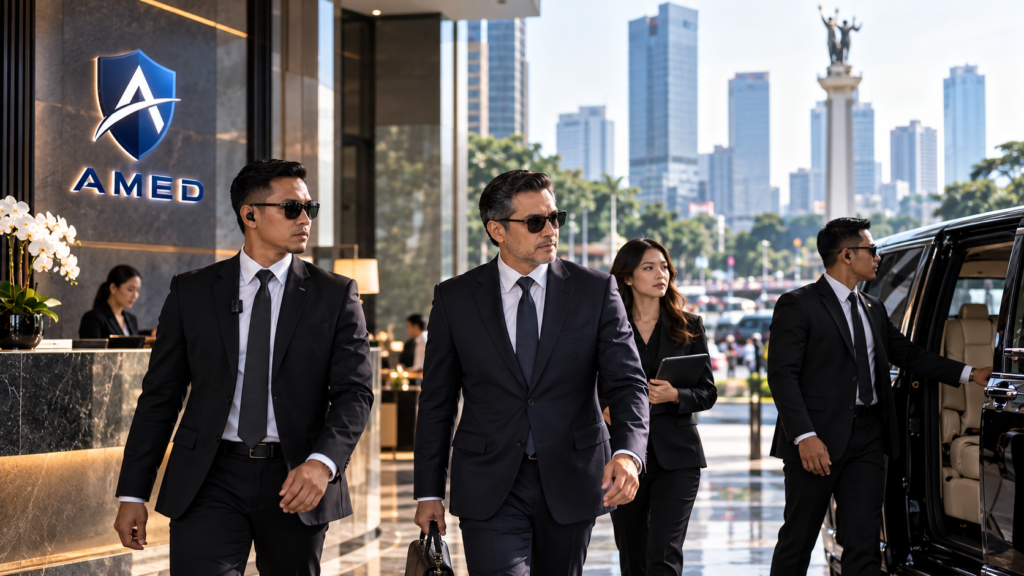
A professional movement plan connects: Executive → Driver → Vehicle → Route → Protection → Destination
AMED’s Secure Transportation service includes professional drivers trained in security awareness, English-speaking drivers, premium MPV vehicles, route risk management, and airport transfers. Amed Protection & Investigation
For business travelers, this approach helps combine mobility and security rather than treating them as separate functions.
It can also reduce unnecessary disruption because the executive does not need to manage route changes personally while continuing business activities.
7. Avoid Unnecessary Exposure to Demonstration Areas
Corporate security does not need to place executives close to a demonstration to understand what is happening.
When an itinerary does not require access to an affected area, avoiding unnecessary exposure is generally the more practical approach.
This principle also aligns with recent police guidance in Jakarta. During demonstrations on September 24, authorities advised people without relevant business near activity locations to consider alternative routes. Korlantas Polri
For corporate travel, the decision framework becomes:
Is the destination essential?
If yes, assess how to reach it appropriately.
If not, consider another route, location, or time.
This keeps security decisions connected to business necessity.
8. Keep Executive Protection Discreet
An executive still needs to conduct meetings, negotiations, presentations, and site visits normally.
For that reason, protection should not unnecessarily dominate the business environment.
AMED describes its Executive Protection Officers as providing discreet personal protection, supported by threat assessment, situational awareness, route planning, and executive escort. Amed Protection & Investigation
The operational balance is:
Protection + Discretion + Mobility + Business Continuity
This is particularly relevant when the executive’s itinerary remains viable but the surrounding environment requires additional awareness.
Security should support the principal’s work rather than become another operational obstacle.
9. Prepare for Sudden Schedule Changes
During periods of heightened public activity, a plan created in the morning may need adjustment later in the day.
Road conditions can change. Meetings may move. Access points may become unavailable. An executive may also need to leave earlier than planned.
Therefore:
Plan → Monitor → Update → Re-Plan
is more realistic than:
Plan Once → Follow Regardless
AMED’s published Corporate Protection Program includes travel planning and emergency response coordination, while its executive protection services include situational awareness and route planning. Amed Protection & Investigation
Flexibility helps companies respond proportionately without immediately suspending the entire business itinerary.
10. Protect Airport Transfers
Airport movements often have little tolerance for major delays.
Missing a flight can affect subsequent meetings, international connections, client commitments, or regional travel.
Companies should therefore review:
Departure Time → Current Conditions → Route → Alternative Route → Airport Buffer
AMED publishes airport transfers as part of its Secure Transportation service. Amed Protection & Investigation
During periods of disruption, the value of secure transportation is not limited to personal protection. It also supports predictable executive movement and schedule continuity.
11. Coordinate Security Around Business Meetings
Not every business meeting needs to be canceled because public demonstrations are occurring elsewhere in the city.
Instead, companies should evaluate the meeting venue and the routes used to reach it.
A useful assessment is:
Meeting Location → Access → Surrounding Activity → Route → Timing → Decision
If exposure remains acceptable, business can continue with appropriate adjustments.
If conditions change materially, the company can modify the route, timing, or venue.
This approach keeps security proportionate to actual circumstances rather than applying the same decision to every activity.
12. Have Clear Escalation Criteria
Management needs to know when a normal business movement should become a security decision.
Instead of relying only on intuition, companies can define escalation points around changes in: Location → Access → Crowd Movement → Transportation → Executive Exposure
The purpose is not to predict every possible development.
The purpose is to establish when the team should reassess the plan.
A simple model is: Normal Operations → Increased Monitoring → Movement Adjustment → Relocation / Postponement
The appropriate decision depends on actual conditions and the company’s risk assessment.
What Should Businesses Prioritize During Civil Unrest?
For executives and corporate management, the priority should remain straightforward:
People → Movement → Critical Business → Continuity
Protecting executives does not automatically mean shutting down operations.
Instead, companies should determine which activities remain viable, which movements require adjustment, and which activities should wait until conditions improve.
This produces a more practical corporate-security model:
Protect What Matters → Adjust What Is Exposed → Continue What Is Safe
For organizations with visiting executives, investors, expatriates, or business travelers, local transportation and protection coordination can become especially important because the traveler may not understand current access conditions or alternative routes.
Corporate Security vs. Business Continuity
Corporate security and business continuity address different but connected needs.
Corporate Security focuses on people, movement, exposure, and security conditions.
Business Continuity focuses on maintaining critical activities despite disruption.
During civil unrest, they should support each other:
Security Assessment → Operational Adjustment → Business Continuity
For example, corporate security may recommend an alternative route while the business team keeps the meeting unchanged.
Alternatively, security conditions may require the meeting to move online or shift to another location.
The objective remains the same: protect people while minimizing unnecessary interruption.
Data Resmi: Demonstrations Can Affect Business Mobility Without Stopping Business
Recent Jakarta events provide a useful example.
On September 24, 2026, Polda Metro Jaya deployed 26,386 combined personnel to support 99 public activities across Jakarta. Of those activities, 73 were public demonstrations and 26 were other community activities. Korlantas Polri
Authorities emphasized that public expression is a democratic right and stated that policing was intended both to facilitate peaceful demonstrations and to allow other people to continue working, studying, doing business, and traveling. Korlantas Polri
The operational impact was primarily situational. Police implemented traffic management according to conditions on the ground and advised road users to consider alternative routes around affected areas such as Sudirman–Thamrin, Monas, and the DPR/MPR area. Korlantas Polri
The following day, Indonesian National Police reported that the labor demonstration around Dukuh Atas had proceeded peacefully and orderly, while traffic management had been adjusted to maintain public mobility. INP | Indonesian National Police
For corporate decision-makers, this distinction matters.
Demonstration ≠ Automatic Business Shutdown
A more useful framework is:
Demonstration → Verify Conditions → Assess Exposure → Adjust Movement → Continue Business Where Appropriate
That is the role corporate security can play in maintaining proportionate protection.
AMED Expertise in Corporate and Executive Protection
AMED Executive Protection provides protection and secure transportation services for executives, expatriates, investors, and business travelers operating in Jakarta, Bali, and other parts of Indonesia. Amed Protection & Investigation
AMED’s currently published capabilities include Executive Protection Officers, threat assessment, situational awareness, route planning, executive escort, Secure Transportation, Business Travel Security, travel coordination, advance route planning, and emergency response coordination. Amed Protection & Investigation
For corporate security during periods of disruption, these capabilities can be connected through:
Assess → Plan → Coordinate → Transport → Protect → Monitor → Adjust
AMED also publishes Business Travel Security coverage for business meetings, site visits, industrial inspections, and regional travel. This makes the service relevant when executives need to maintain business activities while mobility conditions require additional planning. Amed Protection & Investigation
Importantly, AMED’s published positioning focuses on discreet protection and efficient business activity rather than unnecessarily visible security. Amed Protection & Investigation
Corporate Protection for Executives During Disruption
Companies with frequent executive travel may need more than a one-time movement arrangement.
AMED currently publishes a Corporate Protection Program that includes travel planning, executive protection, a dedicated safe-guide, and emergency response coordination. It also offers an Executive Protection Detail with travel coordination and advance route planning. Amed Protection & Investigation
For business continuity, the practical advantage is integration:
Executive Schedule + Local Conditions + Route Planning + Protection + Transportation
Instead of treating each movement independently, the protection arrangement can follow the executive’s broader itinerary.
This can be relevant during public demonstrations, large events, transportation disruption, or other circumstances that change normal executive movement.
How Should a Company Prepare Before an Executive Travels?
Start with the itinerary rather than the security personnel.
Identify where the executive will stay, which meetings are essential, which sites will be visited, airport timings, expected routes, and activities that cannot easily be rescheduled.
Then build:
Itinerary → Risk Review → Movement Plan → Alternatives → Coordination
This approach keeps protection proportional to business needs.
For international executives, AMED also publishes English-speaking security-aware drivers as part of Secure Transportation, which can support local coordination during business travel. Amed Protection & Investigation

FAQ About Corporate Security During Civil Unrest
What is corporate security during civil unrest?
Corporate security during civil unrest protects executives, employees, movement, and critical business activities while adapting operations to changing security and mobility conditions. The objective is to manage actual exposure without unnecessarily disrupting normal business.
Should executives stop traveling during demonstrations?
Not automatically. Companies should assess the location, timing, route, executive exposure, and current conditions before deciding whether to proceed, reroute, delay, relocate, or postpone an activity.
Can businesses continue operating during civil unrest?
Business may continue where conditions allow. On September 24, 2026, Indonesian authorities explicitly stated that security arrangements around demonstrations also aimed to allow people to continue working, doing business, and traveling safely. Korlantas Polri
How can companies protect executives without disrupting meetings?
Use situational awareness, itinerary review, advance route planning, alternative routes, secure transportation, and discreet executive protection. These measures allow security teams to adjust movement while preserving viable business activities.
Why is route planning important during demonstrations?
Traffic restrictions and road engineering may change according to developments on the ground. Alternative routes can help executives avoid affected locations while maintaining their schedule. Korlantas Polri
Does AMED provide secure transportation?
Yes. AMED publishes Secure Transportation with security-aware professional drivers, English-speaking drivers, premium MPV vehicles, route risk management, and airport transfers. Amed Protection & Investigation
Can AMED support executives during business travel?
Yes. AMED’s Business Travel Security covers business meetings, site visits, industrial inspections, and regional travel. Its Executive Protection service also includes route planning, executive escort, and situational awareness. Amed Protection & Investigation
Does every demonstration require executive protection?
No. Protection requirements should depend on the executive’s profile, itinerary, location, exposure, business activity, and actual conditions. The existence of a demonstration alone does not determine the required level of protection.
Protect Executives While Keeping Business Moving
Corporate security during civil unrest should not begin with fear or automatic cancellation.
It should begin with information.
Monitor → Assess → Plan → Adjust → Protect → Continue
This approach helps companies protect executives while preserving meetings, site visits, airport transfers, and other critical business activities whenever conditions reasonably allow.
AMED provides executive protection, secure transportation, route planning, situational awareness, executive escort, and business travel security for executives operating in Indonesia. Its published services can support companies that require discreet protection while maintaining business mobility. Amed Protection & Investigation
For broader business and corporate advisory needs within the same ecosystem, readers can also visit PT EFBA Digital Mulia.