
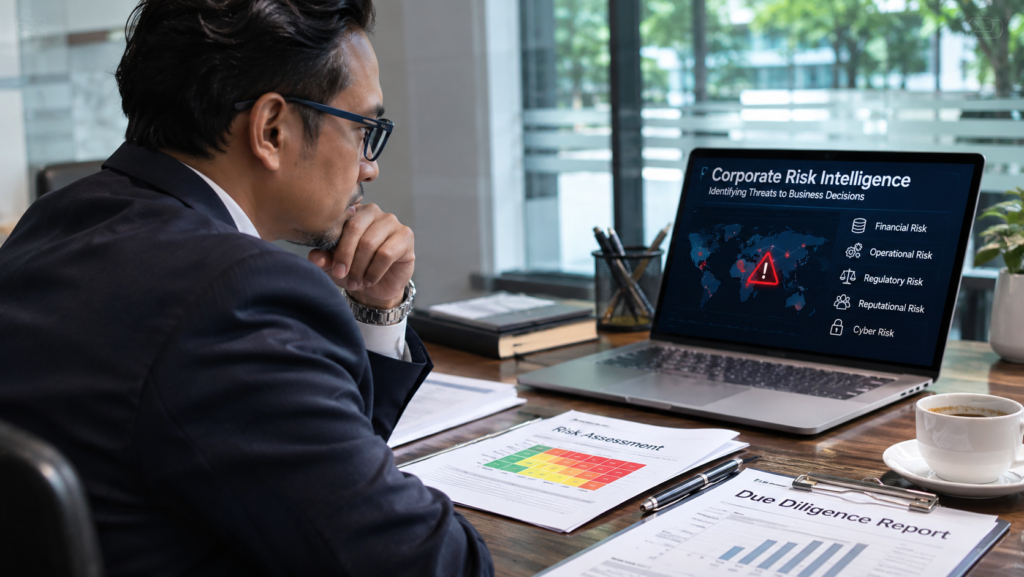
Corporate risk intelligence helps companies recognize threats before making critical decisions about investments, business partnerships, suppliers, and market expansion. However, many organizations focus primarily on financial opportunities while overlooking regulatory exposure, unreliable counterparties, reputational concerns, and operational vulnerabilities. These risks can affect business continuity, investment returns, and management decisions.
Corporate risk intelligence is the systematic collection, verification, and analysis of relevant information to identify threats that may affect business decisions. Companies use it to evaluate partners, assess investments, identify operational weaknesses, monitor emerging threats, and determine appropriate risk mitigation measures.
For companies operating or investing in Indonesia, effective intelligence combines reliable business information, legally obtained records, local market knowledge, and structured risk assessment. This approach supports better-informed decisions without assuming that all threats can be eliminated.
What Is Corporate Risk Intelligence?
Corporate risk intelligence is a decision-support process that converts relevant information about business threats into actionable findings. It helps executives understand what could go wrong, how a threat may affect business objectives, and which measures can reduce exposure.
Unlike general market research, corporate risk intelligence focuses on potential threats, vulnerabilities, warning indicators, and the reliability of information supporting a decision. Its scope may include corporate investigations, background verification, risk monitoring, and business due diligence.
For example, an international company planning a joint venture may evaluate a potential partner’s corporate registration, ownership information, financial position, legal disputes, and operational capabilities. The resulting assessment can help management decide whether to proceed, request additional information, adjust contractual safeguards, or reconsider the transaction.
The core process follows:
Business Objective → Threat Identification → Information Verification → Risk Assessment → Decision Support → Monitoring
A reliable assessment must also distinguish verified facts from allegations, assumptions, and unresolved information gaps.
Why Is Corporate Risk Intelligence Important for Business Decisions?
Companies make strategic decisions under uncertainty. New markets, suppliers, investments, and business partners may create growth opportunities, but each can introduce risks that are difficult to recognize through financial projections alone.
Corporate risk intelligence helps management identify potential weaknesses before allocating capital or signing agreements. It also supports ongoing oversight when business conditions, counterparties, or external threats change.
The main benefits include:
| Business Benefit | Decision-Making Value |
| Early threat identification | Recognizes potential problems before commitment |
| Partner verification | Improves understanding of counterparties |
| Investment assessment | Identifies relevant financial and operational exposures |
| Regulatory awareness | Highlights matters requiring compliance review |
| Reputational protection | Supports responsible partner selection |
| Operational resilience | Helps prepare for potential disruptions |
| Executive security awareness | Supports planning for sensitive business activities |
These benefits depend on information quality and the scope of assessment. Intelligence cannot guarantee that an investment will succeed or that every threat will be detected.
7 Corporate Risks That Can Threaten Business Decisions
Corporate threats originate from different sources. Some emerge within business operations, while others involve third parties, market conditions, or external events. Understanding these categories helps companies determine the appropriate investigation and response.
1. Financial and Investment Risks
Financial risks include weak cash flow, undisclosed liabilities, unstable profitability, and unreliable financial information. These issues can affect acquisitions, joint ventures, supplier contracts, and investment decisions.
For example, a company may present strong revenue growth while carrying substantial unpaid obligations. Management should therefore assess financial statements, cash flow, liabilities, and supporting documentation before committing capital.
2. Third-Party and Business Partner Risks
Suppliers, contractors, distributors, and business partners can expose companies to operational, financial, legal, and reputational problems. Potential warning indicators include inconsistent corporate information, unresolved disputes, unclear ownership, and insufficient operational capacity.
A structured background assessment helps verify relevant information before the company enters a significant commercial relationship. Read AMED’s Corporate Investigation Services in Indonesia for additional due diligence considerations.
3. Legal and Regulatory Risks
Regulatory risks arise when a business fails to meet applicable licensing, reporting, contractual, or sector-specific requirements. For foreign companies entering Indonesia, these matters may involve business registration, investment rules, operational permits, and industry regulation.
Corporate intelligence can identify inconsistencies or areas requiring further examination. However, determining legal compliance and providing formal legal opinions should involve appropriately qualified professionals.
4. Reputational and Integrity Risks
A business relationship can expose a company to reputational damage if a counterparty has a substantiated history of misconduct, serious compliance failures, or misleading commercial representations.
Relevant assessments may review credible public reporting, official proceedings, available corporate records, and properly verified references. Nevertheless, adverse allegations should not be presented as established facts without adequate evidence.
5. Operational and Supply Chain Risks
Operational threats include unreliable suppliers, infrastructure disruption, poor safety practices, inadequate inventory controls, and dependence on a single critical service provider.
For example, a manufacturing business may depend on one supplier located in an area exposed to flooding or transportation disruption. Management should evaluate alternative sourcing options and contingency arrangements before a disruption occurs.
6. Cyber and Information Security Risks
Cyber incidents can interrupt operations, compromise business information, and increase financial exposure. Companies should consider information security when evaluating technology vendors, digital operations, and sensitive business relationships.
Cybersecurity assessments require relevant technical specialists. Corporate risk intelligence can complement that work by evaluating external threat information, vendor exposure, and broader business consequences rather than replacing technical security testing.
7. Geopolitical and Physical Security Risks
Geopolitical developments, civil unrest, natural hazards, and local security conditions may affect supply chains, investments, and executive travel. The level of exposure depends on the company’s location, activities, and operating environment.
Businesses conducting industrial inspections or sensitive meetings should assess the specific itinerary and site conditions. When required, security planning can include executive protection, secure transportation, and situational awareness.
How to Identify Corporate Threats Before Making Business Decisions
Effective corporate risk intelligence requires a repeatable process. Companies should begin with a clearly defined decision, gather relevant information, evaluate evidence, and translate findings into practical recommendations.
1. Define the Business Decision and Risk Scope
Identify the decision that management needs to make. This could involve selecting a supplier, acquiring a company, entering a new market, or appointing a local business partner.
Then define the potential consequences, investigation scope, relevant jurisdictions, and information requirements. A focused assessment prevents unnecessary data collection and keeps the investigation aligned with business priorities.
2. Identify Potential Threats
List risks that could affect the decision. Consider financial reliability, ownership transparency, regulatory exposure, operational capability, security conditions, and reputational concerns.
The investigation should include both known warning indicators and uncertainties that require additional verification. Moreover, the assessment should consider consequences if an expected business opportunity does not materialize.
3. Collect and Verify Information Lawfully
Use appropriate sources such as official company records, relevant regulatory information, publicly available reporting, documents supplied with authorization, and legitimate business references.
Cross-check material findings before drawing conclusions. Also document the source, verification date, limitations, and confidence level of each significant finding.
Investigations must respect applicable privacy, confidentiality, and data protection requirements.
4. Evaluate Likelihood and Business Impact
Assess how likely a risk is to materialize and how seriously it could affect the company’s objectives. Consider financial losses, operational disruption, legal consequences, personal safety, and reputational effects.
A simple assessment matrix can help management prioritize risks. However, scores remain judgment-based unless supported by reliable quantitative evidence.
5. Develop Appropriate Risk Responses
Once risks are identified, management can determine whether to avoid, reduce, transfer, or accept particular exposures. The appropriate response depends on the company’s risk appetite, contractual options, resources, and strategic objectives.
For example, a company may proceed with a supplier under enhanced monitoring, request financial safeguards, establish backup providers, or postpone signing until critical information is verified.
6. Monitor Changes and Update the Assessment
Risk intelligence should not end when management approves a transaction. Ownership changes, new regulatory issues, operational disruptions, or emerging adverse information can alter the original assessment.
Assign responsibility for monitoring key indicators and define when the company should reopen a decision. This helps prevent an outdated risk report from becoming the sole basis for ongoing operations.
Example: Corporate Risk Intelligence Assessment Matrix
A simplified risk matrix helps decision-makers organize findings according to likelihood and potential impact. The following illustration concerns a hypothetical company evaluating an Indonesian distribution partner.
| Identified Risk | Likelihood | Impact | Priority |
| Incomplete ownership documentation | Medium | High | High |
| Delayed supplier deliveries | High | Medium | High |
| Unverified financial liabilities | Medium | High | High |
| Minor administrative inconsistencies | Low | Low | Low |
| Dependence on one logistics provider | Medium | Medium | Medium |
These are hypothetical assessment values, not findings from an actual AMED investigation.
Management should investigate high-priority findings before finalizing the transaction. For example, incomplete ownership information may warrant further verification, while supply chain concerns may justify alternative logistics arrangements.
Importantly, risk ratings should explain the evidence, assumptions, and uncertainties supporting each conclusion. A high-risk label alone does not establish wrongdoing or justify an automatic rejection.
What Are the Warning Signs of a High-Risk Business Partner?
Businesses should consider additional verification when a prospective partner provides information that appears inconsistent, incomplete, or difficult to substantiate.
Common warning indicators include:
- Corporate records that do not match supplied information.
- Unclear beneficial ownership or authorized representatives.
- Material financial claims without adequate supporting records.
- Unresolved litigation or regulatory matters that require review.
- Reluctance to provide ordinary due diligence documentation.
- Operational capabilities that cannot be substantiated.
- Inconsistent explanations of payment arrangements or business relationships.
A warning indicator is not proof of misconduct. The purpose of investigation is to clarify uncertainty, establish reliable facts where possible, and identify matters requiring further assessment.
For a broader explanation of the process, see Due Diligence in Indonesia.
What Do Official Risk Management Standards Say?
ISO 31000:2018 provides internationally recognized guidance for managing uncertainty across organizations. The standard describes risk management as a process that includes identifying, analyzing, evaluating, treating, monitoring, and communicating risks.
Its principles encourage organizations to integrate risk considerations into governance, strategy, and decision-making. However, ISO 31000 is a guidance standard rather than a certifiable organizational risk management standard.
The framework supports corporate intelligence by connecting findings with decisions and risk responses:
Identify → Analyze → Evaluate → Treat → Monitor → Communicate
For executives, the practical objective is to determine whether the available evidence supports a proposed decision and which safeguards are necessary.
Corporate Risk Trends: What Does the 2026 Research Show?
The World Economic Forum’s Global Risks Report 2026 identifies geoeconomic confrontation as the leading risk considered most likely to trigger a material global crisis during 2026. The report also highlights interstate conflict, misinformation, cyber insecurity, and supply chain vulnerabilities.
Meanwhile, the Allianz Risk Barometer 2026 ranks cyber incidents as the leading global business risk, followed by artificial intelligence-related risks and business interruption, including supply chain disruption.
These findings emphasize that corporate threats extend beyond traditional financial and compliance concerns. However, global survey rankings do not represent the risk score of a particular company or investment in Indonesia.
Therefore, organizations should use global research to inform risk scenarios while relying on company-specific and location-specific evidence for actual decisions.
Corporate Risk Intelligence vs Corporate Due Diligence
Corporate risk intelligence and due diligence often overlap, but they serve different purposes.
| Aspect | Corporate Risk Intelligence | Corporate Due Diligence |
| Main purpose | Identify and monitor threats | Evaluate a defined transaction or counterparty |
| Typical timing | Before and during business operations | Commonly before major commitments |
| Scope | Emerging threats, exposure, and risk indicators | Financial, legal, commercial, and operational verification |
| Output | Threat assessment and decision support | Findings, exceptions, and transaction recommendations |
| Monitoring | May be ongoing | Often transaction-focused |
Companies can combine both approaches when evaluating complex investments or ongoing strategic relationships.
For example, due diligence may establish a prospective partner’s documented position before signing an agreement. Corporate risk intelligence can then monitor relevant changes as the relationship continues.
AMED Expertise in Corporate Investigation and Business Risk Intelligence
AMED Corporate Protection & Business Investigation publishes business investigation, strategic assessment, corporate protection, and local coordination services for international companies, foreign investors, and executives operating in Indonesia.
Its official website describes business investigation capabilities that include corporate verification, competitor analysis, industrial benchmarking, local market assessment, and strategic business consultation.
1. Business Investigation and Partner Verification
AMED’s published investigation content covers due diligence on prospective business partners, suppliers, and investment targets. Relevant activities include reviewing corporate information, examining potential warning indicators, and assessing business risks before major commitments.
These capabilities support companies that require greater confidence when selecting local counterparties or exploring market opportunities.
2. Investment and Operational Risk Assessment
AMED also describes operational assessment and site-visit support for international businesses evaluating investments in Indonesia. Its published approach considers relevant business documentation, operational conditions, and potential project exposure.
The precise verification methods, deliverables, and information access must be determined for each assignment. Intelligence findings should not be treated as a guarantee of investment performance or complete legal compliance.
3. Local Business Intelligence and Strategic Support
AMED positions its Business Investigation and Strategic services around market exploration, industrial benchmarking, competitor assessment, and local coordination.
These capabilities can help foreign decision-makers understand commercial conditions that may not be apparent from remote research alone. Nevertheless, the relevance and quality of findings depend on the assignment scope and available evidence.
4. Executive Protection for Sensitive Business Activities
AMED’s published Executive Protection services include threat assessment, situational awareness, route planning, secure transportation, and executive escort.
These services may complement business investigations when executives conduct site visits, meetings, industrial inspections, or other activities that require security coordination.
Business intelligence and executive protection remain different functions. The appropriate combination depends on the client’s objectives and assessed exposure.
How AMED Supports Corporate Decision-Making in Indonesia
A practical corporate intelligence engagement should begin with the client’s decision and the uncertainties that require examination.
An illustrative approach aligned with AMED’s published capabilities is:
Client Requirements → Investigation Scope → Information Review → Risk Assessment → Findings → Decision Support
During the initial discussion, the client can identify the companies, locations, counterparties, or business activities requiring review. The scope can then define relevant information sources, verification priorities, reporting expectations, and confidentiality requirements.
AMED’s website supports the relevance of this approach through its published Business Investigation and strategic consultation services. However, an exact investigation methodology, project outcome, or guaranteed finding should not be assumed without a confirmed engagement scope.
The company’s publicly available materials do not establish independently verified statistics demonstrating a particular reduction in corporate losses. Its expertise should therefore be presented through documented service capabilities rather than unsupported performance claims.
How EFBA and EFBA Consulting Complement Corporate Risk Intelligence
AMED is part of the wider EFBA business network. Its investigation and security-oriented services address different needs from general business strategy and management consulting.
PT EFBA Digital Mulia publishes business consulting services involving business planning, management, financial assessment, and organizational development. These capabilities are relevant when an organization needs to translate identified risks into business planning or operational improvements.
Meanwhile, EFBA Consulting provides consulting across Business Strategy, Finance, Operations, Marketing, and Business Development. Its published approach includes business assessment, root-cause analysis, strategy development, action planning, and performance evaluation.
These services can complement an AMED investigation when a client requires broader business recommendations. However, any combined engagement or coordination between providers must be confirmed according to the actual project requirements.
The distinction is:
AMED: Business Investigation and Risk Intelligence
EFBA / EFBA Consulting: Business Strategy, Management, and Development
Together, these service areas may support a more comprehensive review of corporate risks and business decisions without replacing legal, accounting, cybersecurity, or other specialist advice where required.
FAQ About Corporate Risk Intelligence
1. What is corporate risk intelligence?
Corporate risk intelligence is the collection, verification, and analysis of information about threats that may affect business decisions. It helps organizations evaluate counterparties, investments, operating conditions, and emerging risks. The goal is to support informed decisions and appropriate risk responses.
2. How does corporate risk intelligence help businesses?
It helps companies recognize potential issues before entering partnerships, investing capital, or expanding operations. Relevant findings may concern financial reliability, corporate ownership, compliance, reputation, and operational capability. Management can then determine whether to proceed, investigate further, or introduce safeguards.
3. What are the main types of corporate risk?
Common categories include financial, legal, regulatory, operational, reputational, cybersecurity, third-party, geopolitical, and physical security risks. The importance of each category depends on the business model, location, and decision being evaluated.
4. What is the difference between corporate intelligence and due diligence?
Corporate intelligence can include ongoing monitoring of threats and strategic developments. Due diligence usually examines a specific company, counterparty, or transaction before a commitment. Both activities can complement each other in corporate risk management.
5. How can companies identify high-risk business partners?
Companies can verify corporate identity, relevant ownership records, financial information, operational capabilities, available legal information, and credible business references. Potential warning indicators should be investigated rather than treated as conclusive evidence of wrongdoing.
6. Is corporate risk intelligence legal in Indonesia?
Corporate investigations and risk assessments can be conducted lawfully when the methods, information collection, and processing comply with applicable regulations. Organizations must respect data protection, confidentiality, and other legal requirements. Specific investigative methods may require additional legal review.
7. Does corporate risk intelligence eliminate business risk?
No. Intelligence improves understanding of relevant threats but cannot guarantee that every issue will be identified or that losses will not occur. Companies still need risk controls, governance, monitoring, and contingency planning.
8. When should a company conduct a corporate risk assessment?
A company should consider an assessment before major investments, mergers, acquisitions, partnerships, supplier appointments, and expansion into unfamiliar markets. It should also reassess exposure when material changes affect its operations or counterparties.
9. Does AMED provide corporate risk intelligence services in Indonesia?
AMED publishes Business Investigation, corporate verification, operational assessment, strategic consultation, and executive protection capabilities for businesses operating or investing in Indonesia. Companies can contact AMED to discuss the appropriate assessment scope, verification needs, and deliverables.
10. Can AMED coordinate risk intelligence with business consulting?
AMED belongs to the EFBA network, which also includes business management and strategy consulting services. Relevant service areas may complement each other, but clients should confirm the scope and coordination of any combined engagement before proceeding.
Identify Corporate Threats Before Critical Decisions with AMED
Corporate risk intelligence provides a structured way to recognize threats before they affect investments, partnerships, and business operations. By verifying information, evaluating exposure, and monitoring relevant developments, companies can make decisions with greater awareness of uncertainty and potential consequences.
For organizations operating in Indonesia, effective risk intelligence may require local business knowledge, counterparty verification, operational assessment, and practical coordination. However, the best approach depends on the company’s objectives and the specific decision being considered.
AMED Corporate Protection & Business Investigation provides business investigation, strategic consultation, and corporate protection services relevant to companies evaluating risks in Indonesia.
Whether your organization is assessing a business partner, conducting investment due diligence, exploring a new market, or preparing a sensitive corporate visit, AMED can discuss the appropriate support based on your requirements.
Need reliable corporate intelligence before making a business decision?
Visit AMED Corporate Investigation Services or Contact AMED to arrange an initial discussion.
Prepare the business objective, relevant counterparties, geographic scope, principal concerns, and expected decision timeline. These details help define a focused assessment and suitable next steps.
Better corporate decisions begin with verified information, structured risk analysis, and a clear understanding of what remains uncertain.