
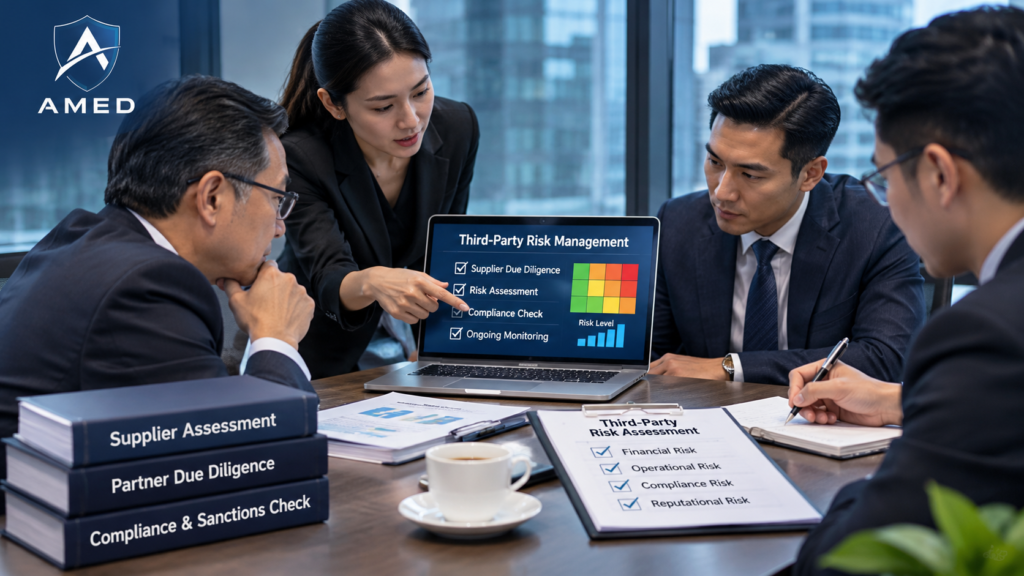
Third party risk management is essential for companies that depend on external suppliers, distributors, contractors, and strategic business partners. These relationships support growth and operational efficiency, but they can also introduce financial, regulatory, reputational, and security risks. Without proper assessment, a supplier’s weaknesses or a business partner’s undisclosed problems may disrupt operations and affect corporate decisions.
Third party risk management (TPRM) is the process of identifying, assessing, mitigating, and monitoring risks associated with external business relationships. Companies can reduce exposure by verifying supplier information, evaluating ownership and financial reliability, conducting due diligence, establishing contractual controls, and reviewing third-party performance throughout the relationship.
For international companies operating in Indonesia, effective TPRM also requires an understanding of local business conditions and relevant regulatory requirements. A risk-based approach helps management prioritize critical relationships without applying unnecessary investigations to every vendor.
What Is Third-Party Risk Management?
Third-party risk management is a structured approach to controlling risks that arise when an organization relies on external companies or individuals. These third parties can include manufacturers, logistics providers, IT vendors, distributors, consultants, contractors, and joint venture partners.
The primary objective is to understand whether a third party can fulfill its obligations without creating unacceptable risks. Assessments may examine financial stability, operational capacity, ownership transparency, legal compliance, cybersecurity, and reputation.
Unlike one-time supplier verification, effective TPRM covers the entire business relationship. Companies should evaluate potential risks before onboarding, establish controls during contracting, monitor performance, and manage risks when a relationship changes or ends.
A practical management cycle follows:
Third-Party Identification → Risk Classification → Due Diligence → Approval → Contracting → Monitoring → Exit
This approach helps businesses connect procurement decisions with corporate governance, risk management, and operational resilience.
Why Is Third-Party Risk Management Important?
Companies increasingly depend on external organizations to manufacture products, operate systems, transport goods, and provide specialist services. Although these relationships can improve efficiency, outsourcing an activity does not automatically eliminate the company’s exposure to related risks.
For example, a logistics partner may experience repeated delivery disruptions, while an IT vendor may face data security problems. A distributor could also create compliance concerns through inaccurate business information or inappropriate commercial activities.
Third-party risk management helps organizations recognize such vulnerabilities before they escalate. It also supports consistent supplier selection, contract negotiation, and decisions about whether a relationship should continue.
| Business Benefit | Practical Value |
| Supplier reliability | Reduces exposure to preventable disruptions |
| Financial assessment | Identifies potential payment or solvency concerns |
| Compliance awareness | Highlights matters requiring further review |
| Reputation protection | Supports responsible counterparty selection |
| Business continuity | Encourages alternative supplier planning |
| Decision transparency | Documents how risks were evaluated |
However, no assessment can eliminate every risk. The effectiveness of TPRM depends on reliable information, appropriate controls, and continuous monitoring.
7 Major Types of Third-Party Risk
External partners can introduce several types of exposure, and the importance of each depends on the relationship. Companies should begin by identifying which risks could materially affect their operations, objectives, or stakeholders.
1. Financial Risk
Financial risk arises when a supplier or partner cannot fulfill its financial obligations. Potential indicators include persistent liquidity problems, significant outstanding liabilities, financial reporting inconsistencies, and dependence on unstable revenue sources.
For critical suppliers, companies should request appropriate financial information and assess whether the vendor can maintain operations during changing market conditions. However, financial statements must be interpreted carefully, and a weak indicator alone does not establish that a company will fail.
2. Operational and Supply Chain Risk
Operational risk includes production delays, inadequate capacity, quality problems, transportation disruptions, and excessive dependence on subcontractors. Such weaknesses can affect delivery schedules and customer commitments.
Companies should evaluate production capability, operational processes, and business continuity arrangements. Where appropriate, a site visit can provide additional context beyond documentation supplied during onboarding.
3. Legal and Regulatory Risk
Third parties may operate under licensing, tax, employment, environmental, or industry-specific obligations. Failure to comply with relevant requirements can create disruption and expose commercial relationships to additional scrutiny.
Risk teams can check available company registration information, relevant licenses, and other appropriate records. Formal legal conclusions should remain within the responsibility of qualified legal professionals.
4. Reputational and Integrity Risk
A company’s reputation can suffer when an important partner becomes associated with substantiated misconduct, serious governance failures, or unethical business practices.
Due diligence may review credible adverse media, official proceedings, relevant regulatory actions, and business references. Importantly, adverse allegations and name matches must be verified before management treats them as established findings.
5. Cybersecurity and Data Protection Risk
Technology providers, outsourced service companies, and vendors with system access may introduce information security risks. These can include unauthorized access, inadequate security controls, data exposure, and weaknesses in subcontractor systems.
Organizations should classify suppliers based on data sensitivity, technical access, and operational criticality. Specialist cybersecurity assessments can then evaluate relevant technical controls in accordance with applicable requirements.
6. Sanctions and Financial Crime Risk
Some business relationships require sanctions screening, beneficial ownership review, or enhanced financial crime due diligence. The applicable obligations depend on jurisdiction, transaction structure, counterparties, and relevant legal requirements.
A potential screening match is not proof of a sanctions violation. Compliance teams should verify the identity, investigate relevant ownership or control information, and seek specialist advice before reaching a conclusion.
7. Geographic and Physical Security Risk
Suppliers and contractors operating in unfamiliar or higher-risk locations may face threats involving local unrest, infrastructure disruption, natural hazards, or physical security.
International companies conducting factory inspections or sensitive site visits may need additional local risk awareness. Depending on the circumstances, operational assessment and secure business travel arrangements can support safer decision-making.
7 Steps to Build an Effective Third-Party Risk Management Program
A TPRM framework should match the organization’s risk exposure and the importance of its external relationships. Not every supplier needs the same level of investigation, but every material business relationship should have an appropriate owner and review process.
1. Create a Complete Third-Party Inventory
Start by identifying suppliers, service providers, distributors, contractors, agents, and other relevant counterparties. Record their legal names, services, operating locations, relationship owners, and critical dependencies.
Include important subcontractors where appropriate and information is reasonably available. A centralized inventory helps management understand which business activities rely on external parties.
2. Classify Third Parties by Risk and Criticality
Assess each relationship based on its potential impact on business continuity, sensitive information, financial exposure, and compliance obligations. For example, a supplier operating a critical production component may require closer review than a low-impact office service provider.
Risk classification should consider both inherent risk and the strength of existing controls. This distinction helps management determine whether additional safeguards can reduce exposure to an acceptable level.
3. Conduct Supplier and Partner Due Diligence
Verify relevant information before entering a significant business relationship. Appropriate checks can include legal identity, ownership, operating capability, financial information, and available compliance or reputational records.
Higher-risk relationships may require enhanced due diligence, such as additional ownership analysis, document verification, or operational site assessment. Read Corporate Investigation Services in Indonesia for related business verification considerations.
4. Evaluate Findings and Assign Risk Ratings
Use a consistent assessment method to determine the likelihood and potential impact of relevant threats. Document the evidence supporting each risk and distinguish verified concerns from unresolved information gaps.
The resulting assessment should support clear decisions: approve, approve with conditions, request additional investigation, or decline the relationship. Management must establish who can accept residual risks.
5. Establish Contractual and Operational Controls
Contracts should reflect the risks associated with the third party and the services provided. Depending on the relationship, relevant provisions may address performance standards, confidentiality, reporting, incident notification, audit rights, subcontracting, and termination.
Legal counsel should review obligations that require contractual interpretation. Meanwhile, procurement and operational teams should ensure that the agreed controls can be monitored in practice.
6. Monitor Third-Party Performance Continuously
Supplier risk may change after onboarding. Financial difficulties, ownership changes, quality incidents, regulatory actions, and operational disruptions can make an earlier assessment outdated.
Establish review schedules based on criticality and use event-driven reassessments when material changes arise. Monitoring should track both business performance and risk indicators rather than relying solely on annual questionnaires.
7. Prepare Corrective Actions and Exit Plans
When a serious concern emerges, the company should assess the impact, investigate relevant facts, and determine suitable corrective measures. Some cases may require enhanced oversight, temporary restrictions, alternative sourcing, or contractual remedies.
Critical suppliers should also have an exit or transition plan where feasible. This helps the business maintain operational continuity if the relationship ends unexpectedly.
What Should Companies Check During Third-Party Due Diligence?
Due diligence should respond to the type of business relationship and the potential exposure. A supplier handling sensitive customer information requires different checks from a distributor or manufacturing contractor.
The following checklist provides a practical starting point.
| Due Diligence Area | Information to Verify |
| Corporate identity | Legal name, registration, business address |
| Ownership | Relevant shareholders and beneficial owners |
| Management | Authorized representatives and governance |
| Financial reliability | Available accounts, payment capacity |
| Operating capability | Facilities, workforce, production capacity |
| Compliance | Relevant permits and regulatory information |
| Reputation | Credible adverse information and references |
| Sanctions exposure | Applicable lists and ownership considerations |
| Cybersecurity | Relevant security practices and system access |
| Business continuity | Contingency planning and dependencies |
Businesses should document the information source, verification date, outstanding questions, and assessment conclusions. When a document is unavailable, the report should explain the limitation rather than assume the supplier is either safe or noncompliant.
For additional context, see Due Diligence in Indonesia.
Example of a Third-Party Risk Assessment Matrix
A risk matrix helps management prioritize suppliers that require closer review. The following example illustrates a hypothetical company assessing four external service providers.
| Third Party | Main Exposure | Likelihood | Impact | Risk Priority |
| Supplier A | Production dependency | High | High | High |
| Supplier B | Financial instability | Medium | High | High |
| Vendor C | Limited data access controls | Medium | Medium | Medium |
| Vendor D | Minor delivery inconsistencies | Low | Low | Low |
All ratings are illustrative and do not represent actual AMED investigation findings or validated supplier assessments.
In this example, Supplier A requires particular attention because a significant production interruption could affect the company’s ability to deliver products. Management may consider alternative sourcing, inventory safeguards, and a documented continuity plan.
Supplier B may need additional financial due diligence or revised payment terms. Vendor C could require a technical security assessment, while Vendor D may be managed through routine operational monitoring.
The final decision must consider the effectiveness of existing controls and the company’s documented risk appetite.
How Often Should Third Parties Be Reassessed?
There is no universally appropriate reassessment schedule for every business relationship. The review frequency should reflect the supplier’s criticality, risk profile, contractual obligations, and changing operating conditions.
A practical internal framework may use the following approach.
| Risk Category | Illustrative Review Approach |
| High risk | Frequent monitoring and formal reviews at least annually |
| Medium risk | Periodic reviews based on exposure and material changes |
| Low risk | Less frequent reviews and relevant event-driven checks |
These are suggested management practices rather than universal legal requirements or mandatory ISO or NIST intervals.
Regardless of the routine schedule, companies should consider reassessment when material warning indicators appear. Examples include ownership changes, major service failures, new sanctions concerns, financial deterioration, or significant changes in subcontracting.
What Are the Warning Signs of a High-Risk Supplier?
Certain circumstances may justify additional verification before or during a commercial relationship. Warning indicators should trigger a proportionate investigation, not an automatic assumption of misconduct.
Examples include inconsistent company records, unexplained ownership structures, repeated financial disputes, unsupported claims about operational capacity, and requests to redirect payments to unrelated accounts.
Other concerns may involve repeated delivery failures, unwillingness to provide standard compliance documentation, or unexplained changes in subcontractors.
When such indicators appear, the risk team should determine whether the issue is a documentation gap, legitimate commercial change, operational weakness, or potentially serious concern. The assessment should rely on lawful and credible information.
What Do NIST and OECD Say About Third-Party Risk Management?
International guidance emphasizes the importance of structured assessments and ongoing oversight of external business relationships.
NIST SP 1326: Supplier Due Diligence
In July 2026, the US National Institute of Standards and Technology published NIST SP 1326, a quick-start guide for cybersecurity supply chain due diligence.
The guidance identifies five assessment areas:
- Foreign ownership, control, or influence.
- Provenance of the supplier or product.
- Supplier resilience.
- Foundational cybersecurity practices.
- Supply chain tiers and dependencies.
Although NIST SP 1326 focuses on ICT suppliers, its approach highlights the importance of understanding ownership, dependencies, and operational resilience before making purchasing decisions.
NIST SP 800-161: Cybersecurity Supply Chain Risk Management
NIST SP 800-161 Revision 1 provides guidance for managing cybersecurity risks throughout supply chains. Its updated publication includes recommendations for integrating risk considerations into acquisition, contracts, supplier assessment, and ongoing oversight.
The guidance supports risk-based supplier evaluation rather than treating all vendors as having identical exposure.
OECD: Risk-Based Due Diligence
OECD responsible business conduct guidance recommends identifying and addressing adverse impacts throughout operations, supply chains, and business relationships.
Its six-step framework includes integrating responsible conduct into management systems, assessing adverse impacts, preventing or mitigating them, tracking results, communicating actions, and enabling remediation where appropriate.
The OECD framework addresses impacts on people, the environment, and society, while corporate TPRM also considers enterprise financial and operational exposure. Companies should use the frameworks for their intended purposes rather than treating them as interchangeable.
Third-Party Risk Management vs Vendor Risk Management
Third-party risk management and vendor risk management are closely related, but their scope can differ.
| Aspect | Third-Party Risk Management | Vendor Risk Management |
| Scope | Suppliers, partners, agents, contractors, other third parties | Primarily vendors and service providers |
| Main concern | Enterprise exposure from external relationships | Risks associated with vendor performance and services |
| Common activities | Due diligence, screening, risk classification, monitoring | Vendor assessment, contract monitoring, performance reviews |
| Relationship lifecycle | Onboarding through termination | Procurement and vendor service lifecycle |
Vendor risk management can therefore operate as part of a broader TPRM program.
For international companies, the broader approach is particularly useful when relationships involve local distributors, intermediary agents, joint venture partners, or other counterparties beyond conventional procurement vendors.
AMED Expertise in Third-Party Investigation and Risk Assessment
AMED Corporate Protection & Business Investigation provides business investigation, corporate verification, strategic assessment, and local operational support for international companies, investors, and executives conducting business in Indonesia.

Its official website describes business investigation services related to verifying companies, prospective partners, suppliers, and investment targets. These services are relevant when an organization needs additional information before making a commercial commitment.
1. Corporate and Supplier Background Verification
AMED’s published Corporate Investigation and Due Diligence content discusses company verification, corporate records, business reputation, ownership information, and relevant operational risks.
These capabilities align with the information-gathering stage of a third-party risk assessment. Companies may use such findings to identify inconsistencies, request further documentation, or support internal approval decisions.
2. Business Partner and Counterparty Due Diligence
AMED describes support for investigating potential local business partners, suppliers, and investment counterparties. The published scope addresses risks related to commercial relationships and business activities in Indonesia.
Such investigations may complement internal procurement or compliance reviews, particularly when a foreign company requires relevant local information.
3. Operational and Site Assessment
AMED’s published due diligence material includes operational assessments and site visits involving facilities, supply chains, workforce conditions, and relevant operating environments.
For critical suppliers, this type of review can help organizations understand potential vulnerabilities that are not apparent from submitted documents alone.
However, any actual site visit, inspection methodology, or verification requirement must be confirmed for the specific assignment.
4. Local Risk Intelligence and Strategic Support
AMED’s website identifies industrial benchmarking, competitor analysis, business investigation, and strategic consultation as relevant service areas.
Its local coordination capabilities may support international companies evaluating suppliers and partners in Indonesia. Nevertheless, AMED’s published materials do not establish that every type of technical cyber audit, sanctions compliance opinion, or legal due diligence is included automatically.
The appropriate investigation scope and any specialist involvement should be agreed upon before engagement.
How AMED Can Support Supplier and Partner Risk Decisions
Third-party investigation should begin with a defined business objective. For example, a company may want to verify a distributor before signing an exclusive agreement or evaluate a manufacturing supplier before committing to a long-term contract.
A practical investigation framework aligned with AMED’s published service areas is:
Client Requirements → Counterparty Identification → Background Review → Operational Assessment → Risk Findings → Decision Support
The first step involves defining the companies, activities, and concerns that require examination. The assessment can then identify relevant information needs, verification priorities, and deliverables.
When findings indicate potential risks, management can decide whether to seek additional evidence, introduce safeguards, or reconsider the proposed business relationship.
This framework illustrates a relevant assessment approach, not a guarantee that AMED provides every activity as a fixed service package. Investigation methods, access to records, timelines, and reporting scope require direct confirmation.
How EFBA Complements Corporate Risk Management
PT EFBA Digital Mulia provides business consulting services covering business planning, financial analysis, management systems, operational improvement, and organizational development.
These areas can complement third-party risk intelligence when companies need to translate investigation findings into procurement controls, operational planning, or management improvements.
For example, a supplier assessment may identify heavy dependence on a single manufacturer. The organization’s management team can then evaluate sourcing diversification, contractual arrangements, and contingency planning.
EFBA’s Business Consulting Services publish relevant capabilities in Financial Plan, Business Management & Administration, Market Research, and Operations.
AMED’s investigation capabilities and EFBA’s business consulting services address related but different objectives. The scope of any coordinated engagement must be confirmed with the relevant providers.
FAQ About Third-Party Risk Management
1. What is third-party risk management?
Third-party risk management is the process of identifying, assessing, mitigating, and monitoring risks associated with external suppliers, vendors, contractors, agents, and business partners. It helps companies understand potential financial, operational, legal, cybersecurity, and reputational exposure.
2. Why is third-party risk management important?
External companies may affect business continuity, service quality, compliance, and reputation. TPRM helps organizations recognize potential weaknesses before entering significant relationships and maintain oversight as risks change. It also supports more consistent procurement and partnership decisions.
3. What are the main stages of third-party risk management?
The typical stages include third-party identification, risk classification, due diligence, approval, contracting, monitoring, and exit management. Companies should adapt each stage to the relationship’s importance and risk exposure.
4. What is the difference between TPRM and vendor risk management?
Vendor risk management generally focuses on risks from suppliers and service providers. TPRM covers a broader set of external relationships, which may include distributors, agents, strategic partners, and contractors.
5. How do companies assess third-party risk?
Companies can verify legal identity, relevant ownership details, financial reliability, operational capability, compliance information, and business reputation. They should then evaluate potential likelihood, impact, and existing controls before deciding whether the relationship is acceptable.
6. What is enhanced due diligence?
Enhanced due diligence involves deeper investigation when a third party presents elevated risks or significant unresolved concerns. It may include additional ownership verification, more detailed information review, or operational assessment. The scope depends on the risk and applicable requirements.
7. How often should suppliers undergo risk assessments?
The frequency depends on supplier criticality, risk exposure, contractual requirements, and relevant changes. High-risk relationships may require more frequent reviews, while lower-risk suppliers can follow proportionate monitoring schedules. Significant warning indicators should trigger reassessment when necessary.
8. Is sanctions screening part of third-party risk management?
Sanctions screening can form part of TPRM when relevant laws, jurisdictions, or company policies require it. A potential list match needs further identity verification and appropriate analysis. Screening alone does not replace comprehensive due diligence or legal assessment.
9. Can third-party risk management prevent supplier failure?
TPRM cannot guarantee that supplier failure will never occur. However, it can help companies recognize vulnerabilities, establish safeguards, plan alternatives, and respond earlier to changing risk conditions.
10. Does AMED provide third-party risk assessment support in Indonesia?
AMED publishes business investigation, corporate verification, counterparty due diligence, and operational assessment capabilities relevant to supplier and partnership risk. Companies can contact AMED to discuss specific investigation needs, reporting requirements, and assignment scope.
Reduce Supplier and Partnership Exposure with AMED
Third-party risk management enables organizations to approach supplier and partner relationships with greater awareness of potential threats. By verifying critical information, assessing exposure, and monitoring business relationships, companies can strengthen procurement decisions and operational resilience.
For businesses operating in Indonesia, local company verification and operational intelligence can provide additional context when evaluating unfamiliar suppliers or business partners.
AMED Corporate Protection & Business Investigation provides corporate investigation and business verification services relevant to third-party risk assessment. Its published capabilities support companies requiring information about prospective counterparties, suppliers, operating conditions, and business activities.
Need to assess a supplier, distributor, or business partner before signing a major agreement?
Explore AMED Corporate Investigation Services or Contact AMED to discuss your requirements.
Prepare the company’s legal name, business relationship, operating location, main concerns, intended transaction, and desired reporting scope. This information can help define an appropriate assessment.
Stronger business relationships begin with verified information, proportionate due diligence, and continuous awareness of third-party risks.