
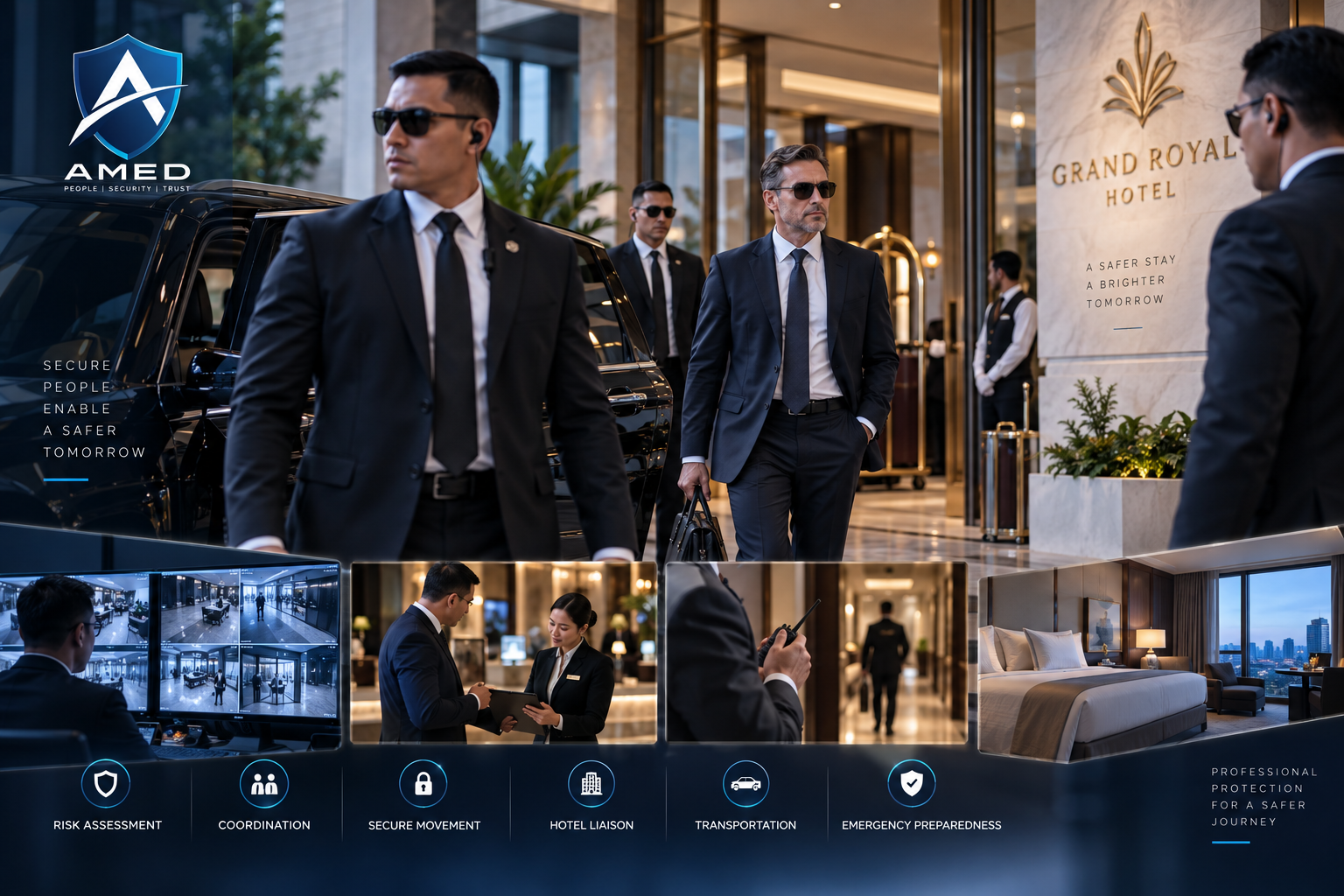
Hotels are designed for hospitality, accessibility, and convenience. For executives and VIPs, however, a hotel also becomes a temporary operational environment that protection teams must understand quickly.
Unlike a private residence or permanent corporate office, hotel environments involve constantly changing guests, staff, contractors, vehicles, events, deliveries, and public access.
That makes VIP hotel security more than guarding a hotel room.
Professional protection should consider the complete movement:
Airport → Vehicle → Hotel Arrival → Lobby → Elevator → Room → Meeting → Departure
This approach aligns with modern travel risk management. ISO 31030 provides organizations with a structured framework for identifying travel threats and hazards, assessing risks, and establishing prevention and mitigation measures.
What Is VIP Hotel Security?
People searching for VIP hotel security generally want to understand how executives, corporate leaders, VIP guests, or other high-profile individuals can stay safely in hotels during business travel.
The direct answer is that effective hotel security begins before the principal enters the property.
Protection teams may assess the hotel environment, arrival and departure points, surrounding area, transportation arrangements, movement routes, emergency procedures, and coordination requirements.
The objective is not to turn a hotel into a fortress.
It is to reduce unnecessary exposure while allowing the executive to continue business activities with minimal disruption.
How Do Protection Teams Secure a VIP at a Hotel?
VIP hotel security typically combines threat assessment, advance planning, controlled movement, situational awareness, transportation coordination, hotel liaison, and emergency preparation.
The process can be understood as:
Threat Assessment → Hotel Assessment → Arrival Planning → Access & Movement → Monitoring → Emergency Response → Departure
The level of protection should always depend on the principal’s actual risk profile.
A visiting company director attending private meetings may require different measures from a highly visible executive facing a documented threat.
1. Security Starts Before Hotel Check-In
Professional executive protection does not begin when the VIP walks through the lobby.
An advance assessment helps the protection team understand the operating environment before arrival.
Factors can include the hotel’s location, surrounding roads, vehicle access, entrance and exit options, lobby configuration, elevators, meeting areas, parking arrangements, nearby medical resources, and potential evacuation routes.
ISO 31030 emphasizes threat and hazard identification, risk assessment, prevention, and mitigation as part of structured business-travel risk management.
This creates a logical sequence:
Understand → Assess → Plan → Protect
rather than reacting only after a problem occurs.
2. Arrival and Departure Require Particular Attention
Arrival is a transition point.
The executive moves from a controlled vehicle into a more public environment, often while carrying luggage and potentially accompanied by assistants, colleagues, or family members.
Depending on risk, protection teams may evaluate vehicle positioning, lobby congestion, alternative entrances, pedestrian exposure, waiting time, and the route from the vehicle to the executive’s destination.
The same principle applies during departure.
A well-planned movement seeks to minimize unnecessary waiting and maintain coordination between:
Protection Team → Driver → Hotel → Executive
AMED’s published Executive Protection service specifically includes threat assessment, situational awareness, route planning, executive escort, and secure transportation.
3. Hotel Rooms Are Only One Layer of Protection
Selecting a room is important, but VIP hotel security should not focus exclusively on the room itself.
The protection team needs to understand how the principal moves between the room and other relevant locations.
For example: Room → Elevator → Lobby → Meeting Room → Vehicle
Each transition creates a different environment.
Protection planning may therefore consider access patterns, public areas, meeting locations, hotel events, elevator movement, emergency exits, and other factors relevant to the specific threat assessment.
The goal is not absolute isolation.
The goal is controlled exposure.
4. Hotel Staff Coordination Must Balance Security and Discretion
Hotels already operate their own security, access, fire-safety, and emergency procedures.
Executive protection personnel should therefore understand where coordination with hotel management or hotel security is appropriate.
Relevant information may include emergency contacts, access arrangements, vehicle procedures, meeting locations, evacuation routes, and incident-response protocols.
At the same time, discretion matters.
Sharing unnecessary information about an executive’s itinerary, room, meetings, or movements can create additional exposure.
A useful principle is:
Coordinate What Is Necessary → Limit What Is Sensitive
This allows hotel operations and executive protection to complement rather than obstruct each other.
5. Secure Transportation Is Part of Hotel Security
A protected hotel stay cannot be separated from transportation.
Executives may leave several times each day for meetings, industrial visits, dinners, conferences, or airport transfers.
Every departure creates another transition between temporary environments.
AMED’s secure transportation service uses professional drivers trained in security awareness and includes route risk management and airport transfers. Its business travel security service also covers site visits, industrial inspections, business meetings, and regional travel.
For that reason, the security chain should remain continuous:
Hotel → Vehicle → Route → Destination → Vehicle → Hotel
A weakness at one point can affect the entire movement.
6. Temporary Environments Require Situational Awareness
One challenge with hotels is constant change.
A quiet lobby in the morning may host a large conference in the evening. A normal entrance can become congested. Road conditions may change. An event can alter access to parts of the building.
This makes static security plans insufficient.
Protection teams need situational awareness and the ability to adjust plans according to changing circumstances.
ISO notes that travel risks can affect personnel, business continuity, data, equipment, reputation, and organizational resilience. It also emphasizes that travel risk varies according to destination and circumstances rather than following one universal security formula.
For VIPs, flexibility is therefore part of protection.
7. Emergency Planning Matters Before an Emergency Happens
Protection planning should also consider what happens when normal arrangements fail.
Potential scenarios include medical emergencies, fire alarms, security incidents, transportation disruption, civil disturbance, severe weather, or another unexpected event.
The protection team should understand relevant emergency procedures and establish communication and decision-making arrangements before they are needed.
A useful framework is:
Incident → Communication → Immediate Action → Safe Movement → Medical/Emergency Support → Continuity
ISO 31030 specifically includes emergency response among the areas organizations should consider when managing business-travel risks.
The objective is not to predict every possible event.
It is to avoid making critical decisions from zero when something unexpected occurs.
Why Travel Risk Management Matters
There is no credible universal statistic showing how many VIP hotel stays result in security incidents, so using an arbitrary percentage would weaken the article’s E-E-A-T.
A stronger reference is the international framework itself.
ISO 31030:2021 provides structured guidance for organizations managing risks associated with business travel. It covers threat and hazard identification, risk assessment, prevention and mitigation, travel arrangements, information-security precautions, logistics challenges, and emergency response.
Executive protection research published by ASIS also reflects the close relationship between executive protection and travel risk. In a 2025 survey of more than 100 security consultants, 60% reported providing travel-risk consulting, making it the most commonly offered service among respondents. ASIS notes that the sample is not large enough for rigorous statistical generalization, so the figure should be read as an industry indicator rather than a universal benchmark.
This supports an important point:
Executive protection does not stop at the principal. It follows the principal’s environment and movement.
Securing an Executive During a Jakarta Business Trip
Consider a hypothetical international executive arriving in Jakarta for a three-day business visit.
The schedule includes an airport transfer, hotel check-in, several corporate meetings, a dinner, and an industrial site visit.
Instead of treating each activity separately, the protection team assesses the trip as one continuous movement.
Before arrival, the team reviews the hotel environment and transportation plan. The driver and protection personnel coordinate airport pickup. At the hotel, movement between the vehicle, lobby, room, and meeting areas is considered.
Before external meetings, routes and destinations are reviewed.
If the schedule changes, the protection plan changes with it.
The model becomes:
Airport → Secure Transportation → Hotel → Meeting → Site Visit → Hotel → Airport
The hotel is therefore not simply accommodation.
It is one component within a broader executive travel security environment.

AMED’s Approach to Executive and Travel Security
AMED Corporate Protection & Business Investigation provides professional protection, secure transportation, and situational awareness for executives operating in Indonesia.
AMED’s Executive Protection service publicly lists capabilities including threat assessment, situational awareness, route planning, executive escort, travel coordination, secure transportation, and emergency-response coordination. Its business travel security scope covers business meetings, site visits, industrial inspections, and regional travel.
That service model is relevant to hotel protection because a hotel cannot be assessed independently from the executive’s wider itinerary.
A practical framework is:
Principal Profile → Threat Assessment → Arrival → Hotel → Daily Movement → Transportation → Emergency Planning → Departure
The objective is proportionate, discreet protection that supports the executive’s business activity.
AMED and the EFBA Business Ecosystem
AMED operates within the wider EFBA business environment, connecting executive protection with broader corporate needs.
PT EFBA Digital Mulia provides business solutions spanning business consulting, legal and business compliance, digital services, product development, and other areas. Its website also displays client references from multiple business sectors.
EFBA separately documents business-development and consulting experience dating from 2013, covering areas including planning, marketing, finance, management, operations, and company systems.
This relationship is relevant because business travel security ultimately protects more than an individual.
Executive Safety → Business Schedule → Decision Making → Operations → Business Continuity
Protecting executives can therefore form part of wider organizational risk management.
Build AMED’s Executive Protection Topic Cluster
Readers requiring protection during business travel can continue to AMED Executive Protection. The service includes executive protection officers, threat assessment, situational awareness, route planning, executive escort, secure transportation, airport transfers, and business-travel security.
For the broader corporate context, connect the article naturally with EFBA Digital Mulia. This creates a useful topical relationship:
Business Operations → Business Travel → Executive Protection → Secure Transportation → VIP Hotel Security → Business Continuity
This structure also gives search engines and AI discovery systems clearer context about how AMED’s services relate to broader corporate risk.
FAQ: VIP Hotel Security
What is VIP hotel security?
VIP hotel security is the planning and protection used to reduce security exposure while an executive or VIP stays in a temporary hotel environment. Depending on risk, it can involve threat assessment, advance planning, secure transportation, movement coordination, situational awareness, hotel liaison, and emergency preparation.
Does VIP hotel security mean guarding the room 24 hours a day?
Not necessarily. Protection measures should follow the individual’s threat profile, itinerary, destination, and operating environment. Some assignments require close protection, while others may primarily require secure transportation and movement coordination.
Why should a protection team assess a hotel before arrival?
Advance assessment helps the team understand entrances, vehicle access, movement routes, public areas, emergency arrangements, and other factors relevant to the specific assignment.
Is secure transportation part of hotel security?
Yes. For travelling executives, hotel and transportation security are interconnected. AMED’s executive protection offering combines protection personnel with security-aware transportation, route-risk management, airport transfers, and travel coordination.
What happens when an executive’s itinerary changes?
Protection planning should adapt. New destinations, routes, meeting times, and environments may create different exposures and should be reassessed when material changes occur.
Should the hotel know that a VIP has a protection team?
That depends on the assignment and risk assessment. Relevant hotel personnel may need certain information for operational coordination, but sensitive details should be limited to what is necessary.
Does every business traveller need VIP protection?
No. Protection should be risk-based rather than status-based. Destination, profile, public exposure, itinerary, known threats, business activity, and local conditions should determine appropriate measures.
Secure the Environment, Not Just the Executive
A hotel may be temporary, but the risks surrounding an executive do not disappear at check-in.
Effective VIP hotel security connects the hotel with the executive’s complete travel environment:
Advance Assessment → Secure Arrival → Controlled Movement → Situational Awareness → Secure Transportation → Emergency Readiness → Safe Departure
AMED provides executive protection, secure transportation, and business travel security for executives operating across Jakarta, Bali, and other parts of Indonesia.
Explore AMED Executive Protection
For VIP and corporate travel, the objective is not simply to secure a room. It is to maintain an appropriate level of protection as the executive moves between temporary environments.