
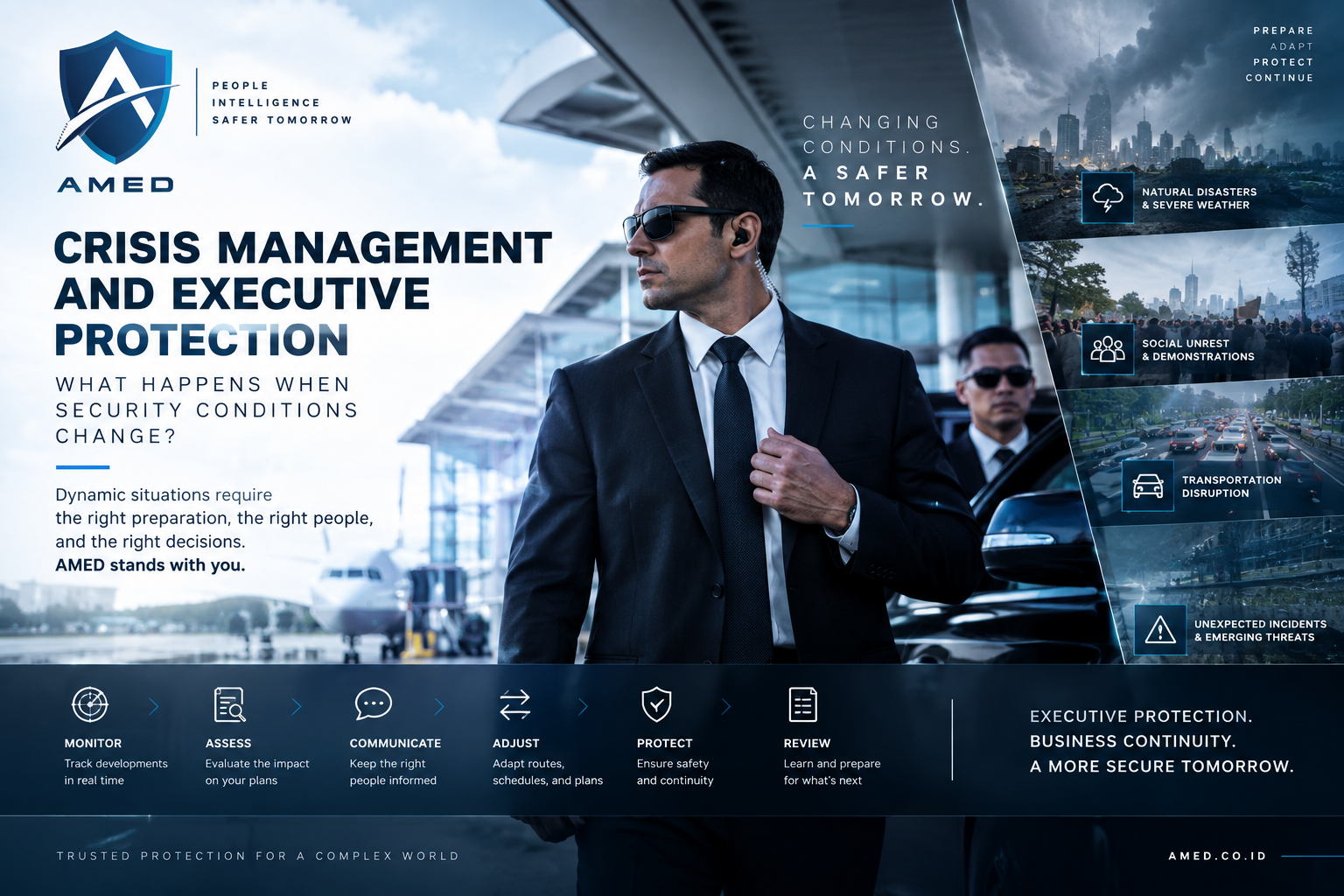
Security conditions do not always remain predictable. An executive may begin a business trip with a carefully prepared itinerary, only for conditions to change because of severe weather, natural disasters, transportation disruption, demonstrations, local incidents, or other unexpected developments.
When this happens, executive protection should not depend only on physical security around the principal. The protection plan needs to adapt.
This is where crisis management executive protection becomes important. It combines situational awareness, threat assessment, secure transportation, route planning, communication, and contingency planning to help executives continue operating while reducing unnecessary exposure to changing conditions.
For companies sending executives, investors, consultants, or senior management across Indonesia, the objective is not to promise that every risk can be eliminated. Instead, the objective is to identify changes early, evaluate their potential impact, and adjust the security plan accordingly.
A practical framework is:
Monitor → Assess → Communicate → Adjust → Protect → Review
What Is Crisis Management in Executive Protection?
Crisis management in executive protection is the process of adjusting security arrangements when the environment around an executive changes.
A protection plan prepared yesterday may no longer be appropriate today.
For example, the original route between an airport and hotel may experience disruption. Severe weather may affect travel. A site visit may be located near an area experiencing a local incident. A natural disaster may affect transportation infrastructure. An executive’s public schedule may also change unexpectedly.
In those situations, the protection team needs to reassess the plan rather than simply continue with the original itinerary.
Therefore, crisis management executive protection should connect several functions:
Threat Assessment → Situational Awareness → Route Planning → Secure Transportation → Communication → Contingency Planning
The exact response depends on the actual situation, location, executive profile, and available information.
What Happens When Security Conditions Suddenly Change?
The first priority is not necessarily to move immediately.
The first priority is to understand what has changed.
Security teams need to determine whether the information is credible, how close the incident is to the executive, whether the planned route or destination is affected, and whether continuing the itinerary creates additional exposure.
Once the situation has been assessed, the protection plan can be adjusted.
The response might involve changing the departure time, selecting another route, moving a meeting, changing the pickup point, coordinating with the destination, remaining temporarily at a secure location, or modifying the itinerary.
The key principle is simple:
Do not react blindly. Assess first, then act.
Why Executive Protection Needs Situational Awareness
Situational awareness is one of the foundations of effective executive protection.
Protection personnel need to understand not only what is happening immediately around the principal but also what could affect the next stage of the journey.
This can include road conditions, access restrictions, weather, local disturbances, crowd activity, transportation disruptions, destination conditions, and other operational factors.
Situational awareness is particularly important for executives whose schedules include several locations in one day.
A small disruption at one location can affect the entire itinerary.
For example:
Airport Delay → Meeting Schedule Changes → Traffic Pattern Changes → Route Changes → Site Visit Changes → Hotel Arrival Changes
That is why executive protection should operate dynamically rather than treating an itinerary as a fixed document.
Current Conditions Show Why Crisis Planning Matters in Indonesia
Indonesia’s geography and operating environment make contingency planning particularly relevant.
Current information from Indonesia’s National Disaster Management Agency, BNPB, provides a practical example.
On 17 September 2026, BNPB reported multiple incidents across Indonesia, including flooding and landslides in Aceh Barat Daya, forest and land fires in several regions, and continuing post-earthquake and tsunami response activities in East Nusa Tenggara.
The same BNPB update reported ongoing forest and land fire management across several priority provinces. In Riau, for example, approximately 20,015.35 hectares of burned land had been recorded from 1 January through 16 September 2026. BNPB also reported thousands of monitored hotspots in Central Kalimantan.
BNPB’s July 2026 disaster bulletin provides another useful indicator. It recorded 165 forest and land fire incidents, representing 71.12% of disaster events reported during that month. The same bulletin recorded 34 drought events, alongside floods, extreme weather, landslides, coastal hazards, and earthquakes.
These figures should not be interpreted as evidence that Indonesia as a whole is unsafe for business travel.
Indonesia is geographically vast, and an event occurring in one province may have little or no effect on an executive operating elsewhere.
Instead, the data demonstrate why security planning needs to be location-specific and time-sensitive.
The right question is not:
“Is Indonesia safe or unsafe?”
A more useful question is:
“What are the current conditions around the executive’s location, destination, route, and schedule?”
1. Reassess the Threat and Its Relevance
When conditions change, the first step is reassessment.
Not every incident requires changing the executive’s itinerary.
A security team should determine the type of incident, location, proximity, potential development, available information, and relevance to the principal.
For example, a natural disaster hundreds of kilometres away may have no direct effect on a meeting in Jakarta.
However, an incident near an airport, industrial facility, hotel, or planned route could require operational changes.
Therefore, the assessment should move from broad information toward specific exposure:
Incident → Location → Proximity → Executive Exposure → Operational Impact → Response
This helps prevent both underreaction and unnecessary overreaction.
2. Reevaluate the Executive’s Route
Route planning becomes particularly important when conditions change.
The fastest route is not automatically the most appropriate route.
Executive protection personnel may consider road access, traffic concentration, choke points, destination access, current incidents, alternative routes, and the availability of safe stopping points.
AMED’s official Executive Protection service specifically lists route planning, threat assessment, situational awareness, and executive escort as elements of its protection services. Its Secure Transportation service also lists route risk management as part of the published service scope.
This is relevant because route planning should not happen only before departure.
Conditions can change during the journey.
The process therefore becomes:
Primary Route → Monitor → Identify Change → Assess → Alternative Route → Continue
3. Adjust Secure Transportation
Transportation is a major part of executive security.
An executive can have professional protection personnel but still face unnecessary exposure if transportation arrangements are poorly coordinated.
Secure transportation considers more than the vehicle itself.
Driver awareness, route planning, pickup and drop-off locations, timing, communication, destination coordination, and contingency options all contribute to the movement plan.
AMED describes its Secure Transportation service as using professional drivers trained in security awareness and publishes services including English-speaking drivers, premium MPV vehicles, route risk management, and airport transfers.
For executives operating in unfamiliar locations, coordinated transportation can also reduce confusion during sudden itinerary changes.
4. Maintain Communication During the Incident
A crisis becomes harder to manage when information is fragmented.
Executives, drivers, protection personnel, corporate management, event organizers, hotel teams, and local contacts may each hold different pieces of information.
The protection function needs a clear communication structure.
A practical model is:
Information Received → Verified → Security Impact Assessed → Decision Made → Relevant Parties Updated
This does not mean distributing sensitive information unnecessarily.
Instead, the goal is to ensure that people responsible for operational decisions have the information they need.
Clear communication becomes especially important when a meeting location, departure time, route, accommodation, or transportation arrangement changes.
5. Prepare Alternative Plans Before They Are Needed
Good crisis management starts before a crisis.
If the team begins searching for alternatives only after a disruption has already occurred, the available options may be limited.
Executive protection planning can therefore consider a primary plan together with realistic alternatives.
For transportation, this may mean identifying alternative routes.
For meetings, it may mean understanding alternative access points or locations.
For accommodation, it can mean assessing how the executive will move if the original itinerary changes.
For regional travel, contingency planning may also consider transport availability and communication.
The principle is:
Plan A → Trigger → Plan B → Escalation Option
However, contingency plans should remain flexible. A pre-planned alternative can also become unsuitable if conditions continue to evolve.
6. Decide Whether to Continue, Delay, Relocate, or Cancel
Not every change in security conditions requires cancellation.
Sometimes changing a route is sufficient.
In another situation, delaying departure may reduce exposure. A meeting could potentially be moved to another location. In more serious circumstances, cancelling an activity may be the appropriate operational decision.
The decision should depend on the actual risk assessment rather than fear, assumptions, or pressure to maintain the original schedule.
A useful decision framework is:
Continue → Modify → Delay → Relocate → Cancel
The appropriate option depends on the nature and severity of the situation.
Executive protection is therefore not about making travel impossible. It is about creating better-informed decisions when circumstances change.
7. Protect Information as Well as Movement
Executive security also involves information discipline.
An executive’s exact location, accommodation, meeting schedule, travel route, and departure time can be sensitive operational information.
During changing conditions, unnecessary distribution of itinerary information can complicate security.
Organizations should consider who actually needs access to the schedule and how itinerary changes are communicated.
This is particularly relevant for high-profile executives, corporate leaders, investors, and individuals whose presence may attract attention.
Physical movement and information management should therefore support each other.
8. Coordinate Security Around Business Activities
Executives rarely travel simply to move between an airport and a hotel.
They may visit factories, plantations, project sites, offices, government institutions, warehouses, construction sites, or business partners.
Each destination creates a different operating environment.
AMED’s official service page describes Business Travel Security for activities including site visits, industrial inspections, business meetings, and regional travel.
This is important because executive protection should support the business objective rather than unnecessarily interfere with it.
A site visit, for example, may require different planning from a formal meeting in a central Jakarta office.
The security plan should adapt to the activity.
Crisis Management Is More Than Emergency Response
One misconception is that crisis management begins only when something serious happens.
In professional security planning, crisis management starts earlier.
Monitoring, threat assessment, route planning, communication, and contingency preparation are all preventive components.
The objective is to identify a developing problem before it becomes an emergency around the principal.
This creates a more useful sequence:
Prevention → Detection → Assessment → Response → Recovery → Review
After an incident, the team should also review what happened.
Were information channels effective? Did route alternatives work? Were decision-makers informed quickly enough? Did the itinerary expose any weakness in planning?
Lessons from one operation can improve the next.
Executive Protection Is Not Just a Bodyguard
The traditional image of executive protection often focuses on a bodyguard standing beside an executive.
Modern executive protection involves much more.
Protection may include advance planning, threat assessment, situational awareness, secure transportation, route planning, destination coordination, executive escort, and emergency response coordination.
AMED’s published Executive Protection service reflects this broader approach. The company lists executive protection officers, secure transportation, business travel security, route planning, situational awareness, and travel coordination within its service offering.
Therefore, effective protection can begin long before the executive arrives at the destination.

Legal Compliance, Security, Transparency, and Trust
Security services should operate within applicable laws, contractual arrangements, and defined responsibilities.
Legal compliance does not automatically guarantee effective protection. At the same time, security capability should never be treated as a substitute for legal compliance.
The two need to work together.
Transparency is also important.
Corporate clients should understand the scope of the service, personnel involved, transportation arrangements, responsibilities, communication procedures, and limitations of the security plan.
A useful relationship is:
Legal Compliance → Clear Scope → Security Procedures → Operational Quality → Transparency → Client Trust
In this context, “quality” refers to the quality of security operations and service delivery rather than product manufacturing.
No security provider can responsibly promise that every threat or disruption will be eliminated.
A more credible objective is to reduce avoidable exposure, improve preparedness, and support informed decisions.
Expertise AMED in Executive Protection in Indonesia
AMED Corporate Protection & Business Investigation publishes dedicated Executive Protection services for executives operating in Jakarta, Bali, and other locations across Indonesia.
According to its official service page, AMED’s Executive Protection Officers provide threat assessment, situational awareness, route planning, and executive escort.
The same page describes Secure Transportation with security-aware drivers, premium MPV vehicles, route risk management, and airport transfer support.
AMED also publishes Business Travel Security services covering site visits, industrial inspections, business meetings, and regional travel.
For corporate clients, this combination is relevant because security conditions do not exist separately from transportation and business activity.
Protection needs to connect:
Executive → Vehicle → Route → Destination → Schedule → Communication → Contingency
You can review the service directly through AMED Executive Protection.
Importantly, these descriptions reflect services published by AMED on its official website. They should not be interpreted as an independent guarantee of a particular security outcome.
When Should a Company Consider Executive Protection?
Executive protection may be considered when the executive’s profile, destination, activities, schedule, exposure, or operating environment creates a need for additional security planning.
This may apply to foreign executives visiting Indonesia, investors conducting site visits, senior management attending sensitive meetings, corporate teams traveling between regions, or executives operating during periods of changing local conditions.
However, protection needs should be determined through risk assessment rather than job title alone.
A CEO does not automatically require the same level of protection in every situation.
Likewise, a less publicly visible employee could face higher exposure during a particular site visit or assignment.
The protection plan should therefore follow the risk.
FAQ: Crisis Management Executive Protection
What is crisis management executive protection?
Crisis management executive protection combines executive security with monitoring, threat assessment, situational awareness, route planning, secure transportation, communication, and contingency planning when conditions change.
What happens if security conditions change during executive travel?
The security team should reassess the situation, determine its relevance to the executive, review the route and destination, communicate changes, and decide whether the itinerary should continue, be modified, delayed, relocated, or cancelled.
Does executive protection mean using an armed bodyguard?
Not necessarily. Executive protection is broader than the presence of a bodyguard. The service can include risk assessment, route planning, secure transportation, situational awareness, travel coordination, and protective personnel depending on the assessed need and applicable rules.
Why is route planning important for executive protection?
Routes can change because of traffic, weather, road restrictions, local incidents, crowd activity, or emergencies. Route planning allows the protection team to assess alternatives and reduce unnecessary exposure during movement.
Can executive protection support business trips in Indonesia?
Yes. AMED publishes Business Travel Security services for site visits, industrial inspections, business meetings, and regional travel, alongside Executive Protection and Secure Transportation services.
Can an executive protection service guarantee complete safety?
No security service can responsibly guarantee that every incident will be prevented. Executive protection is designed to identify risks, improve preparedness, reduce avoidable exposure, and support informed responses when conditions change.
When should a company prepare a crisis plan?
Ideally, before the executive travels. Preparing communication channels, routes, transportation, destination information, and contingency options in advance can provide more flexibility if conditions change.
Prepare Before Conditions Change
The most effective time to think about a crisis is before it happens.
A strong crisis management executive protection approach does not wait for an incident before considering routes, communication, transportation, and alternative plans.
It continuously asks:
What has changed? → Does it affect the executive? → What should we adjust?
Recent BNPB data demonstrates why this flexibility matters in Indonesia. Different regions can experience different hazards at the same time, while conditions can change rapidly. This makes location-specific assessment more useful than broad assumptions about the country as a whole.
For executives, foreign investors, corporate leaders, and companies planning business activities in Indonesia, AMED provides published services covering executive protection, secure transportation, route risk management, and business travel security.

For information about the broader EFBA business ecosystem, visit PT EFBA Digital Mulia.
The objective is not to create fear around business travel. It is to ensure that when conditions change, people, information, transportation, and decisions can change with them.