
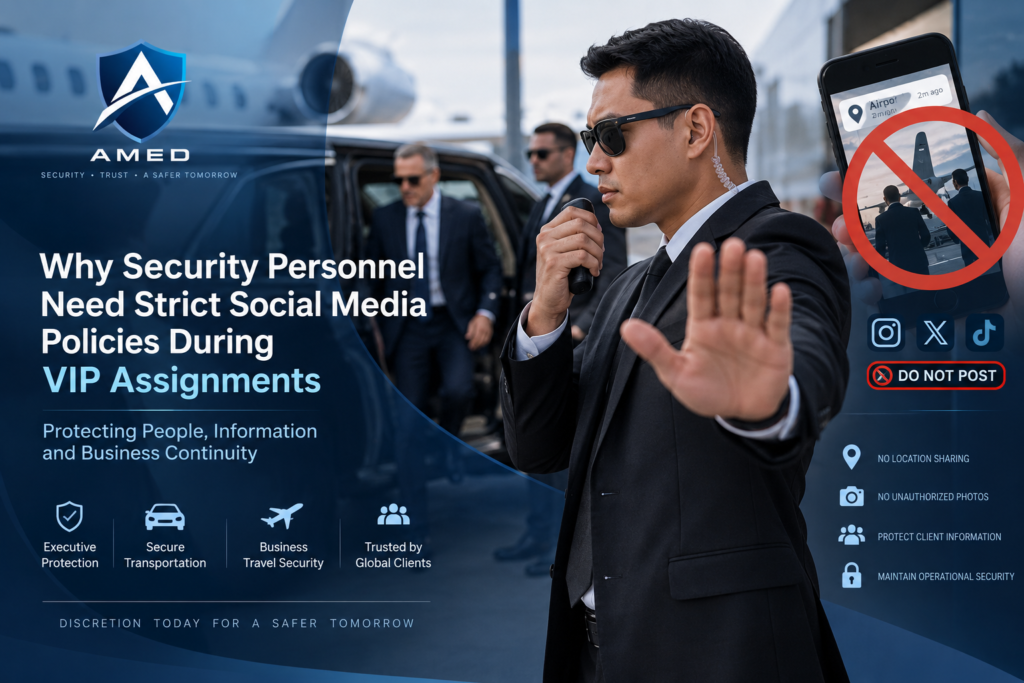
VIP protection does not only depend on physical security. Security teams also need to control information about locations, travel plans, vehicles, meetings, accommodation, and the movements of the people they protect.
A photo at an airport, hotel, business venue, or inside a vehicle may look harmless. However, the image could reveal a location, schedule, security arrangement, vehicle detail, or travel pattern.
For this reason, a security personnel social media policy should form part of operational discipline during VIP assignments. The goal is not simply to restrict social media use. It is to reduce unnecessary exposure of information that could affect the client, security team, or assignment.
CISA advises individuals to limit personal information online and review privacy and location-tagging settings. Its guidance also notes that location data, employment information, vehicle details, and photos can provide useful information to malicious actors.
Why Do Security Personnel Need a Social Media Policy?
A security personnel social media policy helps security teams control what personnel can share before, during, and after a VIP assignment. The policy can cover photographs, locations, itineraries, vehicles, client information, travel plans, and other operational details.
This matters because several small pieces of public information can create a larger picture. Someone may combine a hotel photo, airport post, vehicle image, and meeting location to understand a VIP’s movements.
CISA’s operational security guidance recommends avoiding public posts about work activities, travel plans, schedules, and locations. It also recommends avoiding real-time photos that make a location obvious.
A practical approach is:
Information → Exposure → Pattern → Vulnerability → Security Risk
1. Social Media Can Reveal a VIP’s Location
Real-time location exposure creates an obvious concern during VIP assignments. Security personnel should therefore avoid posting from hotels, airports, restaurants, meeting venues, site visits, or other locations connected with the client.
The risk does not come only from a visible location tag. A photo may contain landmarks, signs, room details, vehicles, or other visual clues. These details can help someone identify a location.
CISA recommends limiting unnecessary location services and reviewing privacy settings. It specifically highlights the risk of others using digital information to track movements or identify places of work and residence.
For security personnel, the principle should remain simple:
No Operational Need → No Real-Time Location Sharing
2. Photos Can Expose More Than the Person in the Image
Security personnel should review the entire image before sharing a photograph. The background can reveal as much information as the main subject.
For example, a photograph may expose a hotel entrance, vehicle, badge, meeting venue, access point, colleague, or other operational detail. Several images can also reveal patterns when people compare them over time.
CISA recommends protecting sensitive physical security information and reviewing materials for accidental disclosure. Its operational security guidance also advises against sharing real-time photos that make sensitive locations obvious.
Security teams should therefore ask one question before sharing content: What could an outsider learn from this image?
3. Travel Posts Can Reveal Movement Patterns
VIP assignments often involve airport transfers, business meetings, hotel transfers, site visits, industrial inspections, and regional travel. AMED specifically lists these activities within its executive protection and business travel security services.
Security personnel should avoid publicly announcing the client’s next destination or current travel status. Posts about airport departures, hotels, meeting locations, or upcoming trips can create unnecessary information exposure.
This is especially relevant when a protection plan includes route planning and travel coordination. AMED lists threat assessment, situational awareness, route planning, executive escort, secure transportation, and route risk management among its protection capabilities.
The relationship is straightforward:
Location → Timing → Route → Movement → Security
Protecting travel information supports the wider protection plan.
4. Security Personnel Should Avoid Unauthorized VIP Photos
A photograph with a VIP may appear to be normal professional documentation. However, personnel should consider confidentiality and operational security before sharing it.
The concern extends beyond the VIP’s identity. The photograph may show the location, vehicle, security team, meeting environment, or another detail connected with the assignment.
A clear security personnel social media policy can establish an authorization process for assignment-related content. Companies can then separate approved corporate documentation from personal social media activity.
A practical rule is:
No Authorization → No Posting
This approach gives personnel a clear standard instead of requiring them to make individual judgments during an assignment.
5. Personal Social Media Accounts Can Still Create Risk
A personal account does not automatically separate someone from a professional assignment. Employment details, uniforms, badges, vehicles, colleagues, locations, and recurring travel posts can still reveal useful information.
CISA notes that employment, family, vehicle, location, and other personal information may hold value for criminals or hostile parties. It also advises users to regularly review social media privacy and location settings.
Companies should therefore define how their policy applies to personal accounts when employees discuss or document professional assignments.
The objective is not to control unrelated private activity. The policy should focus on information that connects personal social media activity with sensitive professional operations.
6. Apply the Policy Before, During, and After the Assignment
Information security should begin before the VIP arrives. Personnel may already know travel dates, meeting locations, hotel arrangements, vehicles, or other assignment details.
During the assignment, teams need to control photographs, location sharing, travel information, and client details. After the assignment, confidentiality may still matter because old posts can reveal operational patterns.
CISA also warns that deleting content does not guarantee that the information disappears. Other users may already have viewed, saved, or shared it.
Companies can therefore apply the following cycle:
Before Assignment → During Assignment → After Assignment → Continued Confidentiality
7. Create Clear Rules Instead of Vague Restrictions
Telling personnel to “avoid sensitive posts” leaves too much room for interpretation. A professional policy should explain what the company considers sensitive information.
The policy can address client identity, itineraries, hotels, meeting locations, routes, vehicles, security procedures, team members, photographs, and internal communications. It should also explain who can authorize public content.
CISA recommends organizational guidelines that protect sensitive information from accidental release. It also recommends regular awareness training for staff.
Companies can structure the decision process as:
Information → Sensitivity Review → Authorization → Publication Decision
This structure gives personnel a practical process to follow.
8. Include Social Media Risk in Security Briefings
A written policy works better when personnel understand why the rules exist. Before an assignment, supervisors can include digital information exposure in operational briefings.
The discussion can cover geotagging, photography, client information, vehicle details, itinerary confidentiality, and personal accounts. Teams can also review realistic examples of posts that appear harmless but expose operational information.
CISA recommends regular awareness training to help staff understand sensitive information and opportunities for exploitation.
Security organizations can apply:
Policy → Briefing → Awareness → Assignment → Review
This process turns social media discipline into part of normal operational preparation.
9. Social Media Discipline Supports Executive Protection
Social media policy should not operate separately from the protection plan. It should support situational awareness, travel coordination, route planning, and information control.
AMED provides executive protection for executives, expatriates, investors, and business travelers operating in Indonesia. Its services combine discreet personal protection, secure transportation, route planning, and situational awareness.
AMED also supports security coordination for business meetings, airport transfers, site visits, industrial inspections, and regional travel. These activities can involve sensitive information about movement and business schedules.
For this reason, teams can connect:
People → Information → Movement → Location → Protection
Controlling information helps support the broader security operation.
10. Companies Need Procedures, Not Only Individual Discipline
Personnel play an important role, but companies should not depend entirely on individual judgment. Management can establish rules, responsibilities, approval processes, and training.
This approach also connects security management with wider business operations. EFBA Consulting describes its expertise across business strategy, marketing, finance, and operations. The company states that it has supported businesses since 2013 and includes system and operational development within its consulting scope.
EFBA Consulting also describes services such as Operational Health Check and SOP Development. Its operational consulting approach focuses on practical systems and processes rather than relying only on informal working habits.
For companies managing VIP assignments, the same management principle can support internal controls:
Risk Identification → SOP → Personnel Briefing → Implementation → Monitoring → Evaluation
What Should a Security Personnel Social Media Policy Include?
A practical policy should clearly identify information that personnel need to protect. It should also define when personnel need approval and who can provide that approval.
The policy can address VIP Identity → Location → Itinerary → Hotel → Vehicle → Route → Security Team → Photos → Internal Communication → Client Information → Authorization.
Companies should also establish procedures for incidents. If someone accidentally shares sensitive information, personnel should know whom to contact and what immediate action the organization expects.
This approach supports operational consistency. Personnel do not need to guess whether specific information is appropriate for public sharing.
AMED Expertise in Executive Protection and Business Travel Security
AMED focuses on supporting executives, expatriates, investors, and business travelers who need professional security while operating in Indonesia. The company combines executive protection with secure transportation, route planning, and situational awareness.
AMED’s published services include Executive Protection Officers, Secure Transportation, and Business Travel Security. Its protection scope covers threat assessment, situational awareness, route planning, executive escort, airport transfers, site visits, business meetings, industrial inspections, and regional travel.
This scope is particularly relevant for foreign business owners and investors who may need local coordination while attending meetings or exploring business opportunities in Indonesia. AMED also states that clients can combine executive protection with Business Consultation and Business Investigation for investment, meetings, or market exploration.
Readers can explore AMED Executive Protection for details about the company’s published protection services.
How EFBA’s Business Experience Supports Operational Management
Security policies also require management systems. Companies need clear procedures, staff responsibilities, implementation, and periodic evaluation.
EFBA Consulting states that it has supported businesses since 2013. Its current consulting areas include business strategy, marketing, finance, operations, and business development.
EFBA’s approach to business risk also connects diagnosis with implementation. Its published framework follows Business Diagnosis → Problem Identification → Root Cause Analysis → Risk Mapping → Priority → Strategy → Implementation → Monitoring → Evaluation.
For security organizations, this business-management perspective can support the development of internal policies and SOPs. It does not replace professional security expertise. Instead, it helps management structure responsibilities, procedures, monitoring, and evaluation.
Companies that need broader business support can learn more through EFBA Business Consulting. EFBA states that its consulting experience includes business management, financial planning, and strategic business development.
FAQ About Security Personnel Social Media Policy
Can security personnel post photos during a VIP assignment?
Security personnel should follow company policy and client authorization before posting assignment-related photos. An image can reveal locations, vehicles, colleagues, access points, or other operational information.
A clear authorization process helps personnel distinguish approved corporate documentation from personal social media content.
Why is geotagging risky during VIP protection?
Geotagging can reveal where personnel or clients are located. Other visual or contextual information may make the location even easier to identify.
CISA recommends limiting unnecessary location services and reviewing privacy and location-tagging settings to reduce exposure.
Should a social media policy cover personal accounts?
Yes, when personal posts can expose professional assignments. Companies should clearly define which assignment-related information personnel cannot share through personal accounts.
The policy should focus on operational information rather than unrelated private activity.
Can security personnel post after an assignment ends?
The end of an assignment does not automatically make all information safe to publish. Old photographs can still reveal locations, security arrangements, vehicles, or recurring operational patterns.
Personnel should continue to follow confidentiality requirements and company authorization procedures.
What information should security personnel avoid sharing?
Personnel should protect sensitive information such as real-time locations, itineraries, hotels, routes, client details, security procedures, vehicles, and internal communications. Companies should define these categories clearly in their policies.
Clear rules reduce uncertainty and help personnel make consistent decisions.
Does AMED provide executive protection for foreign business travelers in Indonesia?
Yes. AMED states that its executive protection services support executives, expatriates, investors, and business travelers in Indonesia. Its published services include personal protection, secure transportation, route planning, situational awareness, and business travel security.
Protect the VIP by Protecting Information
VIP security involves more than physical proximity to the client. Teams also need to protect information about locations, movements, meetings, vehicles, travel schedules, and operational procedures.
A strong security personnel social media policy helps organizations turn that responsibility into a clear system. Companies can connect Policy → Briefing → Information Control → Assignment → Monitoring → Evaluation to support consistent operational discipline.

For executives, investors, expatriates, and business travelers operating in Indonesia, AMED provides executive protection, secure transportation, route planning, and business travel security. Visit AMED Executive Protection to review the service scope.