
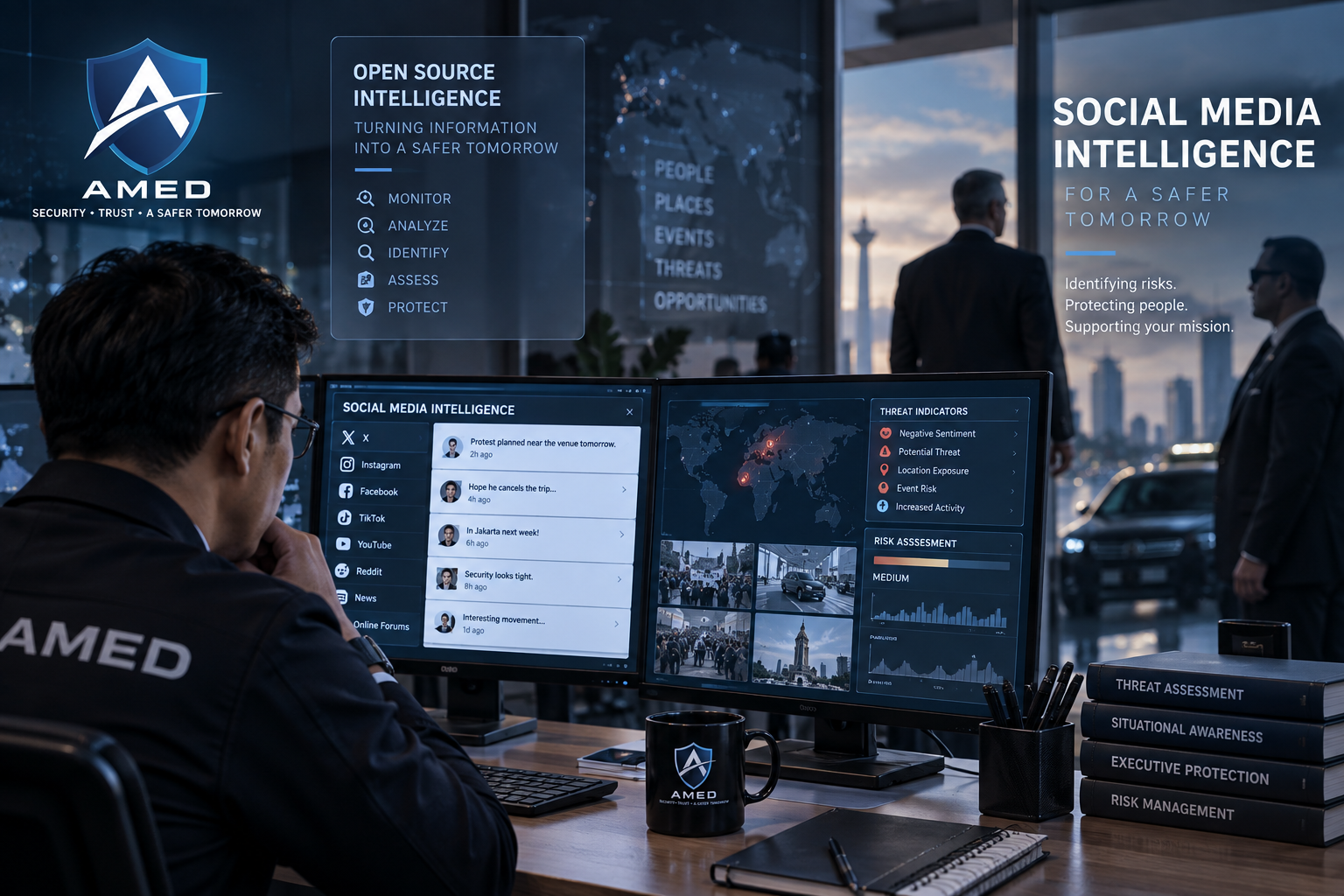
Threats against executives and VIPs do not always begin with direct physical contact. In some cases, warning signs may first appear through public social media posts, online discussions, threatening messages, unusual interest, or information about planned events.
For this reason, protective intelligence social media has become relevant to modern executive protection. Security teams can review lawful, publicly available information to identify potential concerns. In addition, this information can help teams understand the surrounding environment and support threat assessment.
The U.S. Secret Service provides a real-world example of this approach. Its Open Source Intelligence Branch analyzes publicly available information to support protective operations. Moreover, the branch uses open-source research to improve situational awareness, develop investigative leads, and support protective intelligence activities.
However, security teams should not automatically treat every negative comment as a credible threat. Instead, they need context, verification, assessment, and appropriate escalation before reaching a conclusion.
A practical framework is:
Public Information → Detection → Verification → Context → Risk Assessment → Protective Decision
What Is Protective Intelligence Social Media?
Protective intelligence social media refers to the structured review and analysis of relevant, publicly available social media information. Security teams use this process to support protective decision-making and improve their understanding of potential concerns.
For executive and VIP protection, the objective goes beyond collecting posts. Instead, security teams need to determine whether online information relates to a person, location, journey, meeting, or upcoming activity.
The U.S. Secret Service has documented its use of publicly available social media information for protected persons, sites, and events. For example, analysts can combine protectee names with threatening or concerning terms when searching for relevant information.
Therefore, teams should distinguish basic social media monitoring from protective intelligence:
Social Media Monitoring ≠ Protective Intelligence
Protective intelligence requires a structured analysis process:
Information → Relevance → Context → Assessment → Action
1. Social Media Can Provide Early Indicators of Threats
Some threats appear online before they develop into offline incidents. For example, users may post direct threats, hostile statements, fixation, event-related discussions, or other concerning material.
The FBI recognizes social media as one channel through which people communicate threats. Its guidance also covers electronic threats sent through social media, direct messages, email, and other digital channels. Therefore, recipients should preserve relevant information and report it appropriately.
Security teams still need to distinguish general criticism from information that requires closer assessment. After all, a single hostile comment does not automatically indicate intent or capability.
Instead of making an immediate conclusion, teams can ask:
What was posted? → Who posted it? → What is the context? → Is there a specific target? → Does it require escalation?
As a result, security teams can assess online information more systematically. This process also helps reduce both underreaction and unnecessary alarm.
2. Protective Intelligence Looks for Context, Not Just Keywords
Keyword monitoring alone can produce large amounts of irrelevant information. For instance, words such as “attack,” “kill,” or “target” may appear in jokes, news discussions, gaming conversations, political debate, or unrelated content.
Therefore, analysts need context rather than keywords alone. They must examine how a term appears, who uses it, and whether the information has relevance to the protected person or assignment.
The U.S. Secret Service’s documented open-source work illustrates this principle. Its analysts conduct broader searches before narrowing their attention toward material with potential protective-intelligence relevance.
For corporate protection, the same principle can guide the assessment process. Instead of drawing conclusions from isolated posts, teams should examine the wider context and available supporting information.
A more useful process is:
Keyword → Context → Source → Behavior → Relevance → Assessment
Ultimately, the goal is to identify information that may influence protection planning. Therefore, teams should not classify every hostile online statement as a threat without further assessment.
3. Social Media Can Support Situational Awareness Before VIP Activities
Executives and foreign business owners may travel for meetings, site visits, industrial inspections, investment discussions, or regional business activities. Consequently, security conditions may change according to the destination, schedule, and surrounding environment.
Before these activities, publicly available information can contribute to situational awareness. For example, relevant information may include planned demonstrations, disruptions, event activity, or credible public threats connected with a location.
The U.S. Secret Service has used open-source social media analysis before major events. Analysts reviewed organizers, relevant hashtags, expected participation, and publicly visible indicators of planned activity. As a result, the intelligence supported situational awareness for protective operations.
This concept also aligns with AMED’s published executive protection scope. AMED lists threat assessment, situational awareness, route planning, executive escort, secure transportation, and business travel security among its services for executives operating in Indonesia.
Therefore, a protection team may follow this workflow:
Destination → Current Environment → Potential Disruption → Route Assessment → Movement Plan → Monitoring
This approach connects online information with practical protection planning. More importantly, it helps the team evaluate whether changing conditions require operational adjustments.
4. Online Threats Need Verification Before Action
Social media moves quickly, but speed does not guarantee accuracy. For example, anonymous accounts, recycled images, impersonation, rumors, misleading posts, and incomplete context can create false signals.
For this reason, security teams should verify information before using it to support operational decisions. They can compare the information with other available sources. In addition, teams should examine its relevance to the specific person, location, or assignment.
DHS describes open-source intelligence as useful for understanding threats and vulnerabilities. At the same time, its policy stresses a measured approach that respects privacy, civil rights, and civil liberties.
Therefore, corporate security teams also need a structured verification process:
Post Found → Source Review → Context Check → Corroboration → Risk Assessment
Ultimately, protective intelligence should improve decision-making rather than amplify online rumors. A structured assessment helps teams separate relevant information from noise.
5. Public Information Can Reveal Threats Around Locations and Events
Executives do not operate in isolation. Instead, their risk environment can change according to the location, event, meeting, public profile, and surrounding activity.
For example, a protection team preparing for a business meeting may review public developments that could affect access or movement. However, not every online discussion requires a security response. The team still needs to determine whether the information has operational relevance.
The U.S. Secret Service states that its open-source capability supports protected persons, places, and events. Moreover, its analysts use publicly available information to strengthen situational awareness and support protective operations.
Therefore, teams can connect several factors when assessing the environment:
Person → Place → Event → Online Environment → Risk Context → Protection Plan
This process gives online information a clear operational purpose. As a result, teams can focus on information that may influence protection planning instead of monitoring unrelated online activity.
6. Social Media Intelligence Can Support Route and Travel Planning
Travel creates changing exposure for executives and VIPs. Therefore, a route that works under normal conditions may require reconsideration when the surrounding environment changes.
AMED’s executive protection service includes advance route planning and route risk management. In addition, the company provides security coordination for airport transfers, site visits, industrial inspections, business meetings, and regional travel.
Relevant public information can provide additional context for these activities. For example, security teams may review developments that could affect a destination, access point, meeting location, or travel environment.
However, teams should not rely on social media as the only source for route decisions. Instead, they can combine relevant public information with threat assessment, situational awareness, and operational planning.
A broader process can follow:
Threat Assessment → Situational Awareness → Route Planning → Movement → Monitoring → Adjustment
As a result, intelligence remains connected to operational requirements. This approach also allows security teams to review changing conditions throughout the assignment.
Relevant public information can add context to this planning. Security teams may review developments that could affect the destination, access, or travel environment.
However, social media should remain one information source rather than the sole basis for route decisions.
A broader approach is:
Threat Assessment → Situational Awareness → Route Planning → Movement → Monitoring → Adjustment
This approach keeps intelligence connected to operational requirements.
7. Security Teams Should Preserve Relevant Threat Information
When a direct electronic threat appears, deleting or casually forwarding it can complicate further assessment.
The FBI recommends preserving electronic threats. Its guidance advises recipients not to delete threatening messages and to retain information such as the sender, date, time, and message details before notifying the appropriate authorities.
For a corporate security team, internal escalation procedures should therefore define what personnel need to preserve and who needs to receive the information.
A simple process can follow:
Detect → Preserve → Document → Escalate → Assess → Respond
If the threat indicates immediate danger, the priority shifts from routine intelligence analysis toward emergency response and appropriate authorities.
8. Publicly Available Information Can Also Reveal Target Vulnerabilities
Social media intelligence has another side. Threat actors can also use public information about executives.
The FBI warned in 2025 that perpetrators involved in swatting may compile sensitive information from multiple publicly available sources, including online accounts. They can use this information to develop invasive profiles of intended targets.
For executives and foreign business owners, this reinforces the need to consider digital exposure alongside physical protection.
Public posts can reveal business travel, family information, offices, vehicles, meeting locations, routines, or other details. Security teams should therefore consider both:
Threat Intelligence → What others are saying
and
Exposure Assessment → What others can learn about the executive
Together, these perspectives provide a stronger foundation for protective planning.
9. Protective Intelligence Should Respect Privacy and Legal Boundaries
Social media intelligence does not mean unrestricted surveillance.
Organizations need clear rules regarding what information they collect, why they collect it, who can access it, and how long they retain it. Teams should focus on lawful and relevant information that supports a legitimate security requirement.
DHS explicitly recognizes this balance. Its open-source intelligence policy notes the intelligence value of publicly available information while also emphasizing privacy, civil rights, and civil liberties.
For private-sector protection, organizations should also consider the laws and contractual requirements that apply to their jurisdiction and assignment.
A responsible framework is:
Purpose → Lawful Source → Relevance → Minimum Necessary Information → Controlled Access → Review
10. Protective Intelligence Works Best When Connected to Human Assessment
Technology can help teams discover information, but software cannot replace professional judgment.
A social media alert may identify a keyword or account. A trained professional still needs to determine whether the information has relevance, credibility, and operational significance.
The U.S. Secret Service’s model demonstrates this human component. Its Open Source Intelligence Branch uses trained specialists and agents to conduct research and support protective operations.
For corporate executive protection, the principle remains similar:
Technology Finds → Analyst Reviews → Security Team Assesses → Operations Respond
This reduces the risk of allowing automated alerts to dictate protection decisions without context.
How Can Social Media Intelligence Support Foreign Executives in Indonesia?
Foreign executives, investors, expatriates, and business owners often operate in unfamiliar environments. Their schedules may include airport transfers, business meetings, factory inspections, site visits, investment discussions, and regional travel.
Local situational awareness can therefore become an important part of travel preparation.
AMED states that its executive protection services support executives, expatriates, investors, and business travelers in Jakarta, Bali, and across Indonesia. Its services combine personal protection, secure transportation, route planning, and situational awareness.

AMED also allows clients to combine executive protection with Business Consultation and Business Investigation when conducting investments, meetings, or market exploration in Indonesia.
This creates a broader support model for foreign business activity:
Business Objective → Local Information → Risk Context → Travel Planning → Protection → Business Activity
The exact scope should always follow the client’s assignment, location, and agreed service.
AMED Expertise in Executive Protection and Situational Awareness
AMED’s published executive protection service focuses on practical support for executives operating in Indonesia. Its scope includes threat assessment, situational awareness, route planning, executive escort, secure transportation, and travel coordination.
For business travel, AMED specifically lists site visits, industrial inspections, business meetings, and regional travel. Its secure transportation offering also includes route risk management and airport transfers.
These capabilities make protective intelligence relevant as an input to the wider protection process. The intelligence itself does not provide protection. Teams need to translate relevant information into operational decisions.
The relationship can follow:
Information → Assessment → Situational Awareness → Planning → Protection → Review
Readers can learn more through AMED Executive Protection.
How EFBA’s Experience Supports Business Risk Assessment
Executive risk can also intersect with broader business decisions. Foreign owners and investors may need to evaluate operational conditions, business partners, expansion plans, internal systems, and other commercial risks alongside travel security.
EFBA approaches business risk through identification, analysis, prioritization, response, monitoring, and evaluation. Its published risk-management framework also examines how risks across finance, operations, suppliers, markets, regulation, and strategy can affect one another.
EFBA Consulting adds business strategy, marketing, finance, operations, and business development capabilities. Its website states that the consulting practice has supported businesses since 2013 and publishes client documentation across several industries.
This experience does not make EFBA a protective-intelligence agency. Instead, it provides a complementary business perspective when a foreign executive needs to understand operational or commercial risk.
For example:
Business Information → Verification → Risk Mapping → Priority → Decision → Monitoring
This framework can complement AMED’s security-oriented process when an assignment also involves investment, market exploration, or business evaluation.
Foreign business owners who need wider business support can review EFBA Business Risk Management and EFBA Consulting.
FAQ About Protective Intelligence Social Media
What is protective intelligence social media?
Protective intelligence social media involves reviewing relevant publicly available social media information to support threat assessment and protective decision-making.
The process requires context and verification. Security teams should not treat every negative post or keyword as evidence of a credible threat.
Can social media help identify threats against executives?
Yes. Public posts can provide information about direct threats, concerning behavior, planned disruptions, or developments around an event or location.
The U.S. Secret Service uses publicly available social media information as one source for protective intelligence and situational awareness.
Does a negative social media comment mean someone is dangerous?
No. A negative comment alone does not establish intent, capability, or a credible threat.
Security teams need to examine context, relevance, available corroboration, and other indicators before deciding how to respond.
What should an executive do after receiving an online threat?
Preserve the message and its identifying details. Do not delete potentially relevant electronic evidence.
The FBI recommends documenting electronic threats and notifying law enforcement when appropriate. Immediate physical danger requires an immediate emergency response.
Is monitoring public social media the same as surveillance?
Not necessarily. Protective intelligence can use publicly available information for a defined security purpose. However, organizations still need appropriate privacy, legal, access, and information-handling controls.
DHS guidance emphasizes balancing open-source intelligence needs with privacy and civil-liberties protections.
Does AMED provide threat assessment for executives in Indonesia?
AMED lists threat assessment as part of its executive protection service. The same service includes situational awareness, route planning, executive escort, secure transportation, and business travel security.
Can AMED support foreign investors during business activities in Indonesia?
AMED states that its executive protection services support executives, expatriates, investors, and business travelers. Clients can also integrate protection with Business Consultation and Business Investigation during investment, meetings, or market exploration.
From Online Information to Better Protective Decisions
Social media can provide useful information about threats, disruptions, locations, and the wider environment around an executive. However, collecting information alone does not create effective protective intelligence.
Security teams need a disciplined process:
Detect → Verify → Assess → Prioritize → Plan → Protect → Monitor
A strong protective intelligence social media process combines public information with human analysis, situational awareness, and operational judgment. It also respects privacy and legal boundaries.
For executives, expatriates, investors, and business travelers operating in Indonesia, AMED provides executive protection, secure transportation, threat assessment, route planning, and business travel security. Clients can review the scope through AMED Executive Protection.