
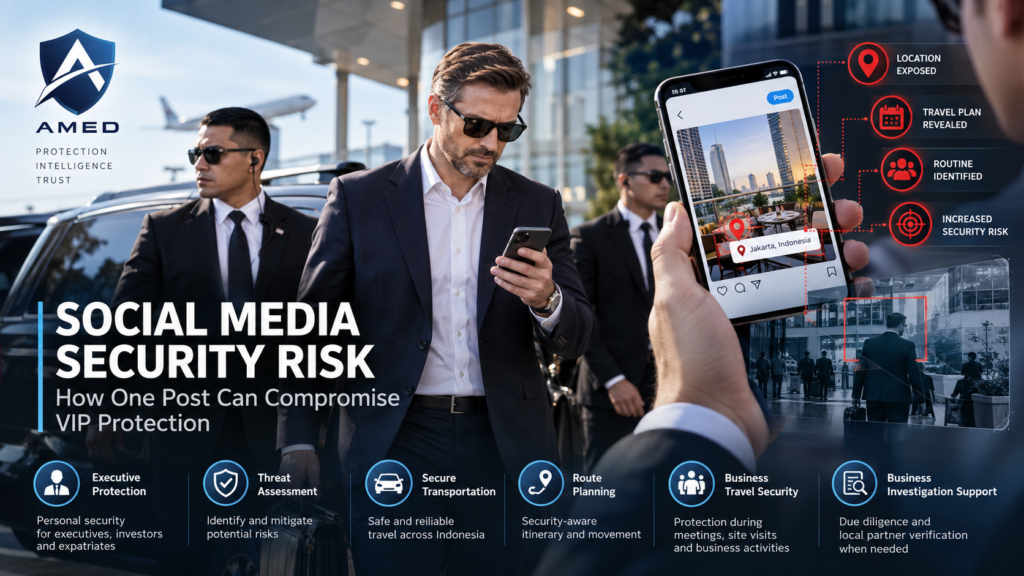
A single social media post can create a social media security risk when it reveals a VIP’s current location, hotel, travel schedule, vehicle, business meeting, companions, or predictable routine. For executives and international business travelers, seemingly harmless content can become useful information for anyone trying to understand where the principal is, where they are going, and how they move.
The risk is not limited to an executive’s personal account. Employees, family members, event organizers, business partners, drivers, assistants, or people taking photographs nearby may unintentionally reveal information about the principal.
For VIP protection, the basic exposure chain is:
Post → Information → Location → Pattern → Vulnerability → Security Risk
This is why executive protection should consider both the physical environment and the information already available online.
Why Can One Social Media Post Become a VIP Security Risk?
A post does not need to contain confidential documents to create risk. A photograph may reveal a hotel entrance, meeting venue, vehicle, airport terminal, badge, office layout, or recognizable landmark.
Multiple posts can create an even clearer picture.
Photo + Location + Time + Companion + Routine = Pattern of Life
The FBI has warned that photographs can contain or reveal information about where people live, work, travel, and spend time. It also notes that historical image data can contribute to a person’s “pattern of life,” even when the information is not posted in real time. FBI
For VIP protection teams, that distinction matters. The security problem is not simply what one photo says explicitly, but what someone could learn by combining multiple pieces of public information.
7 Social Media Security Risks for Executives and VIPs
1. Real-Time Posts Can Reveal a VIP’s Location
Posting from a hotel, airport, restaurant, conference, office, or private event can reveal where an executive is at that moment.
Even without an explicit location tag, the background may contain identifiable signs, architecture, landmarks, badges, screens, room numbers, or venue branding. CISA guidance advises users not to broadcast location and warns that location or geotagging features can expose where a person is. CISA
For executive travel, the safer principle is:
Capture Now → Review → Publish Later
Delayed publication can reduce the connection between online content and a principal’s live movement.
2. Travel Posts Can Expose Future Movement
A business-class boarding pass, airport lounge photo, hotel reservation, conference invitation, or caption such as “Flying to Jakarta tomorrow” may appear harmless.
However, those details can disclose destination, timing, event attendance, and travel plans. FBI travel-security guidance specifically recommends avoiding posts about flights, hotel reservations, specific activities, and location check-ins while traveling. FBI
For a protected executive, the problem becomes:
Travel Information → Expected Location → Expected Time → Predictable Movement
Therefore, upcoming travel information should receive the same security consideration as the physical itinerary.
3. Repeated Posts Can Reveal Routine
One restaurant photo may reveal little. Twenty photographs from the same restaurant every Friday can reveal a behavioral pattern.
Likewise, repeated posts can expose regular office hours, gym visits, preferred hotels, airport routes, recurring meetings, family locations, or weekend activities.
The FBI has noted that historical location information can help reveal day-to-day habits and where a person may be found at particular times. FBI
This means protection teams should think beyond individual posts:
Individual Post → Repetition → Pattern → Predictability → Exposure
Predictability can matter in executive protection because route planning and situational awareness depend partly on controlling unnecessary exposure.
4. Photos Can Reveal More Than the Caption
The caption may say “Great meeting today,” while the photograph reveals much more.
A careful viewer might identify a meeting room, company logo, visitor badge, vehicle, access card, laptop screen, hotel, document, floor plan, or other contextual information. Metadata may also contain time, date, and geographic information depending on the device, platform, and how the image is shared. FBI
Therefore, security review should consider:
Subject → Background → Documents → Screens → Location → Metadata → Timing
A social media security review should examine the entire image rather than the written caption alone.
5. Family and Staff Can Create Indirect Exposure
Executives are not the only people who publish information about their movements.
Family members may share holiday photos. Employees may post behind-the-scenes content. Event organizers may tag a VIP. Business partners may publish meeting photographs immediately after they are taken.
CISA recommends avoiding disclosure of personal information about family, friends, and coworkers and asking them to avoid publishing sensitive information about others. Its guidance also warns against publishing current or future travel plans. CISA
For VIP protection, the digital perimeter is therefore wider than one account:
VIP → Family → Assistant → Staff → Partner → Event → Public
Security awareness should cover the people closest to the principal when their posts can reveal protected movements.
6. Public Information Can Support Social Engineering
Social media exposure is not exclusively a physical-security problem.
An executive’s public profile may reveal job title, colleagues, suppliers, travel, business relationships, interests, and current projects. Attackers can use such information to make fraudulent communication appear more credible.
The FBI has warned that information published through social media can support convincing spear-phishing attempts against users, their families, friends, or business associates. FBI
For an international business owner, the risk chain can therefore extend from:
Social Media → Personal Intelligence → Impersonation/Social Engineering → Business Risk
This is where personal security and corporate risk begin to overlap.
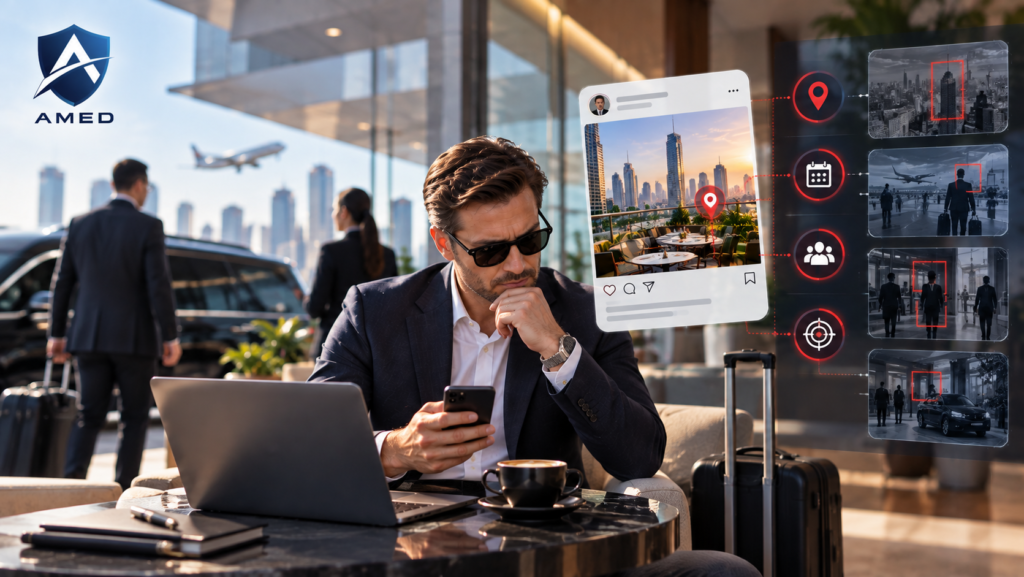
7. Compromised Social Accounts Can Create Reputational and Operational Risk
Social media security also includes account control.
The UK’s National Cyber Security Centre recommends controlling who can publish through organizational social channels, using secure credential management, enabling two-step verification, and establishing recovery procedures. It notes that compromised or poorly controlled social accounts can cause reputational damage and distribute malicious content. National Cyber Security Centre
For executive and corporate accounts, access should follow:
Authorized User → Strong Authentication → Review → Publication → Monitoring
CISA also recommends multifactor authentication for social media accounts because it makes unauthorized access more difficult even when a password has been compromised. CISA
What Information Should VIPs Avoid Posting in Real Time?
Executives do not need to disappear from social media. The objective is to control information that can create unnecessary exposure.
Particular attention should be given to:
- real-time location;
- future travel dates;
- flight and hotel details;
- private residence information;
- regular routines;
- vehicle identifiers;
- access badges and credentials;
- sensitive documents or laptop screens;
- confidential meetings;
- family locations;
- security personnel and protection arrangements.
A useful rule is: Does this post tell someone WHERE, WHEN, WHO, HOW, or WHAT NEXT?
If the answer is yes, review it before publishing.
For high-profile travel, security-sensitive information should ideally move through:
Create → Security Review → Delay → Publish
rather than:
Create → Post Live → Discover Exposure Later
Official Security Guidance: What Government Agencies Recommend
There is no universal statistic that can accurately state what percentage of VIP incidents originate from social media. Therefore, it would be misleading to claim that one number represents global executive risk.
However, official security agencies consistently recognize the underlying exposure.
CISA advises against broadcasting location, current or future travel plans, job locations, and sensitive personal information through social networks. Its guidance also recommends caution with photographs, including their backgrounds and metadata. CISA
The FBI similarly warns that photographs can expose geographic information and behavioral patterns. For travelers, it recommends avoiding posts about flights, hotel reservations, specific activities, and real-time check-ins until after travel. FBI
Meanwhile, the NCSC emphasizes managing digital footprints, reviewing privacy settings, controlling who can publish on corporate accounts, and using two-step verification. Its updated 2026 guidance for organizations also recommends reviewing what social profiles reveal publicly and controlling staff access to business accounts. National Cyber Security Centre
Together, these recommendations support a practical principle:
Less Real-Time Exposure → Less Actionable Public Information
For VIP protection, reducing unnecessary information can complement physical security measures.
Social Media Risk Should Be Part of Executive Protection Planning
Traditional protection focuses heavily on the physical environment: people, vehicles, routes, venues, access points, and emergency procedures.
Today, security planning should also ask what the public already knows.
Before an executive arrives at a destination, review:
Principal → Destination → Itinerary Exposure → Public Information → Venue → Route → Movement → Contingency
This does not mean that every social media post represents a threat. Instead, public information should form part of the broader risk picture used for situational awareness.
For example, if an executive’s attendance at a business conference is already public, the protection team can incorporate that visibility into planning rather than assuming the movement is confidential.
Social Media Security Risk During International Business Travel
The issue becomes particularly relevant when executives travel internationally.
A foreign executive may have limited local knowledge while moving between airports, hotels, meetings, industrial sites, restaurants, and regional destinations. At the same time, corporate communications teams may want to publish business activity for marketing or investor relations.
The two objectives need coordination:
Business Visibility + Information Control + Physical Security
A safer workflow is:
Business Schedule → Risk Review → Travel Planning → Secure Movement → Controlled Publication
This allows corporate communication to continue without unnecessarily publishing sensitive movement information in real time.
AMED Expertise: Connecting Business Activity with Executive Protection
AMED’s official Executive Protection service is designed for executives, expatriates, investors, and business travelers operating in Indonesia. The published service combines personal protection with threat assessment, situational awareness, route planning, executive escort, secure transportation, and business travel security. Amed Protection & Investigation
This positioning is particularly relevant for international owners because executive security often exists alongside commercial activity. A principal may need protection while attending business meetings, conducting site visits, inspecting facilities, meeting potential partners, or exploring investment opportunities.
AMED publicly states that its executive protection services can integrate with Business Consultation and Business Investigation when clients conduct investment activities, meetings, or market exploration in Indonesia. Amed Protection & Investigation
Therefore, the operational framework can become:
Business Objective → Risk Context → Threat Assessment → Route Planning → Secure Transportation → Executive Protection → Business Activity
This keeps security connected to the actual purpose of the trip.
Secure Transportation Matters When Online Exposure Exists
If a VIP’s destination becomes public, movement planning becomes more important.
AMED’s Executive Protection service includes secure transportation with security-aware drivers, route risk management, airport transfers, advance route planning, and executive escort. The service also covers security coordination during business meetings, industrial inspections, site visits, and regional travel. Amed Protection & Investigation
Social media security cannot replace these physical measures. Likewise, physical protection cannot erase information that has already become public.
The stronger approach combines:
Information Awareness + Situational Awareness + Movement Planning + Physical Protection
Business Investigation Adds Another Layer of Risk Awareness
International owners often travel because they are evaluating investments, suppliers, facilities, acquisition targets, or local partners.
AMED publishes business-investigation content covering due diligence, partner verification, corporate intelligence, background checks, reputation checks, and operational verification for foreign investors. Amed Protection & Investigation
That creates an important distinction:
Executive Protection protects the principal’s movement.
Business Investigation examines risks surrounding the commercial decision.
When relevant, combining the two allows international owners to evaluate both personal-security and business-risk considerations without treating them as the same discipline.
A Practical Social Media Protocol for VIP Travel
Before a business trip, executives and their support teams can establish a simple communication protocol.
Start by identifying who can publish content involving the principal. Then determine which information can be published immediately and which information should wait until the executive has left the location.
Use this workflow:
Identify → Review → Restrict → Delay → Publish → Monitor
For example, a conference photograph can still support corporate communications without necessarily being uploaded while the principal remains at the venue.
Likewise, hotel content can be published after checkout, and travel photographs can be shared after the relevant movement has ended.
The objective is not silence.
The objective is controlled visibility.
What Should Companies Do Before a VIP Travels to Indonesia?
A company should review both the executive’s itinerary and the information surrounding it.
Start with:
Travel Purpose → Public Exposure → Meetings → Locations → Transport → Local Risk → Protection Requirement → Contingency
Next, determine whether the executive requires only transportation coordination or a broader executive protection detail.
AMED publishes several layers of support, including a Safe-Guide Day Service, Executive Protection Detail, and Corporate Protection Program. The service scope varies from security-aware transportation to dedicated protection personnel, advance route planning, travel coordination, and emergency response coordination. Amed Protection & Investigation
The appropriate level should depend on the principal’s actual risk context, itinerary, profile, and operational requirements rather than social media activity alone.

FAQ About Social Media Security Risk and VIP Protection
How can social media compromise VIP protection?
Social media can reveal location, travel plans, routine, companions, venues, vehicles, or business activities. When several pieces of information are combined, they can provide a clearer picture of a VIP’s movement and behavioral pattern.
Is geotagging dangerous for executives?
Geotagging can disclose location information. CISA advises against broadcasting location through social media, while the FBI has warned that location information associated with photographs can reveal where someone is or has been. CISA
Should executives stop using social media?
Not necessarily. A more practical approach is to reduce unnecessary real-time exposure, review privacy settings, avoid publishing sensitive travel information, and delay location-sensitive posts until the movement has ended.
Should a CEO post hotel or flight information?
Publishing flight, hotel, or detailed travel information in real time can create unnecessary exposure. FBI travel guidance specifically recommends avoiding posts about flights, hotel reservations, specific activities, and location check-ins while traveling. FBI
Can old social media posts still create security risk?
Yes. Historical posts can reveal routines and behavioral patterns when analyzed collectively. The FBI has specifically noted that historical location information may provide insight into a person’s day-to-day habits. FBI
Can employees create social media risk for executives?
Yes. Employees, assistants, family members, partners, and event organizers may unintentionally reveal an executive’s location or activities. Companies should therefore establish clear rules for publishing content involving protected principals.
What is the connection between social media risk and executive protection?
Social media provides information about the digital environment surrounding a principal, while executive protection manages physical risks around movement, venues, routes, and activities. Effective risk planning considers both rather than treating them as unrelated issues.
Does AMED provide executive protection in Indonesia?
Yes. AMED publicly provides executive protection for executives, expatriates, investors, and business travelers in Jakarta, Bali, and across Indonesia, including threat assessment, situational awareness, route planning, executive escort, secure transportation, and business travel security. Amed Protection & Investigation
Can AMED combine security with business-risk support?
AMED states that executive protection can integrate with its Business Consultation and Business Investigation services for clients conducting investments, meetings, site visits, or market exploration in Indonesia. Amed Protection & Investigation
Protect the Executive Before the Post Becomes a Risk
A social media security risk often begins with ordinary information: a photograph, location tag, hotel name, boarding pass, meeting post, or travel announcement.
Individually, each detail may seem harmless. Combined over time, however, public information can reveal where an executive travels, whom they meet, and how their routine works.
The practical security model is:
Digital Exposure → Risk Assessment → Information Control → Travel Planning → Secure Movement → Monitoring
For executives, investors, expatriates, and international business travelers operating in Indonesia, AMED provides executive protection that includes threat assessment, situational awareness, route planning, secure transportation, executive escort, and business travel security. Amed Protection & Investigation
When a trip also involves investment assessment, site verification, or partner evaluation, AMED’s business-risk capabilities can complement the protection requirement. For broader corporate development and business support within the EFBA ecosystem, visit PT EFBA Digital Mulia.
Planning executive travel, business meetings, or site visits in Indonesia? Review the principal’s physical movement and public information exposure before the trip—not after sensitive details have already been published.