
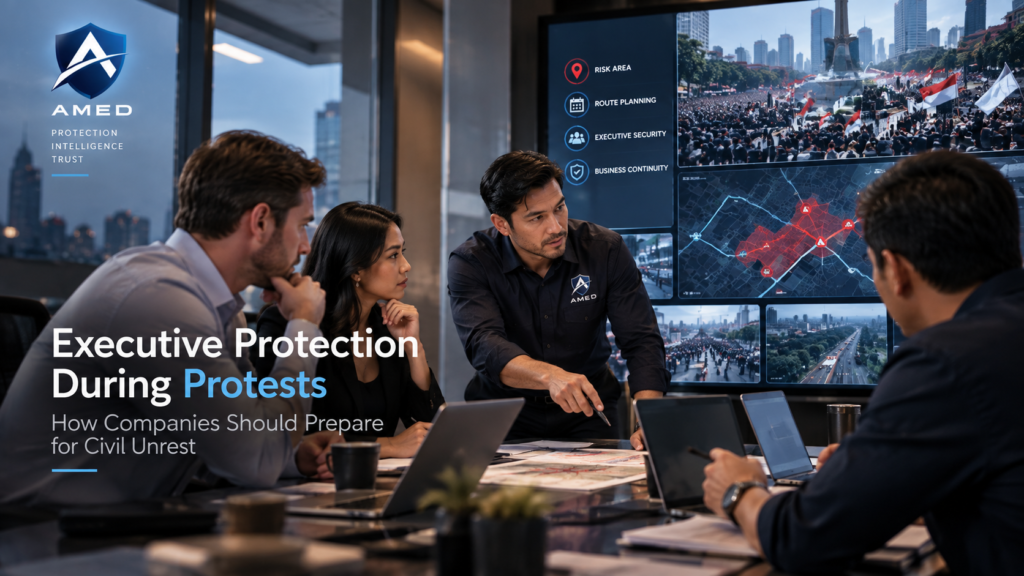
Executive protection during protests should focus on avoidance, early information, flexible movement, secure transportation, communication, and contingency planning—not confrontation with demonstrators. Companies should identify potential protest locations, review executive itineraries, prepare alternative routes, monitor reliable information, establish decision points, and postpone or relocate non-essential movements when conditions become uncertain.
For international executives operating in Indonesia, protests can affect more than personal safety. Demonstrations may disrupt roads, access to offices or meeting venues, airport transfers, site visits, schedules, and wider business operations. Official travel guidance notes that demonstrations occur in Indonesia and some can become violent or create access and traffic disruption. Travel.state.gov
A practical framework is:
Monitor → Assess → Avoid → Reroute → Protect → Communicate → Reassess
The objective is not to move an executive through civil unrest. The objective is to anticipate disruption early enough to keep the principal away from it whenever reasonably possible.
What Is Executive Protection During Protests?
Executive protection during protests is the process of adapting a principal’s security, transportation, routes, schedules, venues, and communications when demonstrations or civil unrest could affect their movement.
This differs from ordinary point-to-point transportation. The protection team needs to understand what is happening around the itinerary and whether planned movements remain appropriate.
The process can be summarized as:
Threat Information → Location Assessment → Executive Itinerary → Route Review → Movement Decision → Contingency
For example, a meeting may remain safe while the original route to the venue becomes impractical because a nearby demonstration blocks a major road. In that situation, changing the route, timing, meeting point, or even the meeting itself may be more appropriate than continuing with the original plan.
Why Should Companies Prepare Before Civil Unrest Happens?
Civil unrest can develop faster than a corporate travel plan can be rewritten.
Australia’s current travel advice for Indonesia states that public protests occur regularly and can turn violent with little notice. It also warns travelers to expect traffic delays and restricted access to locations when protests occur. Smartraveller
UK travel guidance similarly advises avoiding protests, demonstrations, student rallies, and political rallies because they can become violent without warning. GOV.UK
Companies should therefore prepare around four questions:
- Where could disruption occur?
- Who could be affected?
- Which business movements are essential?
- What alternatives are available?
These questions turn civil-unrest preparation from a reactive security response into an operational plan.
7 Ways Companies Should Prepare for Civil Unrest
1. Monitor the Environment Before Executive Movement
Preparation starts with information.
Corporate teams should monitor reliable local information, government travel advice, transportation conditions, planned demonstrations, major political or social events, and developments near executive destinations. The objective is to identify changes early enough to modify the itinerary.
Australia’s Smartraveller advises travelers in Indonesia to monitor local media, avoid demonstrations, plan activities around potential unrest on significant dates, and remain ready to change travel plans. Smartraveller
For corporate security:
Information → Assessment → Decision
Monitoring only creates value when someone has responsibility for deciding what the information means for the executive’s schedule.
2. Map the Executive’s Critical Locations
Companies should know which locations matter before unrest begins.
These may include the executive’s hotel, office, airport, meeting venues, industrial sites, client locations, hospitals, and other essential destinations. The security team can then compare those locations against areas experiencing disruption.
The purpose is not simply to place pins on a map. Teams need to understand how one disruption could affect another part of the itinerary.
Hotel → Route → Meeting → Site Visit → Airport
If a demonstration affects a critical road between two points, the consequences may extend through the rest of the day’s schedule.
3. Prepare Primary and Alternative Routes
Route planning becomes especially important when protests disrupt urban mobility.
A protection team should avoid assuming that the route used yesterday will remain appropriate today. Instead, it should consider alternative routes and departure timing while maintaining awareness of changing road conditions.
AMED’s published Executive Protection service includes secure transportation, route planning, situational awareness, airport transfers, executive escort, and travel coordination for executives, expatriates, investors, and business travelers operating in Indonesia. Amed Protection & Investigation
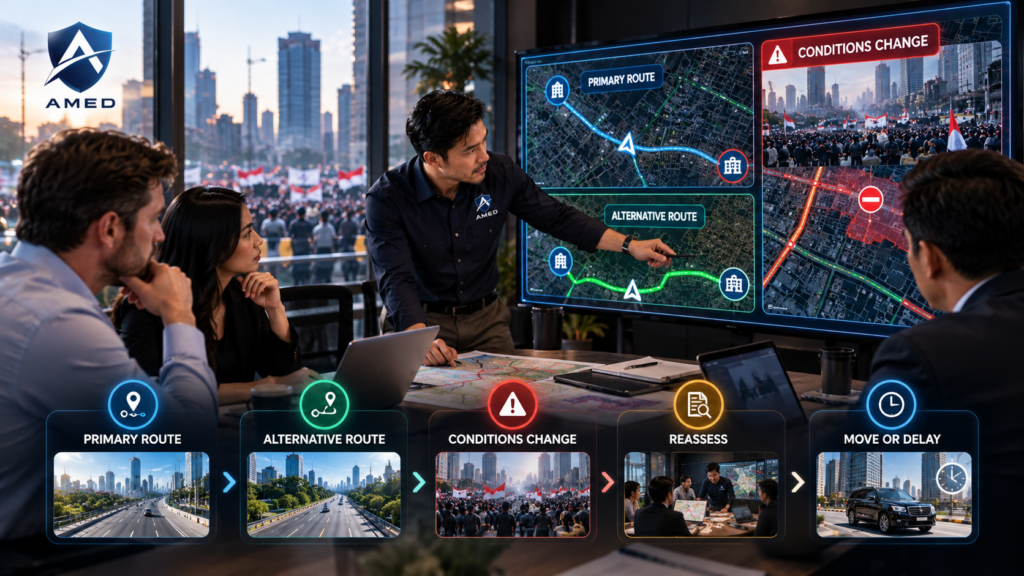
The planning logic is:
Primary Route → Alternative Route → Conditions Change → Reassess → Move or Delay
An alternative route is useful only when current conditions support using it.
4. Establish Go, Delay, Relocate, and Cancel Decisions
Companies need clear decision options.
Not every protest requires cancellation of an entire business trip. Conversely, maintaining every appointment simply because it appears on the calendar can create unnecessary exposure.
A practical decision framework is:
- GO — conditions support normal movement.
- DELAY — wait until disruption decreases.
- REROUTE — destination remains appropriate, but the original route does not.
- RELOCATE — move the meeting to another suitable location.
- CANCEL — risk or disruption makes the activity unnecessary or inappropriate.
The company should define who has authority to make these decisions so that an executive, driver, assistant, and corporate office do not receive conflicting instructions.
5. Strengthen Executive Transportation Planning
Civil unrest can turn transportation into an operational bottleneck.
Road closures, crowd movement, checkpoints, congestion, or restricted access can interfere with airport transfers, business meetings, hotel movements, and site visits. Current Australian travel advice specifically warns that protests in Indonesia can cause traffic delays and make locations difficult to access. Smartraveller
For international executives, transportation planning should therefore consider more than the vehicle.
Driver → Vehicle → Route → Timing → Communication → Destination → Alternative
AMED describes secure transportation as part of its executive protection capability, alongside security-aware drivers, route risk management, executive escort, and advance route planning. Amed Protection & Investigation
6. Establish a Communication and Accountability Plan
During disruption, companies need to know where key personnel are and how to reach them.
Executives, assistants, drivers, local management, security personnel, and relevant corporate contacts should understand the communication chain before an incident occurs. Teams should also establish backup communication methods where appropriate.
The structure can remain simple:
Principal → Protection/Driver → Local Coordinator → Corporate Contact
Companies should define who communicates schedule changes, who monitors developments, and who confirms that personnel have reached the intended destination.
In more severe disruptions, communication infrastructure can also become unreliable. UK guidance notes that internet communications may be switched off in some areas where demonstrations are planned, particularly in higher-risk regional contexts. GOV.UK
7. Connect Executive Protection with Business Continuity
Protecting an executive is only one part of corporate preparedness.
Civil unrest may also affect employees, suppliers, meetings, logistics, customer access, facilities, and business schedules. Companies should therefore connect personal protection decisions with broader operational risk management.
A useful framework is:
People → Movement → Facility → Operations → Communication → Continuity
For example, if an executive meeting cannot occur physically, the company may relocate it or move it online. If a site visit becomes non-essential, postponement may preserve both safety and business continuity.
Within the wider EFBA ecosystem, EFBA’s business risk management guidance uses an Identify → Assess → Respond → Monitor framework and emphasizes scenario planning rather than relying on a single business assumption. EFBA
That business-risk perspective complements physical security planning without replacing specialist executive protection.
What Should an Executive Do If a Protest Starts Nearby?
The priority should generally be to avoid moving toward the demonstration.
Official Australian guidance advises staying away from protests and demonstrations. If someone is already in a safe location, remaining there temporarily may be preferable to entering a developing crowd; if the location becomes unsafe, the guidance recommends moving to a safer place and following local-authority instructions. Smartraveller
For corporate executives, the response can follow:
Stop → Verify → Assess Location → Communicate → Avoid Crowd → Decide Whether to Hold or Relocate
Executives should not approach demonstrations merely to observe or photograph them. Australian consular guidance specifically warns that authorities may interpret people near protests as participants and advises against taking photographs or videos of demonstrations. Smartraveller
Protection teams should prioritize distance, situational awareness, and controlled decision-making.
What International Companies Should Know About Indonesia
As of the U.S. Department of State advisory issued July 7, 2026, Indonesia is classified Level 2 – Exercise Increased Caution, with natural disasters, terrorism, and unrest listed as risk indicators. The advisory notes that demonstrations occur frequently and that their size and impact vary significantly; some can turn violent. Travel.state.gov
This does not mean Indonesia as a whole is experiencing continuous civil unrest. Risk differs significantly by place, time, event, and local conditions.
The UK government currently describes Indonesia’s political situation as stable while noting that domestic or international developments can trigger protests or unrest. It advises travelers to avoid demonstrations because conditions can change without warning. GOV.UK
Australian guidance adds an important operational point for businesses: protests may cause traffic delays and restricted access, and some events can occur with little or no notice. Smartraveller
For companies, the useful conclusion is therefore not:
“Indonesia is unsafe.”
The better operational interpretation is:
Conditions Vary → Monitor Locally → Assess Exposure → Adjust Movement
Executive Protection Is Not Crowd Control
This distinction is important.
Executive protection during protests should not be framed as confronting demonstrators, controlling crowds, or forcing an executive through a protest. Those functions involve different authorities, responsibilities, and legal considerations.
For a corporate principal, the preferred strategy is usually:
Early Warning → Avoidance → Distance → Route Adjustment → Secure Movement
If local authorities establish restrictions, road closures, exclusion zones, or other instructions, companies and travelers should follow applicable local requirements.
The protection objective is to preserve the principal’s safety and business continuity while minimizing unnecessary exposure.
AMED Expertise for Executives Operating in Indonesia
AMED publicly provides Executive Protection Indonesia services for executives, expatriates, investors, and international business travelers operating in Jakarta, Bali, and other parts of Indonesia. Its published capabilities include discreet personal protection, threat assessment, situational awareness, route planning, secure transportation, executive escort, airport transfers, and business travel security. Amed Protection & Investigation
These capabilities are directly relevant when civil unrest could interfere with an executive’s itinerary.
AMED’s operating framework can be summarized as:
Risk Context → Threat Assessment → Situational Awareness → Route Planning → Secure Transportation → Executive Movement → Reassessment
The company’s website also states that executive protection can integrate with Business Consultation and Business Investigation when clients conduct investments, meetings, site visits, or market exploration in Indonesia. Amed Protection & Investigation
That combination is particularly relevant for international owners whose visit has both a security and commercial purpose.
Why Local Coordination Matters
International executives may know their business agenda but have limited visibility into changing local conditions.
A scheduled movement could include:
Airport → Hotel → Client Meeting → Government/Corporate Area → Industrial Site → Dinner → Hotel
When demonstrations affect one part of the city, the impact can cascade through that itinerary.
Local situational awareness therefore helps a company determine whether it should maintain, reroute, delay, relocate, or cancel individual movements.
AMED’s role, based on its published services, centers on security planning and protected movement rather than predicting political developments. Amed Protection & Investigation
That distinction strengthens the credibility of the service.
Civil Unrest Preparation Checklist for Companies
Before sending an executive into an environment where demonstrations may occur, companies can use this checklist:
Current Conditions → Executive Profile → Itinerary → Protest Locations → Meeting Venues → Primary Route → Alternative Route → Transportation → Communication → Contingency
The corporate team should also know which activities are essential and which can move online or be postponed.
Finally, establish clear decision points:
Normal → Monitor → Adjust → Hold → Relocate → Suspend
This structure prevents the company from improvising every decision after disruption has already begun.
FAQ
What is executive protection during protests?
Executive protection during protests is the process of adjusting security, transportation, routes, schedules, communications, and contingency plans when demonstrations or civil unrest may affect an executive. The primary objective is avoidance and safe movement rather than engagement with demonstrators.
Should executives avoid protests while traveling?
Yes. Current official travel guidance from the United States, United Kingdom, and Australia recommends avoiding demonstrations or protests because conditions can change rapidly and some events can become violent or disruptive. GOV.UK
Can protests affect business travel even when they are peaceful?
Yes. A protest does not need to become violent to disrupt business travel. Crowds, road closures, traffic congestion, restricted access, and changes to public transportation can affect meetings, airport transfers, and site visits. Smartraveller
What should a company prepare before civil unrest?
Companies should monitor local conditions, map critical locations, review executive itineraries, prepare alternative routes, establish communication procedures, identify safe alternatives, and determine when to proceed, delay, relocate, or cancel movements.
Should a protection team drive through a protest to keep an appointment?
Avoidance is generally the safer planning principle. Companies should assess current conditions and consider delay, rerouting, relocation, or cancellation instead of treating the original schedule as more important than the changing security environment.
What should an executive do if a protest begins near the hotel?
If the hotel remains safe, avoid unnecessary movement toward the demonstration while verifying conditions and coordinating with local security or company contacts. Follow instructions from local authorities and reassess transportation before leaving.
Does AMED provide executive protection in Indonesia?
Yes. AMED publishes executive protection services for executives, expatriates, investors, and business travelers in Indonesia, including threat assessment, situational awareness, route planning, secure transportation, executive escort, and business travel security. Amed Protection & Investigation
Can AMED support international business owners during site visits?
AMED states that its executive protection services support business meetings, airport transfers, site visits, and other corporate activities. It also states that protection can integrate with Business Consultation and Business Investigation where appropriate. Amed Protection & Investigation

Prepare Before Conditions Change
Effective executive protection during protests begins before an executive encounters a crowd.
Companies should monitor conditions, identify exposed locations, review itineraries, prepare alternative routes, coordinate transportation, establish communication protocols, and decide in advance when movements should proceed, change, or stop.
The objective is straightforward:
Awareness → Assessment → Avoidance → Adaptation → Protection → Continuity
For executives, investors, expatriates, and international business travelers operating in Indonesia, AMED Executive Protection provides threat assessment, situational awareness, route planning, secure transportation, executive escort, and business travel security. Amed Protection & Investigation
For broader corporate risk planning, the EFBA ecosystem also publishes guidance on business risk management and scenario planning, connecting operational resilience with structured risk assessment. EFBA
Planning executive meetings, investment visits, or corporate travel in Indonesia? Prepare the movement plan, alternatives, communication chain, and contingency decisions before local conditions affect the itinerary.