
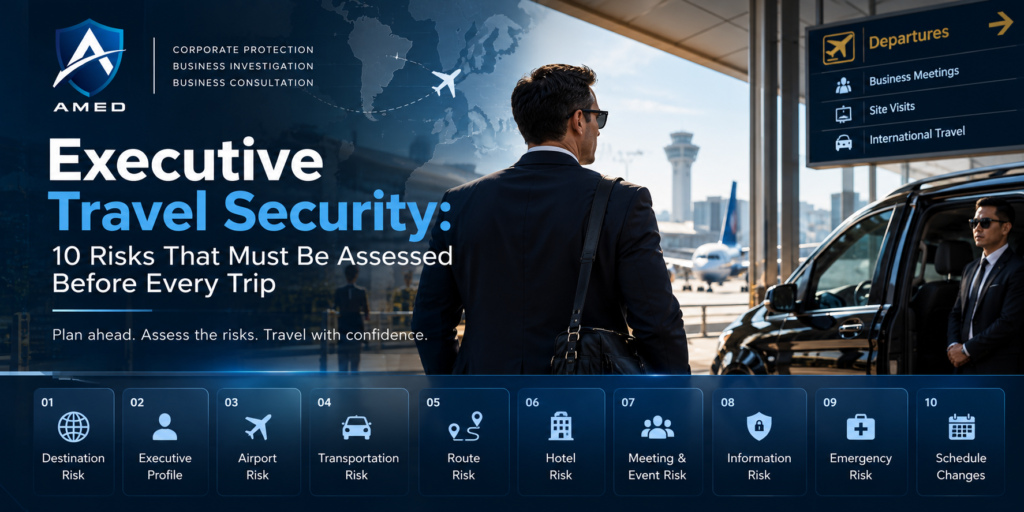
Executive travel can involve airports, hotels, business meetings, site visits, industrial inspections, investment activities, and movement between unfamiliar locations. For senior executives, investors, expatriates, and other business travelers, security planning should therefore begin before departure, not only when a problem occurs at the destination.
Executive travel security is the process of identifying and managing risks that could affect an executive before, during, and after a business trip. A practical assessment should consider the destination, local security environment, itinerary, transportation, routes, accommodation, information exposure, medical or emergency requirements, meeting locations, and contingency arrangements.
International guidance supports this pre-travel approach. The U.S. Department of State advises business travelers to review destination information before traveling, understand local laws and entry requirements, protect sensitive business information and electronic devices, and pay particular attention when traveling to higher-risk areas. Travel.state.gov
For executives traveling in Indonesia, AMED publishes Executive Protection capabilities covering threat assessment, situational awareness, route planning, executive escort, secure transportation, airport transfers, business meetings, site visits, industrial inspections, and regional travel. Amed Protection & Investigation
The basic principle is:
Assess → Plan → Coordinate → Move → Monitor → Respond
The purpose is not to assume that every executive faces a specific threat. Instead, a structured risk assessment helps determine which risks actually matter for a particular traveler, destination, itinerary, and business activity.
What Is Executive Travel Security?
Executive travel security combines travel planning with risk management. It evaluates the traveler, destination, itinerary, transportation, accommodation, business activities, local conditions, information exposure, and emergency requirements before determining the appropriate level of protection.
This differs from simply hiring a vehicle or security officer after arrival. A more complete approach starts by understanding who is traveling, why they are traveling, where they will go, who they will meet, how they will move, and what could disrupt the itinerary.
For example, an executive arriving in Jakarta for three corporate meetings has different requirements from an investor conducting industrial inspections outside a major city. Likewise, an executive attending a public event may have different exposure from someone conducting confidential negotiations inside a private office.
The assessment can therefore follow:
Traveler Profile → Destination → Itinerary → Threat Assessment → Movement Plan → Protection Requirement → Contingency Plan
AMED’s published Executive Protection service follows a similar risk-based approach by combining threat assessment, situational awareness, route planning, executive escort, secure transportation, and business travel security. Amed Protection & Investigation
Why Should Travel Risk Be Assessed Before Departure?
Travel risk becomes harder to manage when planning begins only after the executive reaches the destination. Transportation may already be booked, hotel locations confirmed, meeting schedules distributed, and sensitive itinerary information shared with multiple parties.
Pre-travel assessment gives the security team time to review these elements before movement begins. It can identify avoidable vulnerabilities, clarify transportation requirements, review routes, determine whether additional protection is necessary, and establish communication or emergency arrangements.
The objective is not to eliminate every possible risk. No travel security program can guarantee a risk-free journey. Instead, assessment helps organizations make informed decisions about risks that can be avoided, reduced, transferred, monitored, or managed.
A practical sequence is:
Travel Request → Risk Assessment → Security Planning → Travel Briefing → Movement → Monitoring → Response
This approach is also consistent with a June 2026 U.S. government oversight review that recommended strengthening processes for pre-travel briefings covering threat and risk awareness for official international travelers. Oversight.gov
10 Executive Travel Security Risks to Assess Before Every Trip
The level of risk varies significantly by destination, executive profile, business activity, timing, and local conditions. Therefore, organizations should avoid applying the same security arrangement to every trip.
The following ten categories provide a practical framework for an executive travel security assessment.
1. Destination and Local Security Risk
The first assessment should focus on the destination itself. Security conditions can vary not only between countries but also between cities, districts, neighborhoods, and specific business locations.
The assessment should consider current public security conditions, recent incidents, demonstrations, natural hazards, local regulations, transportation conditions, and any developments that could affect the itinerary. Official travel advisories can provide useful external context, while local security coordination can provide more specific operational information.
For international travel, government guidance should be reviewed close to departure because conditions can change. Australia’s Smartraveller guidance, for example, was updated in September 2026 and currently advises travelers to exercise a high degree of caution in Indonesia overall due to security risks, while noting that different levels apply to certain areas. Smartraveller
However, a national advisory should not automatically be interpreted as the risk level of every individual executive trip.
The assessment should narrow the analysis: Country → City → Area → Venue → Activity → Executive Profile
This creates a more relevant risk picture.
2. Executive Profile and Exposure
Not every traveler has the same exposure. A CEO, investor, corporate representative, expatriate, public figure, or senior executive may attract different levels of attention depending on their position and activities.
The assessment should therefore consider whether the traveler is publicly recognizable, connected to a sensitive industry, attending a high-profile event, conducting confidential negotiations, visiting a controversial project, or carrying valuable business information.
A useful principle is:
Threat + Exposure + Vulnerability = Risk Context
This does not mean seniority automatically creates high risk. Instead, the executive’s profile helps determine whether ordinary transportation is sufficient or whether additional coordination, secure transportation, or executive protection should be considered.
AMED’s Executive Protection service specifically targets executives, expatriates, investors, and business travelers requiring professional security during activities in Indonesia. Amed Protection & Investigation
3. Airport Arrival and Departure Risk
Airports are predictable points within a travel itinerary. Arrival time, departure time, terminal, flight number, baggage requirements, and onward destination may all need coordination.
Problems can occur when drivers cannot locate passengers, vehicle arrangements change unexpectedly, luggage causes delays, an executive exits through an unexpected point, or the next business engagement leaves little time for disruption.
Airport movement should therefore be planned as part of the trip rather than treated as an isolated transfer.
Flight → Arrival Coordination → Passenger Identification → Vehicle → Route → Destination
For departure:
Hotel / Meeting → Departure Time → Route → Airport → Terminal → Flight
AMED specifically lists airport transfers as part of its Secure Transportation capabilities, alongside professional security-aware drivers and route risk management. Amed Protection & Investigation
4. Transportation and Driver Risk
Transportation is one of the most consistent elements of executive travel because the traveler repeatedly moves between airports, hotels, meetings, restaurants, events, and site locations.
Vehicle condition, driver capability, route knowledge, communication, passenger requirements, luggage capacity, and security awareness can therefore influence the quality of the entire assignment.
A professional arrangement should consider:
Driver → Vehicle → Route → Communication → Passenger → Destination
For higher-security requirements, transportation can also integrate with an executive protection detail.
AMED’s published Secure Transportation service includes professional drivers trained in security awareness, English-speaking drivers, premium MPV vehicles, route risk management, and airport transfers. Amed Protection & Investigation
The appropriate arrangement should still reflect the assignment. Not every executive traveler requires the same vehicle or protection configuration.
5. Route and Movement Risk
A destination may be appropriate while the route toward it creates additional operational concerns. Traffic conditions, road closures, demonstrations, flooding, construction, events, access restrictions, and unexpected congestion can affect movement.
Route planning should therefore consider more than the shortest route displayed on a navigation application.
A basic model is:
Primary Route → Alternative Route → Timing → Destination Access → Contingency
For a business traveler attending several appointments, the entire movement schedule should be reviewed together rather than planning each journey independently.
For example:
Hotel → Meeting A → Site Visit → Meeting B → Dinner → Hotel
This allows the team to evaluate travel time, route alternatives, access, and schedule dependencies.
AMED lists both route planning and route risk management among its published Executive Protection and Secure Transportation capabilities. Amed Protection & Investigation
6. Hotel and Accommodation Risk
Hotels are another predictable location in executive travel. The executive may spend multiple nights at the same property, conduct meetings there, receive visitors, store luggage, and begin or end most daily movements from the same location.
Security assessment can therefore consider the property’s location, access arrangements, pickup and drop-off areas, surrounding environment, meeting locations, emergency access, and movement between the hotel and other destinations.
The objective is not necessarily to select the most expensive hotel. Instead, accommodation should support the traveler’s business schedule and security requirements.
A useful assessment structure is:
Hotel Location → Access → Arrival / Departure → Meeting Areas → Daily Routes → Emergency Considerations
When protection requirements are higher, accommodation planning should also connect with the wider travel and movement plan.
7. Meeting, Event, and Site Visit Risk
Executives often travel specifically to meet people or inspect locations. A trip may involve corporate offices, factories, warehouses, construction sites, hotels, conference venues, or potential investment locations.
Each environment creates different operational considerations.
A corporate meeting may require discretion and schedule control. An industrial inspection may involve access restrictions and unfamiliar facilities. A large event may involve crowds and multiple entry points.
Therefore:
Purpose → Venue → Access → People → Schedule → Movement → Exit
should be reviewed before the visit.
AMED explicitly includes business meetings, site visits, industrial inspections, and regional travel within its Business Travel Security scope. Amed Protection & Investigation
For investment or market exploration, AMED also states that Executive Protection can integrate with Business Consultation and Business Investigation. Amed Protection & Investigation
8. Information and Social Media Exposure
Physical security and information security increasingly overlap during executive travel.
A social media post can unintentionally reveal a hotel, vehicle, meeting venue, airport arrival, event attendance, route, or travel schedule. Real-time posts can be particularly sensitive because they provide information while the executive is still at or near the location.
Business travelers also carry laptops, smartphones, documents, credentials, and commercially sensitive information. The U.S. Department of State advises international business travelers to protect electronic devices and sensitive information, keep business materials under control, and exercise caution when using public or hotel Wi-Fi. Travel.state.gov
The travel security assessment should therefore consider:
What information exists? → Who has access? → When is it shared? → Could it reveal movement?
For executive teams, practical controls can include limiting unnecessary itinerary distribution, avoiding real-time disclosure of sensitive locations, and coordinating communications among personnel who actually need operational information.
9. Emergency and Contingency Risk
A well-planned itinerary can still change.
Flights can be delayed. Roads can close. Meetings can move. Vehicles can experience problems. Severe weather or natural hazards can affect routes. An executive may require urgent medical attention or need to leave a location earlier than expected.
Travel security therefore needs contingency thinking.
Primary Plan → Alternative Plan → Communication → Coordination → Response
The objective is not to predict every possible emergency. Instead, the team should understand who coordinates the response and what alternatives are available when the original plan becomes impractical.
AMED’s published Corporate Protection Program includes emergency response coordination alongside travel planning, executive protection, and dedicated safe-guide support. Amed Protection & Investigation
This reinforces an important principle:
Travel Security ≠ Only Preventing Incidents
It also includes the ability to respond when circumstances change.
10. Schedule Changes and Last-Minute Movement
Executive schedules rarely remain completely static. Meetings run late, destinations change, additional appointments appear, and flights can be rescheduled.
Last-minute changes create risk because the new destination or route may not have received the same level of assessment as the original plan.
A good travel security process therefore needs controlled flexibility:
Change Request → Verify Destination → Review Route → Update Team → Adjust Movement
This is particularly important during regional travel or investment activities where executives may decide to inspect another site after receiving new information during a meeting.
Travel coordination should allow legitimate business flexibility without abandoning basic security planning.
For this reason, AMED includes travel coordination and advance route planning within its published Executive Protection Detail. Amed Protection & Investigation
How Should Executive Travel Risk Be Assessed?
A useful assessment does not simply label a trip as “safe” or “dangerous.” It identifies individual risk categories and determines which controls are proportionate to the actual assignment.
A practical workflow is:
Executive Profile → Destination Intelligence → Itinerary Review → Threat Assessment → Transportation Review → Route Planning → Venue Review → Information Control → Emergency Planning → Travel Briefing
The assessment should then lead to an operational decision.
For example:
- Lower Complexity
Professional transportation + itinerary coordination. - Additional Exposure
Secure transportation + route planning + situational awareness. - Higher Protection Requirement
Executive protection + secure transportation + travel coordination + advance route planning.
The exact configuration should depend on the assignment rather than a generic assumption about the executive’s status.
What Information Should Be Reviewed Before an Executive Trip?
The quality of a travel security assessment depends on the quality of information available before departure. A security provider cannot accurately plan movement without understanding the traveler’s itinerary and objectives.
Relevant information can include:
- executive or traveler profile;
- purpose of travel;
- arrival and departure details;
- destination cities and areas;
- hotel or accommodation;
- business meeting locations;
- site visits or industrial inspections;
- event attendance;
- expected daily schedule;
- number of accompanying travelers;
- vehicle and luggage requirements;
- local transportation requirements;
- relevant security concerns;
- communication requirements;
- last-minute itinerary flexibility.
Sensitive information should only be distributed to personnel who need it for operational purposes.
The final assessment can then determine whether the trip requires ordinary transportation, secure transportation, executive protection, or a combination of services.
Official Data: Why Travel Risk Should Remain Context-Specific
National statistics can provide context, but they should never be used to claim that an individual executive will face a particular threat.
BPS-Statistics Indonesia’s latest annual Crime Statistics 2024/2025 publication reports 561,993 police-recorded crime incidents in 2024, equivalent to a crime rate of 204 per 100,000 population. At the same time, the National Socioeconomic Survey estimated that 0.73% of the population experienced crime victimization in 2024, while only 20.28% of victims reported incidents to police. Badan Pusat Statistik Indonesia
These indicators describe Indonesia nationally and do not measure executive travel risk specifically. They also demonstrate why different data sources can show different aspects of security: police administrative records measure recorded incidents, while household surveys capture victimization through a different methodology.
More recent operational information from the Indonesian National Police also illustrates how conditions change over time. On 23 August 2026, Polri recorded 1,491 public-order and security disturbances nationwide during a 24-hour reporting period, including 1,374 crimes, 22 disaster incidents, 18 minor violations, and 77 other disturbances. Polri described the national public-order situation at that time as conducive and reported a decline from the previous day. Polri
Again, a one-day national figure should not be interpreted as the threat level for a particular executive, city, hotel, or journey.
The correct use of official data is:
National Context → Destination Assessment → Local Conditions → Executive Profile → Specific Itinerary
rather than:
National Statistic → Assume Individual Risk
Road Movement Is Also Part of Travel Risk
Executive travel security should not focus exclusively on intentional security threats. Transportation safety and operational disruption also matter because executives frequently spend significant portions of their itinerary on the road.
Indonesia’s Ministry of Transportation reported 3,517 road traffic accidents during the 2026 Eid transportation period, down 6.31% from 3,754 during the comparable previous period. During the same transportation period, public transport carried 23.54 million passengers across road, sea, air, rail, and ferry modes. Dephub
These figures cover a specific national holiday transportation period and should not be presented as normal daily travel conditions. However, they demonstrate why vehicle condition, driver capability, route planning, timing, and movement coordination belong within a broader travel risk assessment.
For executive movement, the operational principle remains:
Safe Vehicle + Professional Driver + Route Planning + Situational Awareness + Coordination
Executive Travel Security Is Also About Business Continuity
A security incident is not the only event capable of disrupting executive travel. Missed meetings, inaccessible locations, transportation failures, lost devices, information exposure, route disruptions, or sudden schedule changes can also affect the purpose of the trip.
This is particularly relevant when an executive travels for an investment meeting, negotiation, site inspection, or corporate decision. The travel program should support the business objective rather than operate separately from it.
A useful framework is:
Business Objective → Executive Movement → Security Controls → Meeting / Site Visit → Continuity of Schedule
This is why travel security should remain proportionate. Excessive security can interfere with business activities, while insufficient planning can expose the traveler and itinerary to unnecessary disruption.
The goal is discreet, coordinated, and risk-based protection.
AMED Expertise in Executive Travel Security
AMED Corporate Protection & Business Investigation publishes Executive Protection services for executives, expatriates, investors, and business travelers operating in Jakarta, Bali, and throughout Indonesia. The service combines discreet personal protection, secure transportation, route planning, and situational awareness to support business activities. Amed Protection & Investigation
AMED’s published Executive Protection Officer capabilities include:
Threat Assessment → Situational Awareness → Route Planning → Executive Escort
Its Secure Transportation capabilities include:
Security-Aware Driver → English-Speaking Driver → Premium MPV → Route Risk Management → Airport Transfer
Meanwhile, AMED’s Business Travel Security scope covers:
Site Visits → Industrial Inspections → Business Meetings → Regional Travel. Amed Protection & Investigation
For assignments requiring dedicated protection, AMED currently publishes an Executive Protection Detail that includes travel coordination, advance route planning, and a trained executive protection agent. Its Corporate Protection Program additionally lists travel planning, executive protection, dedicated safe-guide support, and emergency response coordination. Amed Protection & Investigation
These capabilities support an end-to-end travel security framework:
Pre-Travel Assessment → Travel Planning → Arrival → Secure Transportation → Route Management → Executive Protection → Business Activity → Departure
AMED also states that clients can integrate Executive Protection with Business Consultation and Business Investigation when conducting investments, meetings, or market exploration in Indonesia. Amed Protection & Investigation
This integration is particularly relevant when the purpose of travel extends beyond transportation and involves commercial assessment or business activity.
When Does an Executive Need Executive Protection?
Senior job title alone does not automatically determine the need for close protection. The decision should follow the risk assessment.
Relevant factors include the executive’s profile, destination, itinerary, public visibility, business activity, local conditions, event environment, transportation requirements, and known security concerns.
A simplified decision model is:
Profile + Destination + Activity + Exposure + Vulnerability → Protection Requirement
Some assignments may only require a professional security-aware driver and coordinated transportation. Others may justify a dedicated executive protection agent, advance route planning, or additional travel coordination.
AMED publishes both a Safe-Guide Day Service and a dedicated Executive Protection Detail, allowing different service structures depending on assignment requirements. Current availability, scope, and commercial terms should always be confirmed directly with AMED. Amed Protection & Investigation
Executive Travel Security Checklist Before Departure
Before an executive begins a trip, organizations can use a concise checklist to confirm that the main areas have been reviewed.
- Confirm traveler profile and purpose of travel.
- Review current destination conditions.
- Review the complete itinerary.
- Confirm airport arrival and departure arrangements.
- Verify driver and vehicle requirements.
- Review primary and alternative routes.
- Review hotel and meeting locations.
- Identify site visits and industrial inspections.
- Limit unnecessary itinerary and location exposure.
- Review communication arrangements.
- Establish contingency and emergency coordination.
- Confirm whether executive protection is required.
- Brief the executive and relevant team members.
- Reassess when the itinerary materially changes.
The checklist should not become a box-ticking exercise. Its purpose is to identify issues early enough for the travel team to respond appropriately.
FAQ About Executive Travel Security
What is executive travel security?
Executive travel security is the process of assessing and managing risks associated with executive business travel. It can include threat assessment, itinerary review, secure transportation, route planning, situational awareness, information security, emergency planning, and executive protection depending on the assignment.
What risks should be assessed before executive travel?
The assessment should consider destination conditions, executive profile, airport movement, transportation, routes, hotels, meetings and site visits, information exposure, emergency requirements, and last-minute itinerary changes. The relevance of each risk depends on the individual trip.
Does every executive need close protection?
No. Protection requirements should be based on risk rather than job title alone. Some travelers may only need professional transportation and coordination, while higher-risk assignments may require dedicated executive protection.
When should executive travel security planning begin?
Planning should begin before departure and preferably before transportation and movement arrangements are finalized. This provides time to review the destination, itinerary, routes, accommodation, venues, and contingency requirements.
Why is route planning important for executive travel?
Route planning helps the team understand how the executive will move between airports, hotels, meetings, site visits, and other destinations. It can also identify alternative routes and support schedule continuity if conditions change.
Is social media a risk during executive travel?
It can be. Real-time posts may reveal hotels, airports, vehicles, meetings, locations, or movement patterns. Executives and supporting personnel should consider whether travel-related information needs to be published while the trip is still underway.
What is secure transportation for executives?
Secure transportation combines professional transportation with security awareness and route risk management. AMED’s published service includes professional security-aware drivers, English-speaking drivers, premium MPV vehicles, route risk management, and airport transfers. Amed Protection & Investigation
Can AMED provide executive travel security in Indonesia?
Yes. AMED publishes Executive Protection services for executives, expatriates, investors, and business travelers in Jakarta, Bali, and across Indonesia. Its capabilities include threat assessment, situational awareness, route planning, executive escort, secure transportation, and business travel security. Amed Protection & Investigation
Can AMED support business meetings and site visits?
Yes. AMED specifically lists business meetings, site visits, industrial inspections, and regional travel within its Business Travel Security scope. Amed Protection & Investigation
Can executive protection be combined with business investigation?
AMED states that Executive Protection can integrate with its Business Consultation and Business Investigation services when clients conduct investments, meetings, or market exploration in Indonesia. Amed Protection & Investigation

Assess the Risk Before the Executive Starts the Trip
Effective executive travel security begins before the executive boards a flight. The organization should understand the destination, traveler profile, itinerary, transportation, routes, accommodation, meeting locations, information exposure, and contingency requirements before deciding which protective measures are appropriate.
The process can remain straightforward:
Assess → Plan → Brief → Coordinate → Protect → Monitor → Respond
For a business trip:
Airport → Secure Transportation → Hotel → Business Meeting → Site Visit → Event → Hotel → Departure
When the risk profile justifies additional protection:
Threat Assessment → Advance Planning → Secure Transportation → Executive Protection → Situational Awareness → Emergency Coordination
AMED’s published Executive Protection capabilities cover threat assessment, route planning, situational awareness, executive escort, secure transportation, airport transfers, business meetings, site visits, industrial inspections, regional travel, and travel coordination. Amed Protection & Investigation
Executives, investors, expatriates, and companies planning business travel in Indonesia can review the current service scope through AMED Executive Protection & Secure Transportation before arranging an assignment.