
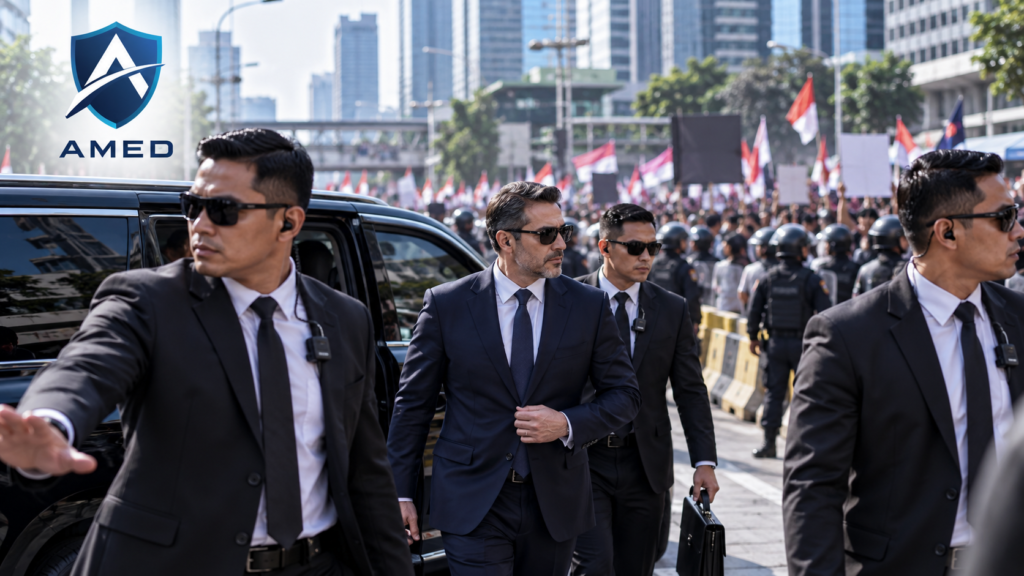
Public demonstrations do not automatically mean executives need close protection. However, companies should reassess security when protests begin affecting executive routes, offices, hotels, meetings, industrial sites, airports, or other locations connected to business activity.
A practical protest security executives strategy should therefore focus on risk rather than the existence of a demonstration itself. Companies need to assess the executive’s profile, protest location, crowd size and behavior, travel itinerary, public exposure, online information, transportation routes, business locations, and the ability to change plans quickly.
The basic decision framework is:
Monitor → Assess → Plan → Avoid → Protect → Move → Reassess
This distinction matters in Indonesia. The U.S. Department of State’s July 7, 2026 Indonesia Travel Advisory states that demonstrations occur frequently, vary significantly in size and impact, and can sometimes become violent. It advises travelers to avoid demonstrations and crowds and monitor local information. Travel.state.gov
AMED’s verified Executive Protection Indonesia service combines threat assessment, situational awareness, route planning, executive escort, secure transportation, and business travel security. These capabilities allow companies to adjust protection according to actual exposure rather than treating every protest as the same security event. AMED Corporate Protection
Why Protests Matter for Executive and Corporate Security
A peaceful demonstration and a rapidly changing civil-unrest situation create very different risk profiles. Companies should avoid assuming that every gathering presents a direct threat to an executive, but they should also avoid waiting for violence before reviewing travel and security arrangements.
Protests can indirectly affect executives through road closures, traffic diversion, restricted building access, crowds near meeting venues, delayed airport transfers, itinerary disruption, or increased public exposure. Australian government travel advice similarly notes that protests can cause traffic delays and restricted access and recommends avoiding demonstrations, monitoring local media, and remaining ready to change travel plans. Smartraveller
This creates two separate questions: Is the protest a direct threat to the executive?
and : Can the protest disrupt the executive’s movement or business activity?
Both matter. Even when there is no evidence of a targeted threat, mobility disruption can create avoidable exposure if an executive becomes trapped near a crowd, road closure, or unfamiliar location.
Protest Security Is a Risk-Based Decision, Not an Automatic Response
Companies should scale protection according to risk. Sending a large protective team to every public demonstration can be unnecessary, while ignoring changing conditions because an event began peacefully can create another problem.
A better protest security executives framework evaluates:
Threat + Exposure + Vulnerability + Itinerary + Location + Mobility + Executive Profile
For example, an executive working remotely from a hotel far from a protest may require little operational change. A CEO scheduled to travel through an affected district to a high-profile meeting may require route changes, secure transportation, closer monitoring, or additional protective support.
AMED follows the same risk-based principle in its secure transportation guidance. Its published framework states that the appropriate protection level should depend on the individual’s profile, itinerary, destination, exposure, and risk assessment; not every traveler automatically needs an executive protection officer. AMED Corporate Protection
When Should Companies Increase Protection During Protests?
Companies should review their security posture when new information changes the executive’s exposure. The objective is not to react to headlines alone but to identify operational indicators that affect people, routes, locations, and business continuity.
The following warning signs provide a practical escalation framework.
1. Protests Move Closer to the Executive’s Location
Location changes the risk calculation. A protest several kilometers away may have little operational effect, while a gathering near an executive’s hotel, corporate office, meeting venue, or planned route can immediately affect mobility.
Security teams should map:
Protest Location → Executive Location → Planned Route → Destination → Alternative Route
If those points begin overlapping, companies should reassess the movement plan before the executive departs.
This does not automatically mean deploying close protection. In some cases, changing the meeting time, destination, or route may reduce exposure more effectively.
2. Crowd Size or Behavior Changes Rapidly
A company’s assessment should remain dynamic because demonstrations can change after they begin. Crowd movement, unexpected groups, confrontations, road occupation, police activity, or rapidly changing access conditions can alter the operating environment.
Official Indonesian police reporting from August 2026 illustrates why monitoring matters. During demonstrations in Jakarta, authorities used situational traffic diversions and deployed personnel not only around protesters but also to maintain traffic, public activity, and access around affected areas. INP | Indonesian National Police
Therefore: Initial Assessment ≠ Final Assessment
The security team should continue reviewing conditions throughout the executive’s itinerary.
3. Main Routes Become Unreliable
Mobility becomes a security issue when executives cannot reliably enter or leave a location.
Road closures, demonstrations, congestion, security cordons, or spontaneous crowd movement may make the normal route unsuitable. AMED’s secure transportation guidance specifically identifies demonstrations among the disruptions that can affect a planned route and recommends preparing alternatives rather than depending on one route. AMED Corporate Protection
A practical movement plan becomes: Primary Route → Alternative Route A → Alternative Route B → Safe Destination
Companies should establish these alternatives before movement starts, not after the vehicle encounters disruption.
4. The Executive Has a High Public Profile
Exposure matters. CEOs, board members, public-facing executives, foreign investors, senior representatives, and VIP guests can have different security requirements from ordinary business travelers.
A recognizable executive attending a publicized event may create a different risk profile from a manager conducting a private meeting. Companies should therefore consider public visibility, media coverage, event exposure, organizational role, and whether the executive’s itinerary has become publicly known.
AMED lists executives, expatriates, investors, and business travelers among the profiles supported by its Executive Protection service in Indonesia. AMED Corporate Protection
5. Executive Itinerary Information Is Public
Security teams should review how much information about the executive’s location and schedule is publicly accessible.
Conference agendas, social-media posts, event invitations, corporate announcements, tagged photographs, hotel information, and real-time updates can unintentionally reveal movement patterns. During a sensitive security environment, that information can make route and location planning more difficult.
The practical principle is: Less Unnecessary Exposure → More Operational Flexibility
Companies should therefore coordinate communications and executive movement rather than treating them as unrelated functions.
6. The Executive Must Visit a Sensitive Location
An executive may still need to attend a government meeting, factory inspection, corporate negotiation, investor meeting, project site, or another business-critical activity while demonstrations occur elsewhere in the city.
Cancellation is not always necessary. Instead, the company should determine whether the movement remains operationally reasonable after reviewing the location, route, arrival point, departure point, timing, and current conditions.
AMED lists site visits, industrial inspections, business meetings, and regional travel among the situations covered by its Business Travel Security capabilities. AMED Corporate Protection
The planning sequence can follow: Purpose → Location → Threat Assessment → Route → Arrival → Meeting → Departure
7. Airport Transfers May Cross Protest Areas
Airport movements deserve particular attention because executives often operate under fixed flight schedules. A route disruption can therefore become both a security and business-continuity issue.
Before departure, review: Hotel → Primary Route → Alternative Route → Airport Access → Departure Time
AMED’s secure transportation service includes airport transfers, advance route planning, travel coordination, premium MPVs, English-speaking drivers, and route risk management. AMED Corporate Protection
Companies should build additional flexibility into airport movements when demonstrations or road restrictions may affect travel time.
8. Online Information Suggests Possible Escalation
Security decisions should not rely on a single social-media post. At the same time, online information can provide early indicators that require verification.
In August 2026, West Java Police specifically urged the public to verify demonstration-related information circulating on social media and warned against spreading unverified mobilization or provocative content. INP | Indonesian National Police
For corporate security teams, the principle should be: Information → Verify → Assess Relevance → Decide
Do not treat rumors as confirmed threats. Conversely, do not ignore relevant information simply because it originated online.
9. The Company Receives a Direct or Specific Threat
This indicator changes the situation significantly.
A direct threat against an executive, office, event, vehicle, or organization requires a different assessment from general civil unrest. Companies should preserve relevant information, review the credibility and specificity of the threat, reassess travel and location exposure, and involve appropriate authorities when circumstances warrant it.
At this stage, the security question shifts from: “How might this protest affect our itinerary?”
to: “Is there evidence of a specific threat to our people or organization?”
The company should escalate protection according to the assessment rather than relying on assumptions.
10. Business Operations Start to Experience Disruption
Executive security does not exist separately from business operations. Demonstrations may affect offices, warehouses, factories, meetings, staff mobility, customer access, suppliers, or scheduled inspections.
Companies should monitor: People → Facilities → Transportation → Operations → Communication → Continuity
If several of these areas experience disruption simultaneously, management should move from a travel-only response toward a broader corporate protection plan.
This approach is particularly relevant for international companies whose executives may be unfamiliar with local routes, operational conditions, or rapidly changing information.
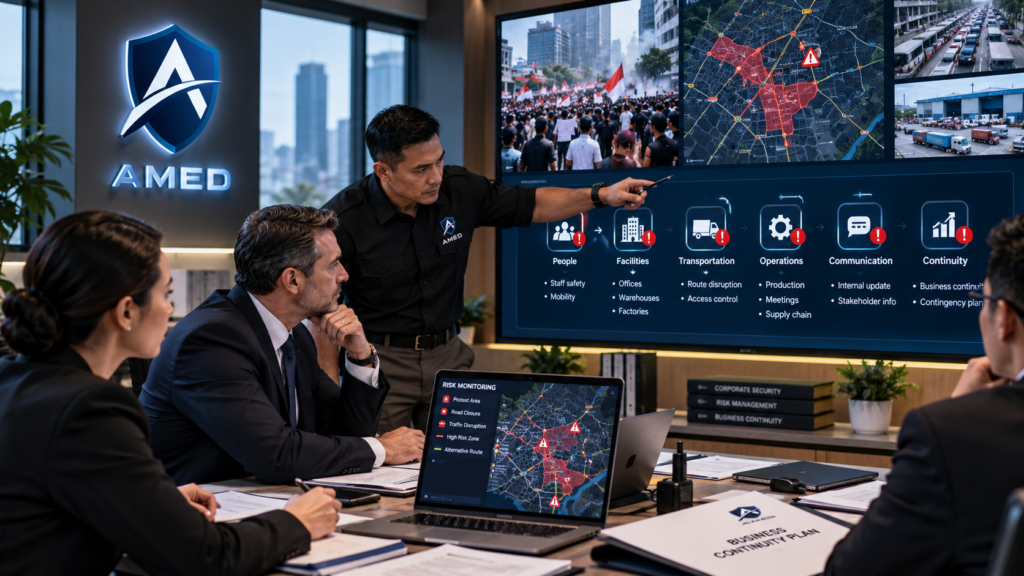
A Simple Executive Protection Escalation Model
Companies do not need to use the same security configuration throughout an entire protest period. Protection can increase or decrease as conditions change.
A practical model is:
Level 1 – Monitor
Local information, executive itinerary, protest location, and transportation remain under review.
Level 2 – Adjust
Change meeting times, routes, pickup points, or destinations to reduce unnecessary exposure.
Level 3 – Secure Movement
Introduce security-aware transportation, advance route planning, alternative routes, and closer travel coordination.
Level 4 – Increase Executive Protection
Add dedicated executive protection when the executive’s profile, location, itinerary, or threat environment justifies additional protection.
Level 5 – Postpone or Relocate
If exposure cannot be reduced to an acceptable operational level, consider postponing, relocating, or conducting the activity remotely.
The principle is:
Monitor → Adjust → Protect → Relocate if Necessary
This model keeps protest security executives proportional to actual conditions rather than automatically choosing either “continue normally” or “cancel everything.”
Data and Current Security Context in Indonesia
Demonstrations are a normal part of public life in Indonesia. The U.S. Department of State currently places Indonesia at Level 2: Exercise Increased Caution, with unrest among the listed risk indicators. Its July 7, 2026 advisory states that demonstrations are common in Jakarta, Surabaya, and other major cities, can be unpredictable, and should be avoided by travelers. Travel.state.gov
Recent Indonesian police data also illustrate the operational scale that public gatherings can create. On August 18, 2026, Jakarta authorities deployed 9,242 joint personnel in connection with 31 demonstrations and 16 community events across the capital. Authorities also reported situational traffic rerouting around areas including the Hotel Indonesia Roundabout, South Medan Merdeka, and Monas. INP | Indonesian National Police
However, these figures should not imply that Jakarta or Indonesia is continuously unsafe. Metro Jaya Police reported on August 29 that Jakarta and surrounding areas remained conducive following recent demonstrations, with offices, commerce, education, and public transportation operating normally. Authorities nevertheless maintained situational traffic and security measures according to field developments. INP | Indonesian National Police
For corporate decision-makers, the correct conclusion is therefore not “protest equals danger.” The more useful conclusion is:
Conditions Change → Monitor Exposure → Adjust Security Accordingly
How Should Companies Protect Executives During Demonstrations?
A strong response starts before the vehicle moves. Companies should understand where the executive needs to go, why the trip matters, what conditions exist around the destination, and which alternatives are available.
Use:
Itinerary → Threat Assessment → Route Planning → Vehicle & Personnel → Movement → Monitoring → Arrival → Reassessment
This mirrors the operational logic published in AMED’s secure transportation framework, which begins with itinerary review and risk assessment before route planning, vehicle preparation, movement, monitoring, and arrival. AMED Corporate Protection
The company can then apply several protective measures according to actual risk.
Route Planning and Alternative Routes
Avoid depending on one route. Identify the primary route, alternatives, suitable pickup and drop-off points, and locations that the executive should avoid.
AMED explicitly includes advance route planning and route risk management within its executive transportation capabilities. AMED Corporate Protection
Secure Transportation
A premium vehicle alone does not constitute secure transportation. Professional movement also requires driver capability, local knowledge, situational awareness, route planning, communication, and coordination.
AMED’s published secure transportation capabilities include professional English-speaking drivers, premium MPVs, airport transfers, route risk management, advance route planning, and integration with executive protection when required. AMED Corporate Protection
Executive Protection
Higher-risk assignments may require dedicated protective personnel.
AMED lists threat assessment, situational awareness, route planning, and executive escort among its Executive Protection capabilities. These services can integrate with secure transportation and business travel security when the assignment requires a higher protection level. AMED Corporate Protection
Continuous Situational Awareness
Conditions should remain under review throughout the assignment.
The relevant question is not only:
“Was the route safe when we planned it?”
but also:
“Does the current information still support this plan?”
That distinction helps companies respond to changing traffic restrictions, protest movement, meeting changes, and other operational developments.
Executive Protection and Business Continuity Should Work Together
A company may successfully protect an executive while still losing an entire day of meetings because the security plan ignored operational continuity.
Corporate security should therefore support the business agenda.
Consider:
Executive Security + Mobility + Communication + Business Schedule + Continuity
For example, relocating a meeting may be more effective than sending an executive through a disrupted area. Similarly, changing the departure time may reduce exposure without cancelling the business activity.
AMED’s Business Travel Security capability supports site visits, industrial inspections, business meetings, and regional travel, while its secure transportation service coordinates routes and executive movement. AMED Corporate Protection
This allows companies to think beyond “bodyguard or no bodyguard” and select a proportionate security arrangement.
Foreign Companies Entering Indonesia Need More Than Physical Security
International companies exploring Indonesia may face another layer of risk. Their executives may be conducting partner meetings, site inspections, acquisition discussions, distributor evaluations, joint-venture negotiations, or market-entry research while also traveling through unfamiliar environments.
Physical protection addresses only one part of that exposure.
AMED’s Executive Protection page states that international clients can integrate protection with Business Consultation and Business Investigation when conducting investment, meetings, or market exploration in Indonesia. AMED Corporate Protection
AMED also publishes guidance on conducting due diligence before acquiring an Indonesian company. That process covers legal, financial, compliance, operational, and partner-related risks that foreign investors may need to evaluate before committing capital. AMED Corporate Protection
The integrated framework becomes:
Business Objective → Local Risk Assessment → Partner/Business Investigation → Executive Travel Planning → Secure Movement → Business Activity → Ongoing Review
For a foreign company entering Indonesia, this creates a connection between corporate intelligence and physical security without treating them as the same service.
AMED Expertise in Protest Security for Executives
AMED Corporate Protection & Business Investigation provides Executive Protection services for executives, expatriates, investors, and business travelers operating in Jakarta, Bali, and other parts of Indonesia. Its published capabilities combine personal protection, secure transportation, route planning, situational awareness, and business travel security. AMED Corporate Protection
The verified Executive Protection scope includes:
Threat Assessment → Situational Awareness → Route Planning → Executive Escort
Secure Transportation adds:
English-Speaking Driver → Premium MPV → Route Risk Management → Airport Transfer
Business Travel Security supports:
Site Visits → Industrial Inspections → Business Meetings → Regional Travel. AMED Corporate Protection
For protest security executives, these capabilities can form a scalable response. A lower-exposure assignment may primarily require route planning and secure transportation, while a higher-risk situation may justify dedicated executive protection and closer movement coordination.
AMED does not need to apply the same protection model to every client. The objective is to match security arrangements with the executive’s actual profile, itinerary, location, and operating environment.
A Practical Corporate Protest Security Checklist
Before an executive moves during a period of demonstrations, the company should answer several questions:
- Where are demonstrations currently taking place?
- Are they near the executive, hotel, office, or meeting venue?
- Does the planned route cross affected areas?
- Are road closures or traffic diversions active?
- Are reliable alternative routes available?
- Has the crowd size or behavior changed?
- Is the executive publicly recognizable?
- Has the executive’s itinerary become public?
- Has the company or executive received a specific threat?
- Can the meeting move to another location or time?
- Is secure transportation sufficient?
- Does the current assessment justify executive protection?
- Are airport movements likely to face disruption?
- Who monitors conditions during movement?
- What triggers escalation, relocation, or cancellation?
The answers create a stronger basis for security decisions than reacting solely to the existence of a demonstration.
Related AMED Services and Insights
Companies reviewing protest security executives can start with AMED Executive Protection Indonesia for threat assessment, situational awareness, route planning, executive escort, secure transportation, and business travel security. AMED Corporate Protection
For executive mobility, the Secure Transportation Indonesia guide explains itinerary review, alternative route planning, security-aware drivers, movement coordination, and integration with executive protection. AMED Corporate Protection
Foreign companies evaluating investments, acquisitions, or partners can also review AMED’s Due Diligence Before Acquiring an Indonesian Company and Joint Venture Indonesia guide. These resources extend the discussion from physical security into business investigation and investment risk. AMED Corporate Protection
AMED operates within the broader PT EFBA Digital Mulia ecosystem. For this article, however, all protection and investigation claims remain limited to services AMED itself publishes.
Frequently Asked Questions
Do executives always need protection during protests?
No. The appropriate protection level depends on the executive’s profile, itinerary, destination, exposure, and current threat assessment. A protest in the same city does not automatically mean an executive needs a dedicated protection officer.
Companies should first evaluate whether the event affects the executive’s route, destination, meeting location, public exposure, or ability to move safely.
When should a company increase executive security during a protest?
Consider increasing protection when demonstrations move close to executive locations, routes become unreliable, crowd conditions change, the executive has high public exposure, a critical trip cannot be postponed, or credible information indicates increased risk.
A direct or specific threat should trigger a more immediate reassessment.
Should executives travel through protest areas?
Companies should generally avoid unnecessary exposure to demonstrations. The U.S. State Department advises travelers in Indonesia to avoid demonstrations and crowds, while Australian travel guidance similarly recommends staying away from protests and remaining ready to change travel plans. Travel.state.gov
Where possible, companies should change the route, timing, or destination rather than deliberately moving an executive through a protest area.
Is secure transportation enough during a demonstration?
Sometimes. A security-aware driver, advance route planning, alternative routes, and movement coordination may provide appropriate support in lower-risk situations.
Higher exposure may justify integrating secure transportation with dedicated executive protection. The decision should follow a risk assessment rather than a fixed rule. AMED Corporate Protection
What should companies monitor during demonstrations?
Monitor protest locations, crowd behavior, official information, traffic restrictions, route accessibility, executive exposure, meeting locations, and changes to the itinerary.
Companies should verify information before acting on social-media claims and maintain alternative movement plans.
Can AMED provide executive protection in Jakarta?
Yes. AMED states that its Executive Protection service supports executives operating in Jakarta, Bali, and throughout the Indonesian Archipelago. Its capabilities include threat assessment, situational awareness, route planning, executive escort, secure transportation, and business travel security. AMED Corporate Protection
Can AMED support foreign executives visiting Indonesia?
Yes. AMED’s Executive Protection service specifically includes executives, expatriates, investors, and business travelers. It also publishes integration with Business Consultation and Business Investigation for investment, meetings, and market exploration in Indonesia. AMED Corporate Protection
Can AMED help a foreign company assess business risks in Indonesia?
AMED publishes Business Investigation and due-diligence capabilities for foreign investors evaluating Indonesian companies and business partners. These services address a different risk category from physical protection but can complement executive security during investment or market-entry activity. AMED Corporate Protection

Strengthen Executive Security Before Conditions Escalate
Companies should not wait for a demonstration to become violent before reviewing executive exposure. At the same time, a professional security response does not mean automatically deploying maximum protection whenever a protest occurs.
The better approach is:
Monitor → Assess → Avoid Exposure → Plan Routes → Secure Movement → Increase Protection When Required → Reassess
AMED provides Executive Protection in Indonesia for executives, VIPs, expatriates, investors, and international business travelers. Its verified capabilities include threat assessment, situational awareness, route planning, executive escort, secure transportation, airport transfers, and business travel security. AMED Corporate Protection
For companies developing a protest security executives plan, begin with the executive’s itinerary and actual exposure. Identify protest locations, review routes, establish alternatives, define escalation triggers, and then determine whether the assignment requires secure transportation, dedicated executive protection, or a broader corporate-security response.
That approach protects the executive while allowing the security plan to remain proportionate to the business objective.