

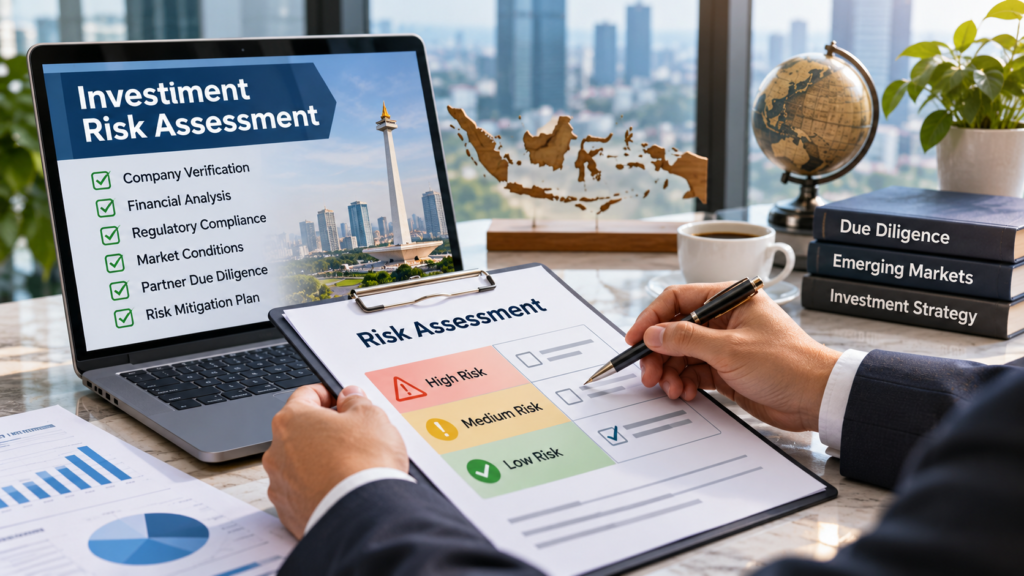
Investment risk assessment is the process of identifying, analyzing, and evaluating potential threats before committing capital to a business, partnership, acquisition, or market expansion. In emerging markets, investors must consider financial performance, regulatory requirements, political uncertainty, business partner reliability, and operational conditions that may affect investment outcomes.
An effective investment risk assessment involves verifying company information, reviewing financial and legal exposure, evaluating market conditions, conducting due diligence, and developing risk mitigation strategies. For international investors entering markets such as Indonesia, local business investigation and on-ground verification can help identify warning signs that financial projections alone may overlook.
What Is Investment Risk Assessment?
Investment risk assessment is a structured evaluation of uncertainties that could affect the performance, value, or viability of an investment. It helps investors understand what could go wrong, how likely a problem may be, and how severely it could affect business objectives.
For corporate investments, risk assessment extends beyond financial returns. Investors must examine the legal standing of target companies, ownership structures, regulatory compliance, operational capacity, commercial assumptions, and the reliability of local partners.
For example, a foreign company planning to acquire a manufacturing business in Indonesia should evaluate reported revenue and profitability while verifying business licenses, production facilities, outstanding liabilities, and supplier relationships. This broader assessment helps management decide whether to proceed, renegotiate terms, request further verification, or withdraw from the transaction.
Why Is Investment Risk Assessment Important in Emerging Markets?
Emerging markets offer opportunities for business expansion, manufacturing, distribution, infrastructure development, and strategic partnerships. However, market conditions, legal frameworks, infrastructure capacity, and business practices can differ significantly between countries and industries.
Investors may face changes in regulations, currency volatility, unexpected operating costs, incomplete corporate disclosures, or difficulties verifying potential partners. These challenges do not mean emerging markets are inherently unsuitable for investment. They mean companies should evaluate each opportunity using reliable evidence and market-specific information.
A structured assessment allows investors to identify material risks before signing agreements, allocate resources more carefully, and establish conditions for proceeding with an investment. It also helps management distinguish manageable commercial uncertainty from issues that could threaten legal compliance or operational continuity.
7 Steps to Conduct an Investment Risk Assessment
A reliable assessment combines market research, financial evaluation, corporate due diligence, and operational verification. The following seven steps provide a practical framework for companies considering direct investments or acquisitions in emerging markets.
1. Identify the Investment Objective and Risk Exposure
Start by defining the purpose of the investment, expected business outcomes, capital requirements, ownership structure, and intended operating period. Establish whether the company plans to acquire an existing business, create a joint venture, establish a subsidiary, or develop a new facility.
Different investment structures create different exposures. A joint venture introduces partner and governance risks, while a factory acquisition may involve existing liabilities, equipment conditions, and regulatory compliance.
Management should determine its risk tolerance, maximum acceptable exposure, and conditions that would prevent the transaction from proceeding. Clear investment objectives help the assessment remain focused on decisions that matter.
2. Evaluate Political and Regulatory Risks
Review the country’s investment rules, sector-specific restrictions, licensing requirements, taxation, and regulatory environment. Investors should also consider changes in government policies that could affect ownership structures, operating permissions, or business costs.
In Indonesia, foreign investors should examine applicable investment regulations, permitted business activities, and requirements related to company establishment and operational licensing. Relevant documents may include the Business Identification Number (NIB), corporate registration documents, and sector-specific permits.
Regulatory compliance should be verified against current official requirements rather than assumptions or informal assurances from prospective partners. Qualified legal professionals should review material legal questions before an investment commitment.
3. Assess Financial and Commercial Risks
Financial due diligence examines the target company’s financial statements, cash flow, profitability, debt, assets, liabilities, and working capital requirements. Investors should compare financial records with supporting evidence where appropriate.
Commercial evaluation considers customer demand, competitors, pricing, distribution channels, and the assumptions behind revenue forecasts. A profitable company may still face significant risk if its income depends heavily on one customer or its growth projections are unrealistic.
Investors should develop multiple financial scenarios and test how changes in revenue, costs, exchange rates, or financing conditions could affect the investment. Independent financial and accounting specialists may be necessary for transactions involving substantial capital.
4. Conduct Business Partner Due Diligence
Local partnerships can provide market knowledge, distribution access, and operational capabilities. However, investors should verify the identity, ownership, reputation, financial standing, and business history of potential partners before signing agreements.
Due diligence may include reviewing corporate registrations, identifying beneficial owners, examining relevant public litigation records, and verifying business references through lawful methods.
Warning signs include inconsistent ownership information, unexplained financial obligations, unwillingness to provide supporting documents, and significant discrepancies between business claims and observable operations.
Learn more through AMED’s Due Diligence in Indonesia Guide and Corporate Investigation Services in Indonesia.
5. Verify Operational Capabilities and Physical Assets
Operational due diligence examines whether the target company or local partner can actually deliver the products, services, or production capacity represented in the investment proposal.
Depending on the business, assessment activities may include visiting facilities, reviewing equipment, examining supply chain relationships, evaluating workforce capacity, and checking operational processes.
For manufacturing investments, an on-site inspection may help verify whether a factory exists, operates at the claimed scale, and holds relevant documentation. However, physical visits should complement rather than replace technical assessments, financial reviews, and legal due diligence.
Investors can review How to Verify a Factory in Indonesia Before Investing for additional considerations.
6. Assess Security and Business Continuity Risks
Business investment can expose executives, employees, assets, and facilities to operational disruptions. Relevant risks may include theft, fraud, industrial incidents, civil unrest, transportation disruption, and threats associated with sensitive business activities.
A security assessment should examine the investment location, nature of operations, executive travel requirements, access controls, and business continuity arrangements.
For investors conducting site visits or sensitive meetings, coordinated travel planning and appropriate security support can help reduce unnecessary exposure. The required protection level should follow a specific assessment rather than assumptions about a country or region.
AMED provides Executive Protection and Business Investigation services that can support different aspects of an investor’s activities in Indonesia.
7. Prioritize Risks and Develop Mitigation Strategies
After identifying risks, management should evaluate their likelihood, potential impact, available controls, and remaining exposure. A risk register can organize the findings and identify which issues require immediate attention.
Possible responses include strengthening contractual protections, requesting additional documentation, changing the investment structure, arranging independent verification, or deciding not to proceed.
Assign a responsible person, deadline, and monitoring indicator to each significant risk. Review the assessment whenever regulations, market conditions, counterparties, or operating circumstances change.
Investment risk assessment workflow:
Investment Objectives → Market Research → Financial and Legal Review → Partner Due Diligence → Operational Verification → Risk Evaluation → Mitigation and Monitoring
What Are the Main Risks of Investing in Emerging Markets?
Investment risks vary significantly according to the country, industry, transaction structure, and investment horizon. International investors should avoid treating every emerging market as having the same risk profile.
| Risk Category | Potential Exposure | Recommended Assessment |
| Political risk | Policy changes and political disruption | Country-specific regulatory and political review |
| Regulatory risk | Licensing restrictions and compliance failures | Legal due diligence and permit verification |
| Financial risk | Hidden debt, weak cash flow, unreliable projections | Financial statement review and independent checks |
| Currency risk | Exchange-rate movements | Currency exposure and scenario analysis |
| Partner risk | Unreliable counterparties and ownership concerns | Background checks and beneficial ownership review |
| Operational risk | Production delays and supply chain problems | Facility inspection and operational assessment |
| Security risk | Threats to personnel, assets, and business continuity | Security assessment and contingency planning |
| Reputational risk | Misconduct or problematic business relationships | Reputational due diligence and relevant records review |
Investors should evaluate these risks together because one issue can create several consequences. For example, a licensing problem may delay operations, interrupt cash flow, and increase contractual exposure.
How Do Investors Measure Investment Risk?
Risk assessment commonly combines qualitative judgment with quantitative analysis. The appropriate method depends on the investment size, availability of reliable information, and complexity of the transaction.
1. Use a Risk Probability and Impact Matrix
A practical starting point is to score each identified risk according to its likelihood and impact.
Risk Score = Likelihood × Impact
For example, management may use a scale from 1 to 5 for each dimension.
| Risk | Likelihood | Impact | Risk Score |
| Regulatory approval delay | 3 | 4 | 12 |
| Supplier disruption | 4 | 3 | 12 |
| Currency volatility | 4 | 4 | 16 |
| Minor administrative delay | 2 | 2 | 4 |
These figures are illustrative rather than actual risk ratings for any country or investment. Companies should define their own scoring criteria, risk thresholds, and escalation procedures.
Certain risks, particularly serious legal violations or threats to life, may require immediate action regardless of the numerical score.
2. Apply Financial Scenario Analysis
Investors can test the investment under optimistic, base-case, and downside scenarios. Each scenario should consider realistic changes in revenue, operating costs, financing conditions, and implementation schedules.
For example, a company may evaluate whether its investment remains financially viable if sales decline by 15%, operating costs rise by 10%, or the project launch is delayed. These percentages are hypothetical stress-test assumptions, not forecasts.
Such analysis helps investors identify how much financial flexibility is necessary and which commercial assumptions carry the greatest risk.
3. Monitor Risk Indicators
After the investment begins, management should monitor indicators that reveal emerging problems. Relevant measures may include operating cash flow, overdue receivables, supplier concentration, regulatory compliance, project delays, and security incidents.
Periodic reporting allows investors to determine whether existing controls remain effective. Risk assessment should therefore function as an ongoing management process rather than a single report prepared before signing.
What Do Official Reports Say About Emerging Market Investment Risks in 2026?
The UNCTAD World Investment Report 2026, published on July 7, 2026, reported that global foreign direct investment increased by 6% to approximately USD 1.6 trillion in 2025. However, investment growth remained uneven and increasingly concentrated.
Developing economies received approximately USD 901 billion in foreign direct investment, representing growth of only 2%. The world’s 20 largest host economies accounted for more than 80% of global investment inflows, illustrating the uneven distribution of investment opportunities.
The report identifies geopolitical tensions, changing investment policies, economic fragmentation, and financing conditions as important challenges for international investment. These developments reinforce the need to evaluate country-specific risks before committing capital.
Meanwhile, the World Bank Global Economic Prospects, June 2026, projected growth in emerging market and developing economies of approximately 3.6% for 2026. The report highlights commodity disruptions, uncertainty, tighter financial conditions, and geopolitical developments as downside risks.
These findings do not indicate that every emerging market investment carries excessive risk. Instead, they demonstrate why investors should combine macroeconomic analysis with company-specific due diligence and operational verification.
Why Is Due Diligence Important Before Investing in Indonesia?
Indonesia presents opportunities for international companies exploring manufacturing, distribution, consumer markets, and business partnerships. However, investors need reliable information about potential counterparties, corporate structures, operational capabilities, and applicable regulations.
A professional due diligence process helps distinguish verified information from unsupported commercial claims. Investors should review corporate documents, financial records, licensing status, ownership information, and operational evidence before completing significant transactions.
For acquisitions or joint ventures, legal and financial specialists should address transaction-specific questions, while business investigators can help verify relevant factual information through lawful and appropriate methods.
Read Foreign Investment in Indonesia: 7 Key Things Investors Should Know for additional guidance on investment structures and verification.
AMED Expertise in Investment Risk Assessment and Business Investigation
AMED Corporate Protection & Business Investigation provides services for international companies, foreign executives, and investors exploring or conducting business activities in Indonesia.
Its published service portfolio includes Business Consultation, Business Investigation, Executive Protection, and Legal Administrator Shield. These services address different aspects of market entry, corporate verification, regulatory coordination, and business security.
Business Investigation and Corporate Due Diligence
Through its Business Investigation service, AMED describes corporate background checks, business partner due diligence, information verification, and corporate risk assessment.
The company’s published investigation activities include legal background verification, financial risk indicators, ownership structure review, reputation assessment, competitor intelligence, and industry benchmarking visits.
These activities are relevant when international investors need to verify a potential partner or target company before making a commercial commitment. However, an investigation report does not replace a statutory financial audit, formal legal opinion, or independent valuation when those services are required.
Business Consultation and Investment Feasibility
AMED also publishes Business Consultation services for foreign investors and companies planning business activities in Indonesia.
The stated scope includes market entry strategy, business feasibility studies, operational cost analysis, regulatory barriers, local competition, profitability projections, partnership evaluation, and risk mitigation strategies.
This combination of market research and operational evaluation can help investors identify issues requiring additional investigation before developing a market-entry plan.
Executive Protection and On-Ground Risk Support
International executives may need to visit business facilities, meet potential partners, inspect industrial sites, or travel across unfamiliar operating environments.
AMED’s Executive Protection service covers threat assessment, route planning, secure transportation, situational awareness, and executive escort according to assignment requirements.
These services complement business investigations by addressing physical safety and movement coordination. They do not replace financial due diligence or commercial investment analysis.
AMED’s Published Experience and Service Documentation
AMED’s website contains detailed guides on corporate investigations, verifying factories, investment due diligence, foreign investment requirements, and business security in Indonesia.
This documentation demonstrates the subjects and service processes AMED publicly addresses. However, the available pages do not independently establish the number of completed investment assessments, client returns, or the financial performance of investments supported by the company.
For this reason, prospective clients should request a proposed scope, relevant service qualifications, methodology, deliverables, and confidentiality arrangements before engaging AMED.
How Can AMED Help International Investors Evaluate Business Risks?
Investors may need several types of assistance before committing capital. AMED’s published services can support the local business intelligence, strategic consultation, and operational security elements of an investment assessment in Indonesia.
A potential engagement can follow a structured approach:
Initial Consultation → Scope Definition → Business Investigation → Risk Findings → Mitigation Discussion → Decision Support
The specific activities depend on the client’s industry, investment structure, available documentation, location, and objectives.
For example, an international company considering an Indonesian manufacturing partnership may request background verification, site visits, operational benchmarking, and a market feasibility review. If executives need to visit the facility, secure transportation or protection support can be assessed separately.
AMED should confirm which activities it can provide directly and where independent legal, financial, tax, or valuation specialists are required.
For broader business development and risk management perspectives, investors can also review PT EFBA Digital Mulia and its Business Risk Management guidance.
FAQ About Investment Risk Assessment
1. What is investment risk assessment?
Investment risk assessment is the structured process of identifying, analyzing, and evaluating uncertainties that may affect an investment. It considers financial, legal, commercial, operational, and external risks. The objective is to support informed decisions and establish appropriate mitigation measures before and after committing capital.
2. How do investors assess risks in emerging markets?
Investors review economic conditions, political and regulatory developments, business partners, financial records, market demand, and operational capabilities. They can combine document verification, company due diligence, scenario analysis, and on-site assessments. The process should reflect the specific country, industry, and transaction structure.
3. What are the biggest risks of investing in emerging markets?
Common risks include regulatory changes, currency volatility, political uncertainty, unreliable counterparties, supply chain disruptions, and weak financial transparency. The severity of each risk depends on the investment and operating environment. Investors should avoid applying one general risk rating to every emerging market.
4. What is the difference between investment risk assessment and due diligence?
Investment risk assessment identifies and prioritizes potential threats to investment objectives. Due diligence verifies specific information about a business, transaction, partner, or asset. Due diligence provides evidence that investors can use within a broader risk assessment and decision-making process.
5. How can investors reduce business investment risks?
Investors can reduce risks through independent verification, financial analysis, legal review, operational inspections, diversified business arrangements, and clear contractual protections. They should also establish contingency plans and monitor material risk indicators. No mitigation strategy can eliminate every possible loss.
6. Why is business partner due diligence important?
Partner due diligence helps investors verify business identity, ownership, financial standing, reputation, and relevant corporate history. It can reveal inconsistencies or unresolved issues before the parties enter a formal relationship. Reliable verification also helps management determine suitable contractual safeguards.
7. Does investment risk assessment guarantee investment success?
No. Risk assessment helps identify uncertainty and improve decision-making, but it cannot guarantee profitability or prevent all losses. Market changes, unexpected events, and execution problems may still affect results. Investors should update their assessments as circumstances change.
8. When should a company conduct an investment risk assessment?
Companies should conduct an assessment before significant investments, acquisitions, joint ventures, or market-entry decisions. They should also review risks when regulations, ownership arrangements, financial performance, or operating conditions change. Continuous monitoring is important for long-term investments.
9. Does AMED provide investment risk assessment services in Indonesia?
AMED publishes Business Consultation and Business Investigation services covering corporate due diligence, partner verification, market analysis, operational risk, and feasibility studies. These services can support business investment assessments in Indonesia. Clients should confirm the specific scope and any specialist professional requirements before engagement.
10. How can foreign investors contact AMED for risk evaluation?
Foreign investors can contact AMED through its official website and explain the proposed investment, industry, target company, location, and principal concerns. Providing available documents and the intended decision timeline helps AMED assess the inquiry. The team can then discuss suitable services and a proposed scope of work.
Evaluate Your Business Investment Risks With AMED
Investment risk assessment is essential for companies entering unfamiliar markets, acquiring local businesses, or establishing strategic partnerships. Reliable decisions require more than optimistic financial projections. Investors need verified corporate information, realistic commercial assumptions, regulatory understanding, and operational evidence.
In emerging markets, these assessments become especially valuable when companies face unfamiliar business practices, complex partnerships, or changing market conditions. Professional verification helps management identify issues early and develop a clearer basis for investment decisions.
AMED Corporate Protection & Business Investigation supports international investors in Indonesia through business investigation, corporate due diligence, market-entry consultation, operational verification, and security-related services. Its integrated approach can help clients evaluate local business conditions while identifying the professional support required for more specialized matters.
Planning a business investment, acquisition, joint venture, or expansion into Indonesia?
Contact AMED Business Consultation or explore AMED Business Investigation to discuss your investment risk assessment requirements.
You can also submit your inquiry through the official AMED Contact Page.
Share your investment objectives, target industry, location, potential partners, and key concerns so the AMED team can review your requirements and propose an appropriate scope.
Make more informed investment decisions through structured risk assessment, verified business intelligence, and professional on-ground support with AMED Indonesia.