
Jakarta is one of Indonesia’s primary business gateways, where executives, investors, expatriates, corporate delegations, and international business travelers frequently move between Soekarno-Hatta International Airport, hotels, corporate offices, meeting venues, industrial areas, and client locations. For these travelers, transportation is not only a matter of finding a comfortable vehicle. Secure transportation Jakarta combines a professional driver, suitable vehicle, route planning, situational awareness, communication, and contingency preparation so the traveler can move efficiently while reducing unnecessary operational exposure.
The need becomes more relevant when an itinerary includes several meetings in one day, unfamiliar locations, airport transfers, public events, industrial visits, or changing local conditions. A vehicle can be premium and comfortable but still fail to support the trip if the driver does not understand the itinerary, the route becomes disrupted, or there is no alternative plan when schedules change. Secure transportation therefore focuses on controlled and coordinated movement rather than simply moving a passenger from one address to another.
AMED currently publishes secure transportation as part of its Executive Protection service for executives, expatriates, investors, and business travelers operating in Jakarta and other parts of Indonesia. Its published service includes professional drivers trained in security awareness, an English-speaking driver, premium MPV vehicle, route risk management, and airport transfers, while broader protection services can add threat assessment, situational awareness, route planning, and executive escort when required. AMED Corporate Protection
What Is Secure Transportation Jakarta?
Secure transportation Jakarta is a professionally coordinated transportation service designed around the executive’s itinerary, business requirements, and operating environment. Unlike an ordinary chauffeur booking, the planning process considers where the traveler needs to go, when each movement should happen, what conditions may affect the route, who needs to receive movement updates, and what alternatives are available if the original plan is no longer practical.
The basic structure can be understood as:
Traveler → Driver → Vehicle → Route → Timing → Destination → Communication → Contingency
This approach is useful for business travelers because Jakarta trips often involve more than one destination. A principal may arrive at the airport in the morning, attend meetings in a central business district, continue to an industrial site, move to a dinner venue, and return to the hotel later in the evening. Treating each trip as an isolated ride increases the likelihood of delays, communication gaps, and last-minute decisions.
AMED’s published Executive Protection service explicitly connects secure transportation with route planning, situational awareness, airport transfers, business meetings, site visits, industrial inspections, and regional travel. This means transportation can be integrated into the overall business itinerary rather than handled only as a vehicle reservation. AMED Corporate Protection
Why Do Business Travelers Need Secure Transportation in Jakarta?
1. Jakarta Business Trips Often Involve Multiple Movements
Corporate travel rarely consists of one airport pickup followed by a hotel stay. Senior executives may have several meetings across different districts, while investors may combine office discussions with factory inspections or project visits outside the central business area. When every appointment depends on the previous movement arriving on time, transportation planning becomes part of business continuity.
A practical itinerary may look like:
Airport → Hotel → Corporate Office → Client Meeting → Site Visit → Dinner → Hotel
The driver and local coordinator should understand the full schedule before movement begins. This enables the transportation plan to account for meeting duration, travel time, access points, luggage, waiting requirements, and alternative routes instead of repeatedly improvising throughout the day.
AMED also lists Business Travel Security for site visits, industrial inspections, business meetings, and regional travel. That published service scope makes secure transportation particularly relevant to executives whose visit extends beyond hotels and office buildings. AMED Corporate Protection
2. Airport Transfers Require More Than a Pickup Time
Soekarno-Hatta International Airport is one of the main gateways for international visitors entering Jakarta. BPS recorded 323,880 international visitor arrivals through Soekarno-Hatta in August 2026, up from 307,051 in July, while total international visitor arrivals through Indonesian airports reached 1,159,495 during the same month. These numbers represent general international arrivals rather than business travelers specifically, but they illustrate the scale of international movement through Indonesia’s major airports. Badan Pusat Statistik Indonesia
For a corporate traveler, airport coordination can involve flight changes, baggage, meeting schedules, hotel check-in, communication with an executive assistant, and immediate onward travel. A delayed arrival may affect every appointment after it, so the transportation plan needs enough flexibility to adjust. Airport transfer security becomes even more relevant when the principal has public visibility, carries sensitive business information, or must travel immediately to another location.
AMED lists airport transfers directly under its Secure Transportation service and also provides an English-speaking driver. Those capabilities are relevant for foreign executives who need local transportation without relying on multiple intermediaries for basic communication. AMED Corporate Protection
3. Route Conditions Can Change During the Day
Jakarta’s operating environment is dynamic, so a route that works in the morning may not remain the most practical option later in the day. Traffic congestion, public events, local demonstrations, severe weather, access restrictions, and unexpected road disruptions can affect travel time and destination access. Secure transportation therefore needs a decision process rather than a rigid dependence on one route.
Use:
Primary Route → Current Condition → Alternative → Decision → Movement → Reassessment
This does not mean a driver should constantly change routes without reason. Instead, the transportation team should know that alternatives exist and assess whether the original movement remains appropriate. AMED’s service specifically lists route risk management, while its Executive Protection capability adds route planning and situational awareness. AMED Corporate Protection
4. International Business Travelers Need Local Coordination
An international executive may understand the meeting agenda but not necessarily local road conditions, airport procedures, building access, or travel patterns between Jakarta districts. Secure transportation reduces the number of operational details that the traveler or executive assistant needs to manage personally. The local transportation team can coordinate movement while the executive remains focused on meetings, negotiations, site visits, and business decisions.
Communication becomes particularly important when several parties are involved:
Executive → Executive Assistant → Driver → Local Coordinator → Security Team
Each party should understand who communicates itinerary changes and who confirms movement status. A strong transportation service does not require the principal to repeatedly explain the schedule to different drivers throughout the assignment.
AMED’s Safe-Guide Day Service currently combines a premium vehicle, English-speaking driver, fuel, and a security-trained guide within a 10-hour service period. Its Executive Protection Detail adds travel coordination, advance route planning, and a trained executive protection agent for clients requiring a stronger protection structure. AMED Corporate Protection
How Is Secure Transportation Different from a Normal Chauffeur Service?
A professional chauffeur service can provide a comfortable car, punctual driver, and good customer service. Secure transportation keeps those fundamentals but adds security awareness, route management, communication, itinerary coordination, and contingency planning. The difference becomes clearer when the traveler has a sensitive schedule, high visibility, unfamiliar destinations, or multiple movements during the day.
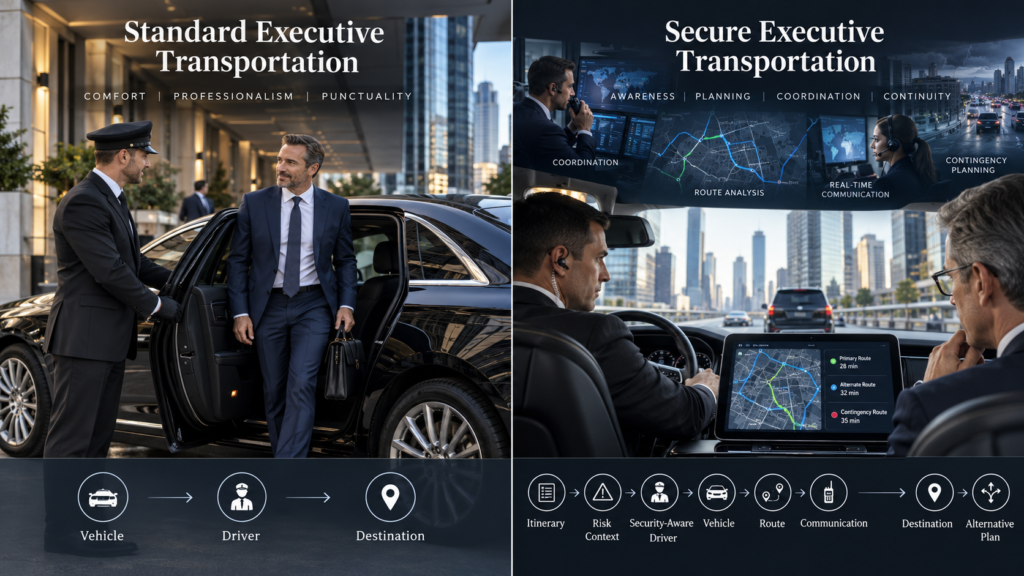
The comparison can be simplified as:
Standard Executive Transportation:
Vehicle → Driver → Destination
Secure Executive Transportation:
Itinerary → Risk Context → Security-Aware Driver → Vehicle → Route → Communication → Destination → Alternative Plan
This distinction does not mean every business traveler needs a close protection officer or an overt security presence. In many cases, the requirement may simply be a professional, security-aware driver with a suitable vehicle and a well-planned itinerary. When the traveler’s exposure becomes higher, the transportation can be integrated with AMED’s wider Executive Protection service. AMED Corporate Protection
What Should Secure Transportation Jakarta Include?
1. Security-Aware Driver
The driver is one of the most important components because they directly manage the movement of the principal. Beyond professional driving, the driver should understand the schedule, routes, communication procedure, pickup points, destination access, and any agreed contingency arrangements. Discretion also matters because executive movement frequently involves confidential business schedules and meetings.
AMED states that its secure transportation service uses professional drivers trained in security awareness and includes an English-speaking driver. This is especially relevant for international travelers who need clear communication while operating in Jakarta. AMED Corporate Protection
The expected working logic is:
Prepare → Drive → Observe → Communicate → Adapt → Confirm Arrival
The driver does not replace a close protection officer when one is required. Instead, the driver becomes one component within a broader movement plan.
2. Suitable Premium Vehicle
Vehicle selection needs to reflect passenger numbers, luggage, schedule, travel distance, comfort, and operational requirements. For business travel, premium MPVs are often practical because they provide cabin space, luggage capacity, easier passenger access, and a professional appearance without necessarily creating excessive attention.
AMED currently publishes a premium MPV vehicle as part of its secure transportation and Safe-Guide offering. The exact vehicle and service arrangement should still be confirmed for each assignment because requirements can differ according to itinerary, passenger count, duration, and protection level. AMED Corporate Protection
The decision should follow:
Traveler Profile → Passenger Count → Luggage → Itinerary → Vehicle Requirement
A premium vehicle supports the service, but vehicle quality alone does not create secure transportation without proper driver and route planning.
3. Route Planning and Risk Management
Route planning should begin before the executive starts moving. The team needs to understand the primary destination, expected timing, practical alternatives, access points, and conditions that could affect the journey. The objective is not to design unnecessarily complicated routes but to reduce preventable uncertainty.
AMED explicitly lists route planning under Executive Protection Officers and route risk management under Secure Transportation. AMED Corporate Protection
A useful process is:
Destination → Primary Route → Alternative Route → Timing → Current Conditions → Movement
This becomes particularly useful when several meetings are scheduled closely together. Better transportation planning can protect both the travel schedule and the executive’s ability to complete business objectives.
4. Airport Transfer Coordination
Airport movement should connect the flight schedule with the rest of the itinerary. The transportation provider needs accurate flight information, passenger details, luggage requirements, hotel or meeting destination, and the person responsible for receiving schedule updates. If the flight changes, the transportation schedule should adjust rather than forcing the original timing.
AMED lists airport transfers within its Secure Transportation service. It also offers broader travel coordination through its Executive Protection Detail, making it possible to integrate airport movement with the next stages of the executive’s schedule. AMED Corporate Protection
The operational sequence can be:
Flight Monitoring → Arrival → Coordination → Pick-Up → Route → Destination → Confirmation
This creates a clearer transition from international travel into local business activity.
5. Communication and Schedule Management
A well-planned movement can still fail if the itinerary changes and the driver does not receive the information. Corporate schedules often shift because a meeting ends late, a venue changes, the principal adds another appointment, or the executive decides to return to the hotel before the next engagement. Communication procedures should therefore remain simple and clear.
Use:
Schedule → Update → Confirmation → Movement Adjustment
The principal should not need to manage every operational detail directly. Ideally, the executive assistant or designated coordinator communicates with the driver or security team while the principal remains focused on the business programme.
6. Contingency Planning
The original transportation plan should never be treated as the only possible option. Delays, road closures, destination changes, weather, or public disruption can make a planned route impractical, and secure transportation should provide a structured way to respond rather than relying on rushed decisions.
The basic sequence is:
Plan A → Change Detected → Assess → Reroute / Delay / Hold → Continue → Review
The goal is not to predict every possible situation. Instead, contingency planning ensures the team already understands what to do when ordinary travel assumptions change.
Secure Transportation Jakarta for Airport-to-Meeting Travel
One common business-travel scenario involves an executive arriving at Soekarno-Hatta and heading directly to a meeting rather than first checking into a hotel. In this case, the driver needs the latest flight information, luggage assumptions, pickup plan, meeting location, timing, and alternative schedule if immigration or baggage takes longer than expected. The travel coordinator should also know whether the executive needs time to prepare before the meeting.
The movement can be structured as:
Soekarno-Hatta → Pick-Up → Route Assessment → Business District → Meeting → Next Movement
BPS’s latest available August 2026 data show 323,880 foreign visitor arrivals through Soekarno-Hatta, making the airport one of Indonesia’s largest international gateways. Again, the number is not a measure of executive travel, but it provides useful context for the volume of international movement entering the Jakarta region. Badan Pusat Statistik Indonesia
For an executive, the primary value of secure transportation is that the transition from airport arrival to business activity is managed as one itinerary rather than as separate travel bookings.
Secure Transportation for Corporate Meetings in Jakarta
Jakarta business travelers may need to move between hotels, central business districts, government offices, corporate headquarters, private meeting venues, restaurants, and conference locations. Each movement has different access considerations, and the schedule can change quickly when meetings run longer than expected. A dedicated driver who understands the full itinerary can reduce the need to repeatedly arrange new transport.
The preferred approach is:
Daily Brief → Meeting Sequence → Route Planning → Movement → Schedule Update → Next Destination
For a normal corporate itinerary, secure transport may be sufficient without adding a full protection detail. For a higher-profile executive, investor, public figure, or traveler with an elevated corporate risk profile, the transport plan can be strengthened with close protection personnel and advance planning through AMED’s Executive Protection service. AMED Corporate Protection
This scalability allows the transportation structure to match the actual business requirement instead of applying the same security posture to every client.
Secure Transportation for Site Visits and Industrial Inspections
A foreign investor or regional executive may need to travel beyond Jakarta’s central districts to a factory, warehouse, industrial estate, project site, supplier facility, or regional business operation. These trips can involve longer travel times and less familiar operating environments than a hotel-to-office transfer. They may also require more precise coordination with site management and access personnel.
AMED lists security coordination for site visits, industrial inspections, business meetings, and regional travel within its Business Travel Security capability. AMED Corporate Protection
A suitable planning model is:
Hotel → Route → Site Access → Visit → Departure Window → Return / Next Destination
The purpose is not to overcomplicate the visit. It is to make sure the transportation arrangement supports the executive’s operational agenda.
What Happens If Demonstrations Affect the Route?
Jakarta occasionally experiences demonstrations around government areas, business districts, or major roads. The existence of a demonstration does not automatically require all corporate movement to stop, but the transport plan should not assume the original route remains suitable regardless of changing conditions. The appropriate response is to assess, avoid unnecessary exposure, and adjust the schedule or route when needed.
Use:
Monitor → Assess → Avoid → Reroute → Communicate → Reassess
For executives, the important principle is that transportation should prioritize distance and controlled movement rather than attempting to push through a disrupted area. When a meeting can be delayed or relocated without harming the business objective, schedule adjustment may be more appropriate than unnecessary exposure.
This is where situational awareness and route risk management add value beyond a normal chauffeur booking.
Official Data: Why Jakarta Remains Important for International Business Mobility
BPS reported 1.60 million international visitor arrivals to Indonesia in August 2026, representing a 6.27% increase from August 2025. The same month recorded 1,159,495 arrivals through Indonesian airports, with 323,880 through Soekarno-Hatta. These statistics cover tourism and general international arrivals, not only corporate travelers, but they show the large volume of international movement entering Indonesia. Badan Pusat Statistik Indonesia
Indonesia’s international passenger transportation was also active during the period. BPS recorded approximately 1.9 million international air passengers in August 2026, an increase of 7.25% compared with the previous month. This national figure again covers all passenger types, but it reinforces the importance of airport-ground transportation coordination within Indonesia’s broader travel system. Badan Pusat Statistik Indonesia
For companies, the relevant conclusion is not that high visitor volume itself represents a security problem. Instead, Jakarta’s role as an international entry and business destination creates continuous demand for reliable airport movements, corporate transportation, itinerary coordination, and professional local support.
How Should Companies Choose Secure Transportation in Jakarta?
Companies should begin with the traveler’s itinerary rather than simply asking for a vehicle type. The provider needs enough information to understand the number of passengers, airport schedule, meetings, sites, travel duration, luggage, communication requirements, and whether additional executive protection is needed. This allows the transport plan to reflect the actual assignment.
The assessment can follow:
Traveler → Itinerary → Exposure → Vehicle → Driver → Route → Protection Level → Contingency
Price is still relevant, but it should be compared after the required service level is clear. A basic airport transfer, a full-day security-aware transportation service, and an integrated executive protection assignment are different services and should not be compared only by vehicle rate.
AMED currently publishes a Safe-Guide Day Service combining a driver, security-trained guide, premium vehicle, English-speaking driver, fuel, and 10 hours of service. It also publishes a separate Executive Protection Detail with dedicated personnel, travel coordination, and advance route planning for assignments that need a stronger protective layer. AMED Corporate Protection
AMED Expertise in Secure Transportation Jakarta
AMED provides Executive Protection services for executives, expatriates, investors, and business travelers operating in Jakarta, Bali, and other areas of Indonesia. Its official service page combines discreet personal protection, secure transportation, route planning, situational awareness, airport transfers, and Business Travel Security, with support for meetings, site visits, industrial inspections, and regional travel. AMED Corporate Protection
For secure transportation specifically, the published service includes:
Security-Aware Driver → English-Speaking Driver → Premium MPV → Route Risk Management → Airport Transfer
For clients requiring additional protection, AMED publishes an Executive Protection Detail that adds travel coordination, advance route planning, and a trained executive protection agent. A Corporate Protection Program is also published for recurring executive-security requirements, including travel planning, executive protection, a dedicated safe-guide, and emergency-response coordination. AMED Corporate Protection
AMED’s website therefore demonstrates operational capability across transportation, route planning, executive movement, and security coordination. However, the current published page does not state a specific number of years that AMED has operated its transportation service, so this article does not invent a longevity claim or client count that cannot be verified.
As part of the wider business context, PT EFBA Digital Mulia publishes experience in business services and describes its development from earlier commercial experience into a more established business from 2013. This corporate background can support broader business coordination, while the secure transportation expertise discussed here remains specifically tied to capabilities publicly presented by AMED. EFBA
AMED Secure Transportation Framework for Jakarta Business Travel
AMED-style executive movement can be summarized through the following framework:
1. TRAVELER PROFILE
Who is traveling, and what operational or security considerations apply?
2. ITINERARY
Which airport, hotel, offices, venues, and sites are included?
3. VEHICLE REQUIREMENT
How many passengers, how much luggage, and what travel duration is expected?
4. DRIVER
Is an English-speaking security-aware driver required?
5. ROUTE
What is the primary route and what alternatives are practical?
6. TIMING
How much time exists between appointments?
7. COMMUNICATION
Who communicates changes to the itinerary?
8. CONTINGENCY
What happens if the route, destination, or meeting schedule changes?
9. PROTECTION LEVEL
Does the traveler require secure transportation only or integrated executive protection?
The full flow becomes:
Assess → Plan → Coordinate → Move → Monitor → Adjust → Confirm
This keeps the transportation plan connected to the executive’s business objectives rather than treating security and mobility as separate functions.
FAQ About Secure Transportation Jakarta
What is secure transportation Jakarta?
Secure transportation Jakarta is an executive transportation service that combines a professional vehicle and driver with security awareness, route planning, communication, and contingency preparation. It is designed for executives, investors, expatriates, VIPs, and business travelers who need more coordination than a normal point-to-point ride. The service can cover airport transfers, corporate meetings, site visits, events, and other business movements. Additional executive protection can be integrated when the traveler’s profile requires it.
Does AMED provide airport transfer services in Jakarta?
Yes. AMED lists airport transfers as part of its Secure Transportation service together with a professional security-aware driver, English-speaking driver, premium MPV vehicle, and route risk management. AMED Corporate Protection Airport movement can also be integrated with wider travel coordination when an executive protection detail is required. The exact scope, timing, and vehicle arrangement should be confirmed for each assignment.
Does AMED provide an English-speaking driver?
Yes. An English-speaking driver is specifically listed in AMED’s published secure transportation and Safe-Guide Day Service. AMED Corporate Protection This can help foreign executives communicate directly regarding schedules, destinations, and normal travel coordination. For more complex security requirements, the driver can operate as part of a broader protection arrangement.
Is secure transportation only for VIPs?
No. The service can also be relevant to executives, investors, expatriates, visiting corporate teams, and international business travelers who have demanding or sensitive itineraries. A traveler does not need celebrity status to benefit from better transport coordination. The appropriate security level should depend on itinerary, exposure, business importance, and operating conditions.
Can AMED support business site visits?
Yes. AMED’s Business Travel Security service specifically lists site visits, industrial inspections, business meetings, and regional travel. AMED Corporate Protection This allows secure transportation to support investment visits, operational reviews, supplier meetings, or corporate inspections. The route and transportation plan can be built around the complete schedule.
Is secure transportation the same as executive protection?
No. Secure transportation focuses primarily on the movement component: driver, vehicle, route, airport transfer, communication, and route risk management. Executive protection can add trained protection personnel, threat assessment, situational awareness, executive escort, and advance planning. AMED publishes both levels of service so the scope can match the client’s needs. AMED Corporate Protection
What information should a company prepare before booking?
Companies should prepare flight details, passenger numbers, luggage requirements, hotel, meeting addresses, site locations, expected timing, responsible corporate contact, and any special travel requirements. They should also identify whether the principal needs transportation only or integrated protection support. A clearer itinerary allows the provider to plan routes and vehicle use more effectively. Last-minute changes can still occur, but an initial movement plan creates a better operational baseline.
Arrange Secure Transportation in Jakarta with AMED
Secure transportation Jakarta is most effective when the vehicle, driver, airport movement, route, timing, business meetings, and communication plan are coordinated before the executive begins traveling. For international business travelers, this reduces unnecessary operational uncertainty and allows the principal to concentrate on meetings, investment activities, client engagements, or site visits instead of repeatedly managing transportation details.
AMED provides secure transportation within its wider Executive Protection capability, including security-aware professional drivers, English-speaking drivers, premium MPV vehicles, route risk management, airport transfers, route planning, situational awareness, and travel coordination. Companies requiring a stronger protection posture can also combine transportation with trained executive protection personnel and advance route planning. AMED Corporate Protection

For broader corporate planning and business support in Indonesia, PT EFBA Digital Mulia operates as a business-solution company with business consulting and related development services. EFBA
Do not begin only with “Which vehicle is available?” Begin with “Who is traveling, where do they need to go, what could disrupt the itinerary, and what transportation plan will keep the business schedule controlled?”