
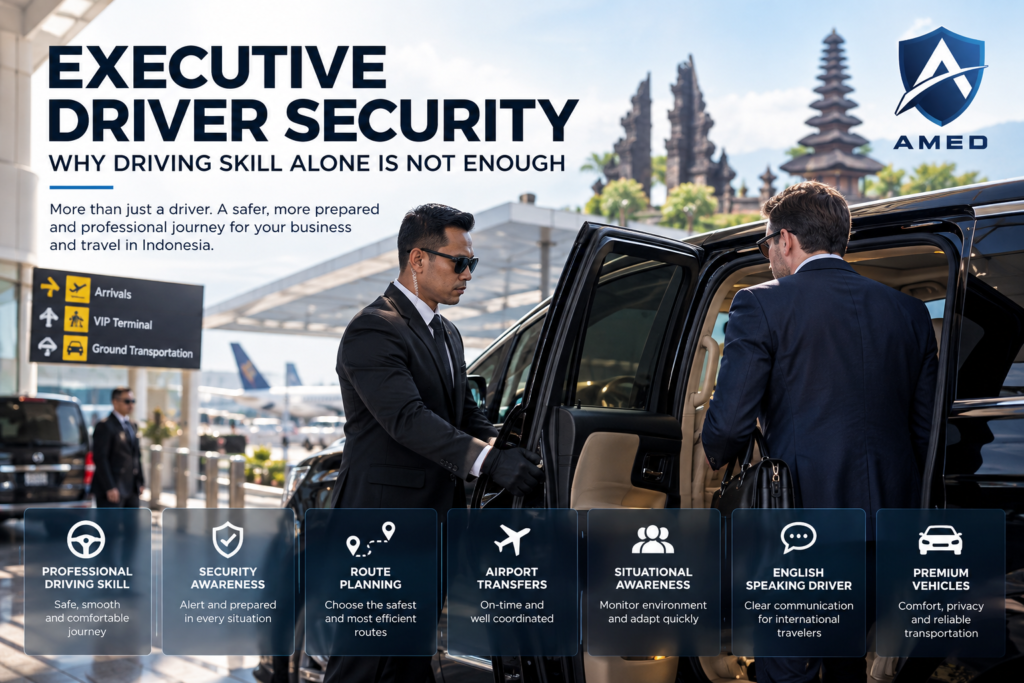
For tourists, executives, expatriates, investors, and business travelers visiting Indonesia, transportation is not only about moving from one destination to another. Airport transfers, hotel movements, business meetings, site visits, and regional travel can involve unfamiliar roads, traffic conditions, schedules, and environments.
A conventional professional driver primarily focuses on driving safely and efficiently. Executive driver security adds another layer: security awareness, route preparation, situational awareness, discreet coordination, and the ability to support safer movements throughout the journey.
This distinction is relevant to AMED’s published Executive Protection service. AMED combines secure transportation with professional drivers trained in security awareness, route risk management, airport transfers, and broader executive protection support for clients traveling in Jakarta, Bali, and other parts of Indonesia.
What Is Executive Driver Security?
Executive driver security is secure transportation that combines professional driving with security awareness, route planning, situational awareness, and travel coordination. The objective is not simply to drive a passenger safely. The driver must also understand the environment around the journey and support the client’s movement from departure to arrival.
For international visitors, this can become particularly relevant when they have multiple meetings, carry valuable business equipment, travel through unfamiliar areas, arrive late at night, visit industrial locations, or need coordinated airport and hotel transfers.
The basic approach can be summarized as:
Travel Requirement → Route Planning → Vehicle Preparation → Situational Awareness → Secure Movement → Arrival Coordination
Driving skill remains essential. However, secure transportation requires preparation before the vehicle even starts moving.
Road Safety Remains Relevant in Indonesia
Indonesia continues to face significant road-safety challenges. Korlantas Polri reported 158,508 traffic accidents during 2025, while fatalities declined from 26,839 in 2024 to 24,296 in 2025. Although fatalities decreased, the figures show why road safety and disciplined journey planning remain important.
Police evaluations also show that driver behavior remains relevant. Ahead of the 2026 Eid travel period, the Indonesian National Police identified failure to maintain a safe following distance as the most common cause in the evaluated accident data, with 1,156 cases. Police also highlighted speed, fatigue, and drowsiness as contributing factors, particularly during long-distance journeys.
These national statistics do not measure the risk faced specifically by executives or foreign tourists. However, they provide useful context: safe transportation requires more than knowing how to operate a vehicle.
1. Driving Skill and Security Awareness Serve Different Purposes
A skilled driver understands vehicle control, road rules, traffic behavior, parking, and efficient navigation. An executive security driver needs those abilities, but also needs awareness of what is happening around the vehicle and passenger.
Security awareness means paying attention to unusual activity, changing road conditions, access points, crowd situations, traffic disruption, and other circumstances that could affect the journey. The purpose is not to treat every movement as dangerous. Instead, it allows the driver to recognize changes early and respond calmly.
AMED specifically describes its secure transportation service as using professional drivers trained in security awareness. Its published Executive Protection service also connects transportation with situational awareness and route planning.
Therefore:
Professional Driving + Security Awareness = More Prepared Transportation
2. Route Planning Should Begin Before Departure
Tourists often rely on navigation applications to find the fastest route. For ordinary transportation, this may be sufficient. Executive transportation needs to consider more than estimated travel time.
The driver may need to understand the departure point, destination, expected arrival time, traffic conditions, access arrangements, and suitable alternatives. For business travelers with several appointments in one day, poor route planning can affect both security and schedule reliability.
AMED includes route risk management within its Secure Transportation service and advance route planning within its Executive Protection Detail. This indicates that route preparation forms part of the company’s documented protection approach.
A more structured journey therefore follows:
Destination → Primary Route → Conditions → Alternative Route → Arrival Point → Next Movement
The goal is not simply to find the shortest road. It is to make the movement more predictable and manageable.
3. Situational Awareness Matters During the Journey
Security awareness continues after departure. Traffic patterns, road closures, demonstrations, accidents, weather, crowds, or unexpected changes can affect a planned journey.
A security-aware driver monitors the road while remaining attentive to the surrounding environment. If conditions change, the driver should prioritize safe decision-making rather than continuing with the original route simply because it was planned earlier.
For foreign visitors, local familiarity can also reduce unnecessary uncertainty. A traveler may not understand which entrances are normally used at a venue, how local traffic changes during certain periods, or how long movement between locations realistically takes.
AMED’s Executive Protection service explicitly lists situational awareness as part of its protection activities.
The operating principle is simple:
Observe → Assess → Adjust → Continue Safely
4. Airport Transfers Need More Than a Pickup
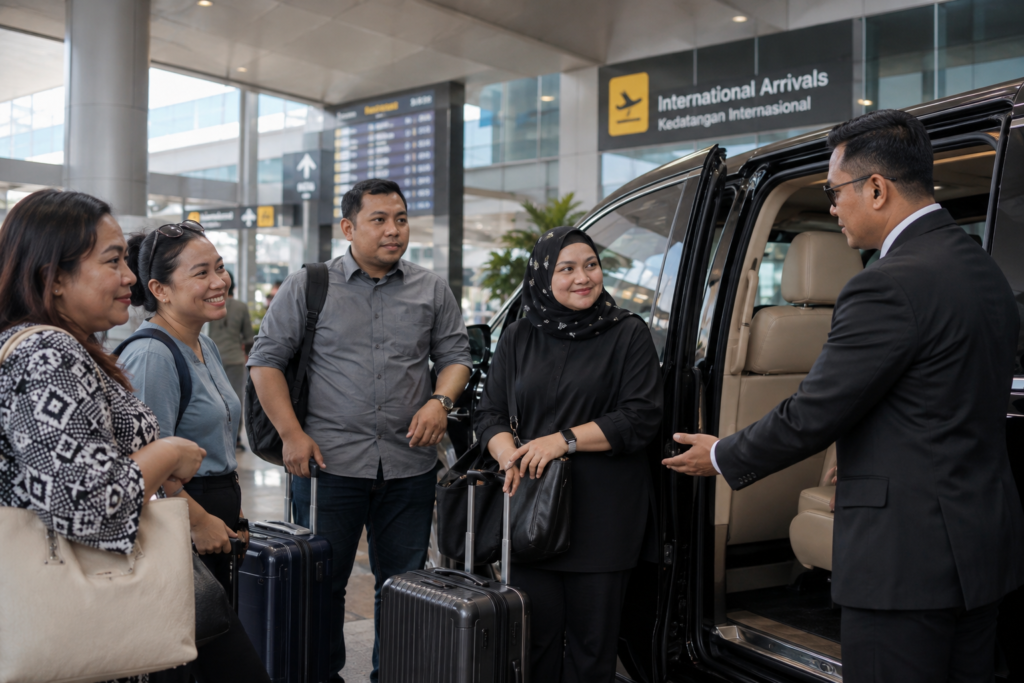
Airport transportation may appear straightforward, but international arrivals involve several moving parts. The traveler may be tired after a long flight, unfamiliar with the airport, carrying luggage, and unsure about local transportation arrangements.
A structured transfer therefore starts before the passenger enters the vehicle. The driver needs clear information about the airport, pickup arrangement, destination, timing, and onward schedule. The vehicle and route should also be prepared before movement begins.
AMED lists airport transfers as part of its Secure Transportation service. Its published Safe-Guide Day Service combines a driver and security-trained guide with a premium vehicle, fuel, and an English-speaking driver.
For international visitors, the intended journey becomes:
Airport Arrival → Pickup Coordination → Vehicle → Planned Route → Hotel / Meeting → Arrival
This reduces unnecessary confusion during one of the first movements after entering Indonesia.
5. Communication Is Part of Secure Transportation
Driving skill alone does not solve communication problems. International tourists and business travelers may need to explain schedule changes, meeting locations, hotel arrangements, or additional destinations during the journey.
AMED specifically lists an English-speaking driver within its Secure Transportation offering. This is relevant because clear communication can improve coordination between the traveler, driver, hotel, meeting venue, and other parties involved in the itinerary.
Communication becomes even more important when plans change. A meeting may finish early, a flight may arrive late, or a destination may change unexpectedly. The driver needs to understand the updated requirement and adapt transportation accordingly.
For international clients:
Clear Communication → Better Coordination → Fewer Misunderstandings → More Controlled Movement
6. Vehicle Choice Is Only One Part of the Service
A premium vehicle can improve comfort, privacy, and travel experience, but the vehicle alone does not create secure transportation.
The more important question is how the journey is managed. Vehicle readiness, professional driving, route planning, situational awareness, communication, and coordination need to work together.
AMED lists premium MPV vehicles within its secure transportation offering. However, the same service also includes an English-speaking driver, security awareness, route risk management, and airport transfers.
This distinction matters when tourists compare transportation services. Instead of asking only, “What vehicle will I get?”, they should also ask:
Who is driving? How is the route prepared? How is the journey coordinated? What security support is included?
7. Executive Driver Security Can Connect with Wider Protection
Not every tourist or executive needs a dedicated close-protection team. The appropriate level of support depends on the traveler, itinerary, destination, activities, and security requirements.
Some clients may only need secure transportation and a security-aware driver. Others may require dedicated executive protection personnel, advance route planning, travel coordination, or security support during meetings and site visits.
AMED distinguishes these levels on its official website. Its Safe-Guide Day Service combines a driver with a security-trained guide, while its Executive Protection Detail adds dedicated protection personnel, travel coordination, and advance route planning. Its Corporate Protection Program adds ongoing executive protection and emergency response coordination.
This creates a scalable approach:
Secure Driver → Safe-Guide → Executive Protection → Corporate Protection
The level of service should follow the actual travel requirement rather than applying the same protection model to every visitor.
When Should a Tourist or Business Traveler Consider Executive Driver Security?
Executive driver security can be relevant when a traveler has an intensive itinerary, multiple business meetings, unfamiliar destinations, airport transfers, site visits, industrial inspections, regional travel, or specific security concerns.
AMED’s published service scope specifically includes security coordination for site visits, industrial inspections, business meetings, and regional travel, in addition to airport transfers and secure transportation.
A useful decision process is:
Traveler Profile → Itinerary → Destination → Movement Requirements → Security Needs → Transportation Plan
The objective is not to make ordinary travel feel threatening. The objective is to match transportation planning with the traveler’s actual requirements.
Executive Driver Security Process
If the complete process is simplified, secure executive transportation can follow:
Travel Requirement → Itinerary Review → Vehicle Preparation → Route Planning → Pickup Coordination → Secure Movement → Situational Monitoring → Arrival → Next Movement
The process does not always run in a perfectly fixed sequence. Routes can change, meetings can move, flights can be delayed, and local conditions can require adjustments.
However, every journey should return to three practical questions:
1. Where does the client need to go?
2. What conditions could affect the movement?
3. How can the journey remain safe, discreet, coordinated, and efficient?
This approach separates executive transportation from a service focused only on driving from point A to point B.
Expertise AMED in Executive Protection and Secure Transportation
AMED describes its Executive Protection service as professional protection for executives, expatriates, investors, and business travelers operating in Jakarta, Bali, and across Indonesia. Its documented service combines personal protection, secure transportation, route planning, and situational awareness.
For transportation specifically, AMED publishes several relevant capabilities: professional drivers trained in security awareness, English-speaking drivers, premium MPV vehicles, route risk management, and airport transfers. For broader protection requirements, AMED also lists threat assessment, executive escort, advance route planning, travel coordination, and emergency response coordination.
For travelers who combine transportation with business activities, AMED also states that protection can support business meetings, site visits, industrial inspections, and regional travel. This creates a connection between mobility and wider business-travel requirements without treating every journey as a high-risk security operation.
FAQ About Executive Driver Security
What is executive driver security?
Executive driver security combines professional driving with security awareness, route planning, situational awareness, and travel coordination. Depending on the service level, it can also integrate secure transportation with executive protection personnel.
Is an executive security driver the same as a regular private driver?
Not exactly. A professional private driver primarily provides transportation, while an executive security driver adds security awareness and journey preparation. AMED’s published secure transportation service specifically includes drivers trained in security awareness and route risk management.
Do tourists in Indonesia need executive driver security?
Not every tourist requires it. The decision depends on the traveler’s itinerary, destinations, activities, schedule, and security needs. It may be particularly relevant for executives, investors, business travelers, VIP visitors, or travelers with intensive multi-location itineraries.
Does AMED provide airport transfers?
Yes. Airport transfers are listed as part of AMED’s Secure Transportation service. The company also lists English-speaking drivers and premium MPV vehicles within the service.
Does AMED provide executive driver security in Bali?
AMED states that its executive protection and secure transportation services support clients in Jakarta, Bali, and throughout the Indonesian Archipelago. Availability for a particular date, location, vehicle, or itinerary should be confirmed directly before booking.
Can secure transportation support business meetings and site visits?
Yes. AMED lists business meetings, site visits, industrial inspections, and regional travel under its Business Travel Security coordination.
What should I provide before arranging secure transportation?
Prepare your arrival information, hotel, destinations, meeting schedule, number of passengers, luggage requirements, travel dates, and any specific security or privacy requirements. This information helps determine the appropriate transportation and protection arrangement.
Travel in Indonesia with More Than Driving Skill
A good driver gets the vehicle to its destination. Executive driver security adds preparation around that journey through route planning, security awareness, communication, situational monitoring, and coordinated movement.
For international visitors, the objective is straightforward:
Plan → Prepare → Pick Up → Monitor → Move → Arrive → Coordinate
AMED provides secure transportation as part of its Executive Protection services for executives, expatriates, investors, and business travelers in Indonesia. Its published capabilities include English-speaking drivers, premium vehicles, security-aware driving, route risk management, airport transfers, travel coordination, and executive protection options.
For travelers who need professional transportation combined with security awareness, review AMED Executive Protection & Secure Transportation before planning your itinerary.

For broader information about the EFBA business ecosystem, visit EFBA Digital Mulia.
The goal is not simply to reach the destination. It is to make every movement more prepared, coordinated, and appropriate to the client’s travel requirements.